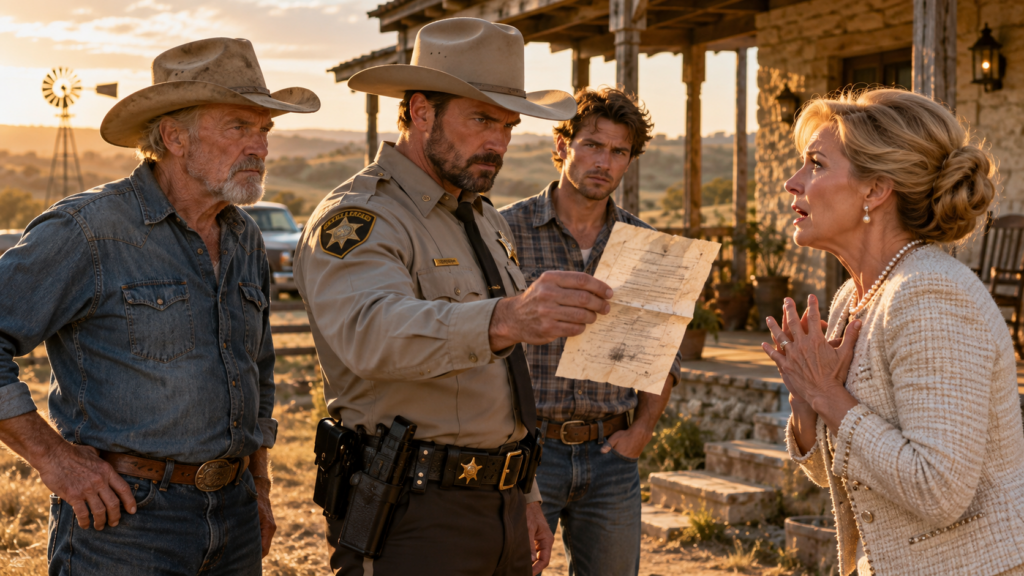
“You’re trespassing on Kincaid land, boys. Turn that truck around and get off my property.”
The two men standing outside my cattle gate didn’t move.
Their white SUV had an amber light flashing on the roof and black letters on the door:
STONE RIDGE HOA PATROL.
Both wore navy vests. Both had handcuffs hanging from their belts.
The larger man stepped closer.
“Sir, we’re law enforcement for the community. Open the gate.”
I was sixty-two years old, and until that Saturday morning I had never pointed a firearm at another human being.
By sunset, I would be sitting in handcuffs beside my own barn.
My name is Amos Kincaid.
My family has worked Kincaid Creek Ranch in the Texas Hill Country since 1889.
We survived droughts, floods, cattle crashes, and two world wars.
My wife Ruth is buried beneath the big oak beside the creek.
My father died in the west bedroom of the house.
My grandfather’s initials are still carved into one of the barn beams.
This ranch is not an investment to me.
It is every person I ever loved.
Three years before that morning, Stone Ridge Estates appeared on the ridge east of us.
Stucco houses.
Clubhouse.
Security gate.
Fountain.
I had no objection.
Their land was theirs.
Mine was mine.
Then the first cream-colored envelope arrived.
Stone Ridge’s board claimed my ranch road was a “community trail easement” and ordered me to remove fencing that supposedly blocked resident access.
I drove to the county office.
The clerk searched the deed index, plats, easements, and older records.
Nothing.
No trail easement.
No recreational corridor.
No agreement involving Stone Ridge.
I sent the board certified notice telling them my road was private.
A week later, Bonnie Stafford arrived.
She introduced herself as HOA president and held a clipboard like it was a badge.
“Everybody signs the master plan eventually.”
“I’m not everybody.”
Her smile remained fixed.
“Stone Ridge is expanding.”
“Not across my ranch.”
Then came the fines.
One hundred dollars for livestock odor.
Three hundred for “unapproved agricultural fencing.”
Five hundred for what Bonnie called a visual nuisance.
I assumed she meant my barn.
The notices meant nothing legally if Stone Ridge had no authority over the ranch, but I stopped throwing them away.
My grandson Tanner convinced me to keep everything.
He also installed trail cameras.
Three nights later, one caught a white SUV beside my western fence.
Two people stepped out.
One carried bolt cutters.
By sunrise, twenty feet of fencing had been cut open.
That afternoon, a Stone Ridge resident named Maribel Soto drove to my ranch.
She looked nervous.
“They hired private security,” she said.
“For what?”
She handed me a meeting flyer.
The board planned to “open community access” through my road Saturday morning.
“They’re coming at nine.”
I called the sheriff.
Deputy Mendoza took my report.
“Land-use disputes can become civil very quickly,” she said. “But your no-trespassing notice matters. If they enter after being told not to, call us. Do not escalate it yourself.”
I wrote that down.
I also hired Hannah Brewer, a local property attorney.
She reviewed my deeds, surveys, and recorded chain of title.
“Amos, I can’t find any Stone Ridge easement.”
She sent a cease-and-desist letter.
The board never answered.
Saturday morning arrived cold and still.
At 8:56, the SUV appeared.
The two men got out.
The large one identified himself as Brent Lawson.
His partner was Kyle Mercer.
“Open the gate,” Brent ordered.
“Show me your state credentials.”
He flashed a laminated card too quickly for me to read.
I asked again.
He held it closer.
It was a private-security identification card.
Not a peace-officer commission.
“You said you were law enforcement.”
“We handle enforcement for Stone Ridge.”
“That’s not the same thing.”
Kyle shifted uncomfortably.
Brent walked back to the SUV.
He returned holding bolt cutters.
“This is your final warning.”
Then he cut my padlock.
My cattle scattered when the gate slammed open.
Something in me broke.
I walked to the porch and took my grandfather’s shotgun from the rack.
I had no intention of firing it.
But I carried it outside.
“Leave my property.”
Both men froze.
Brent’s hand moved toward his belt.
Kyle immediately raised his phone and began recording.
“Sir,” Brent said, “you just made a serious mistake.”
“No. You cut my gate.”
A woman’s voice burst from the SUV speaker.
Bonnie.
“Call 911. Tell them he threatened officers.”
Officers.
That word mattered.
Ten minutes later, sheriff’s cruisers came up the road.
I set the shotgun on the hood of my truck before deputies reached me.
Then I raised my hands.
Deputy Mendoza cuffed me.
Not roughly.
But she cuffed me.
“Amos, stay calm. We have to sort this out.”
Brent immediately said, “We’re officers conducting lawful enforcement.”
Mendoza looked at him.
“State commission number?”
He hesitated.
Tanner came running from the barn carrying his tablet.
“Deputy, you need to see the camera footage.”
The video showed Brent cutting the lock.
Then another clip played.
His voice was clear.
“Bonnie says call us police if anybody asks. Nobody checks.”
Nobody spoke.
Sheriff Delgado arrived and reviewed the footage himself.
He removed my cuffs but gave me a hard look.
“Amos, pointing a firearm at someone is serious. The district attorney will review what happened.”
“I understand.”
Then Bonnie’s SUV came flying up the road.
She stepped out carrying a folder.
“These men were legally accessing Stone Ridge property,” she announced. “We have a recorded easement.”
Sheriff Delgado held out his hand.
Bonnie gave him the document.
He read the first page.
Then the signature block.
His forehead creased.
“Amos?”
“Yes?”
“Who is Walter Kincaid?”
My throat tightened.
“My father.”
Sheriff Delgado looked back at the page.
“This easement is dated last month.”
I stared at Bonnie.
“My father died in 1998.”
For the first time since I met her, Bonnie Stafford’s face went completely blank.
And suddenly, the cut lock, the fake officers, and every ridiculous HOA fine meant nothing compared with the piece of paper in the sheriff’s hands.
