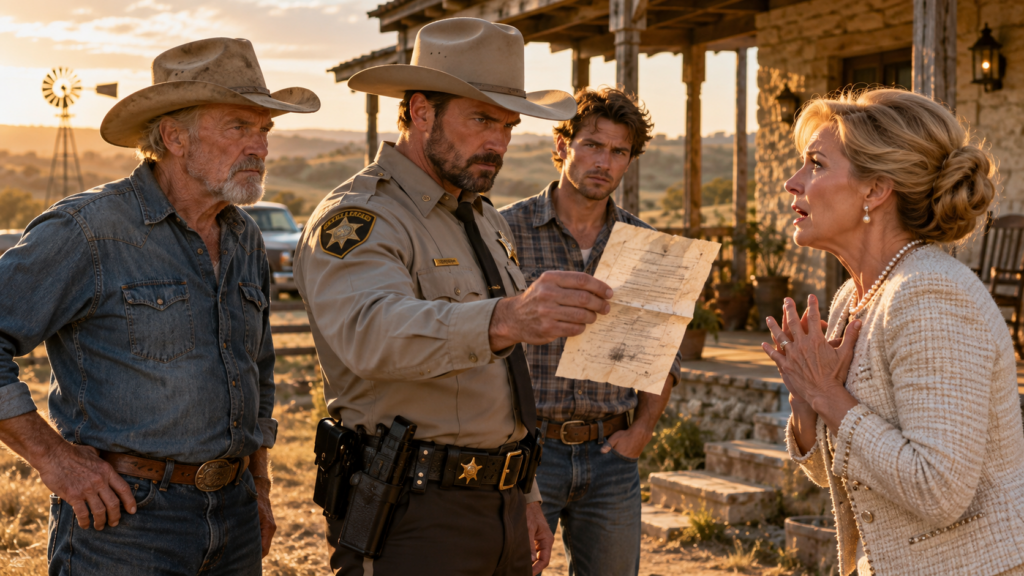
He knew the gate was locked.
He knew there were no-trespassing signs.
He knew Hannah’s cease-and-desist letter existed because Bonnie had forwarded a copy to RidgeLine.
Brent ordered him to proceed anyway.
That testimony helped separate their roles.
Kyle had still participated.
But responsibility was not identical.
That mattered to me.
People wanted the story to be simple.
Two fake cops.
One evil HOA president.
One heroic rancher.
Real life wasn’t that clean.
Kyle was a young man who made a bad decision while following someone stronger.
Brent was much more aggressive.
Bonnie orchestrated the access attempt.
Preston’s role existed mostly in emails and financial records.
Each person had to answer for what the evidence actually showed.
THE SHOTGUN
The hardest part for me was my own conduct.
People around town began congratulating me.
“You showed those boys.”
“They deserved it.”
“You had every right.”
I hated hearing that.
I had rights.
That did not mean every choice I made was smart.
Sheriff Delgado came to the ranch after prosecutors finished reviewing the incident.
We stood by the repaired gate.
“You’re lucky the video was clear,” he said.
“I know.”
“You’re also lucky Brent didn’t panic.”
“I know that too.”
He looked toward the porch.
“You ever think about how fast that could’ve gone wrong?”
Every night.
I didn’t tell him that.
I didn’t need to.
He could see it.
“The deputies arrive, see a man with a shotgun and two people saying they’re officers. Maybe somebody moves wrong.”
“I understand.”
“Next time, you call.”
“I will.”
He held out his hand.
I shook it.
I never wanted that gun to become a symbol of winning.
What saved my ranch was not a shotgun.
It was the camera.
The deeds.
The certified notice.
The county records.
Hannah’s letter.
The documents Bonnie thought nobody would bother checking.
THE FORGED EASEMENT
Forensic examination of the easement became central to the criminal investigation.
Dad’s signature appeared to have been copied from an older document associated with a ranch transaction.
The purported notary information raised additional problems.
Digital evidence tied creation and editing of the document to equipment accessible through Bonnie’s office.
Investigators also found communications discussing the need for “documentation supporting historical Kincaid access.”
That wording did not prove every step by itself.
Taken together with the timing, metadata, financial records, and witness statements, it became part of the prosecution’s theory.
Bonnie eventually stopped speaking publicly.
Her attorney did it for her.
Preston Gaines initially insisted his consulting agreement was completely legitimate.
He claimed Bonnie had been hired for community-relations advice unrelated to the ranch.
Then investigators obtained invoices.
Several descriptions referenced access negotiations, stakeholder pressure, and Phase Two entitlement support.
One invoice was dated two days after my fence was cut.
That coincidence required an explanation.
THE ARRESTS
The arrests did not happen in the middle of an HOA meeting.
Reality was less theatrical.
Investigators built the case over several months.
Subpoenas were issued.
People were interviewed.
Financial records were traced.
Documents were examined.
Eventually, prosecutors approved charges supported by the evidence.
Bonnie faced allegations connected to the forged property document, fraudulent representations, and the effort to obtain rights over my ranch.
Preston faced charges tied to his alleged role in the conspiracy and financial arrangements.
Brent faced charges related to the forced entry, property damage, and the way he represented his authority.
Kyle reached a different resolution after cooperating.
The exact charges shifted as lawyers negotiated and evidence was tested.
That was fine with me.
I wasn’t looking for dramatic sentences.
I wanted the fake easement dead.
THE CIVIL CASE
Hannah filed separately to clear the title and stop Stone Ridge or Preston’s development entities from claiming access.
That part was much simpler.
They had no recorded easement predating the dispute.
The document Bonnie relied upon was invalid.
My chain of title remained intact.
The court entered orders confirming that Stone Ridge had no access right across Kincaid Creek Ranch based on the disputed document.
The HOA withdrew every fine it had issued against me.
Not that those fines ever governed the ranch.
Still, I wanted them canceled in writing.
Every one.
Livestock odor.
Fencing.
Barn appearance.
Road access.
All of it.
Stone Ridge also reimbursed me for certain documented property damage associated with the cut fence and gate.
Preston’s development company eventually resolved my separate civil claims through a confidential financial settlement.
It was substantial.
Not some fantasy amount that made me suddenly rich.
Enough to repair damage, cover professional expenses, and make it painfully clear that private property is cheaper to negotiate for before you try to take it.
Phase Two was redesigned.
The western access route disappeared from the plan.
Alternative infrastructure cost the developer more.
That was his problem.
THE WATER
My creek rights stayed where they had always been.
Mine, subject to the law that had governed them long before Stone Ridge existed.
Preston eventually pursued other water arrangements for the reduced expansion.
No one from his company ever contacted me again about Kincaid Creek.
I preferred it that way.
Maribel became president of Stone Ridge.
Not by some miraculous unanimous vote.
But comfortably.
Her first letter to me was handwritten.
Mr. Kincaid,
The new board acknowledges that your ranch is not part of Stone Ridge and that no HOA representative has authority to enter your property without permission.
We apologize for what happened.
Maribel Soto
President
I filed it.
Tanner laughed.
“You file everything now.”
“Your grandmother did too.”
“I thought you burned the first fines.”
“That was before I learned.”
THE RANCH AFTERWARD
Stone Ridge didn’t collapse.
People still lived there.
Children played in the streets.
The fountain still ran.
Property values did not vanish because the board stopped harassing a cattle rancher.
If anything, residents seemed relieved.
Maribel opened meetings to more questions.
Large outside contracts required conflict disclosures.
Security vendors received clearer limits on authority.
Property claims had to be supported by actual recorded documents before anyone acted on them.
