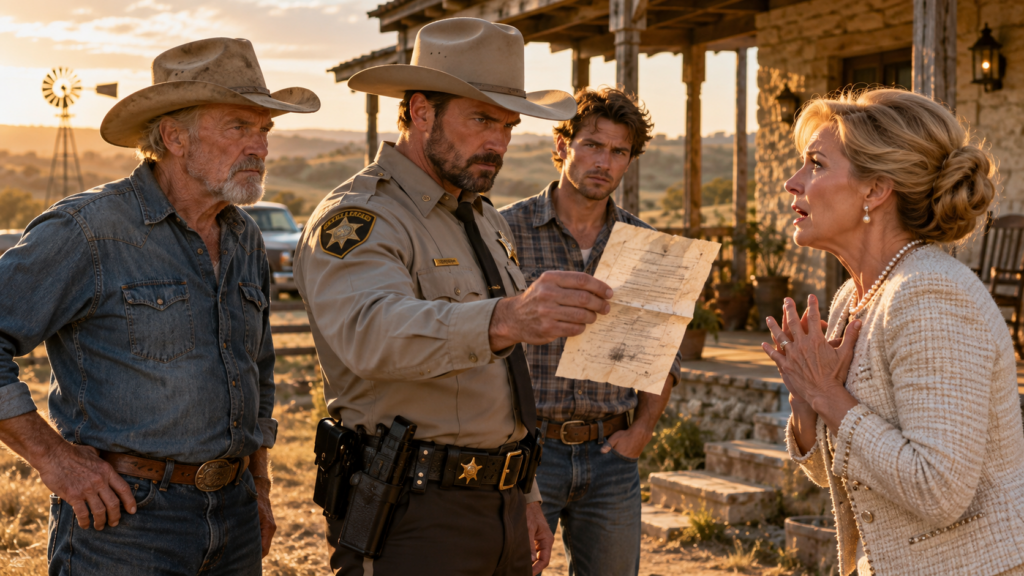
Somebody had forged my dead father’s name.
Hannah examined the supposed easement the next morning. The notary information didn’t match current records, Walter Kincaid’s signature differed from every verified sample we possessed, and the document had never been properly recorded in the county index. More importantly, Dad had been dead for more than twenty-five years when someone claimed he signed it.
Then Maribel brought us something worse: internal Stone Ridge emails discussing “Phase Two,” a proposed nine-hundred-home expansion beyond the existing subdivision. The development needed a western access route across my ranch and, even more critically, a reliable water source tied to Kincaid Creek.
A developer named Preston Gaines appeared throughout the correspondence. His company had been paying Bonnie through a consulting agreement worth up to $180,000 if certain expansion milestones were achieved. One email described my ranch as “the remaining access obstacle.” Another instructed the board to increase pressure until I became “open to sale or participation.”
Texas Rangers and county investigators took over the document review. Brent and Kyle’s private-security company was also examined after the trail-camera recording showed them discussing how to present themselves as police.
Meanwhile, the district attorney reviewed the footage of me holding the shotgun. Nobody told me I had acted perfectly. Sheriff Delgado made that clear. But investigators also had video of the men cutting a locked gate after written trespass notice and entering my ranch.
Weeks later, the prosecutor declined to charge me based on the full circumstances.
Then Ranger Dale Rosson called Hannah.
“We found where the easement came from,” he said.
The digital file had been created on a computer linked to Bonnie’s HOA office.
And its metadata showed it had been edited the same week Preston Gaines transferred another payment to her consulting company…
Hannah did not smile when Ranger Rosson gave us the news.
Neither did I.
The evidence was getting stronger, but she kept reminding me that suspicious timing was not the same thing as proving exactly who had forged a document.
“Let the investigators make the criminal case,” she said. “Our job is to protect your land.”
That became our rule.
No public accusations we could not support.
No dramatic confrontations.
No threats.
Paper first.
Everything else second.
THE REAL REASON FOR THE ROAD
The more records surfaced, the clearer Stone Ridge’s expansion plans became.
Phase Two was enormous.
Nine hundred proposed homes spread across several tracts north and east of the existing development.
The developer already controlled much of the land.
What he did not control was the most convenient western access route.
My ranch road connected almost directly to a county highway.
Building an alternative entrance would require additional roadwork, drainage engineering, and negotiations with several other landowners.
Using mine would be cheaper.
Then there was the creek.
Kincaid Creek crossed my property before feeding into a larger watershed.
My family held long-established rights associated with our agricultural use, subject to the applicable state framework and permits.
The exact legal water questions were complicated.
But the business reality was simple.
A development that large needed a reliable water plan.
Preston Gaines wanted options.
One preliminary planning memo listed “Kincaid participation” as a preferred solution.
Another referred to securing “access and water cooperation through HOA alignment.”
I stared at that phrase.
HOA alignment.
That was what Bonnie had been trying to manufacture.
If she could make the ranch appear subject to Stone Ridge rules, then every fine, inspection, fence demand, and access claim became leverage.
Not ownership.
Pressure.
Hannah found an email from Preston to Bonnie sent nearly a year earlier.
Need this solved before Phase Two financing.
If Kincaid won’t deal voluntarily, board pressure may change the economics for him.
Bonnie responded:
Understood. He’s old-school. Eventually the inconvenience will outweigh the principle.
I read that sentence several times.
Not because it hurt.
Because it explained everything.
They believed age made me easier.
They thought a sixty-two-year-old widower would eventually get tired of letters and strangers at the gate.
They had mistaken grief for weakness.
THE BOARD FINDS OUT
Most Stone Ridge homeowners knew almost none of this.
That surprised me at first.
Then I thought about how HOAs actually work.
People elect a board because they do not want to spend Tuesday nights reading drainage maps and vendor agreements.
They assume somebody is checking.
Bonnie depended on that assumption.
Maribel began contacting board members individually.
One by one, they learned about the forged easement claim, the Phase Two communications, and Bonnie’s consulting payments.
The treasurer, Paul Hendricks, called Hannah directly.
“I never approved any $180,000 consulting payment.”
“It didn’t come from Stone Ridge,” Hannah explained.
“It came from the developer.”
That made things worse.
Bonnie had been receiving outside money from a company whose expansion would benefit if the HOA gained access across my ranch.
Whether every dollar was unlawful was a question for investigators.
But as a governance conflict, it was devastating.
Paul asked for copies of the emails.
Hannah told him to obtain them through proper board channels.
Within forty-eight hours, Stone Ridge scheduled an emergency meeting.
I did not attend.
Maribel did.
She called me afterward.
“It was ugly.”
“What happened?”
“Bonnie said the consulting work had nothing to do with the ranch.”
“And?”
“Then Paul read the email where Preston called you the remaining access obstacle.”
I sat quietly.
“She still president?”
“For the moment.”
Not for long.
THE SECURITY COMPANY
Brent Lawson and Kyle Mercer worked for a small private-security contractor called RidgeLine Protection.
The company had a legitimate license to provide certain security services.
What it did not possess was authority to transform employees into police officers.
Investigators reviewed uniforms, training materials, vehicle markings, and communications with Stone Ridge.
The phrase HOA Patrol itself was not necessarily unlawful.
The problem was how people used it.
The trail-camera audio showed Brent saying Bonnie wanted them presented as police because “nobody checks.”
Kyle later cooperated with investigators.
According to records disclosed later, he told them he had objected before entering my ranch.
