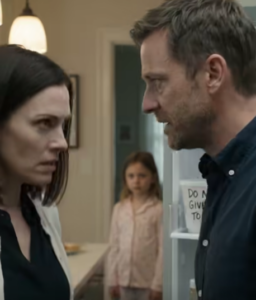
Ma fille de cinq ans avait tellement peur de demander une autre tranche de pain qu’elle regardait sa mère comme si un seul mot de travers pouvait lui coûter son dîner.
Je me souviens précisément de ce moment car tout autour de nous semblait d’une banalité affligeante.
La cuisine embaumait le poulet rôti, la télévision murmurait dans le salon, et ma femme, Vanessa, disait à notre fils de huit ans, Noah, d’arrêter de balancer ses pieds sous la table.
Rien, ce soir-là, n’aurait dû effrayer qui que ce soit.
Pourtant, lorsque j’ai regardé Lily, j’ai vu une expression qui m’a noué l’estomac.
Elle fixait du regard la corbeille à pain au centre de la table, ses petits doigts immobiles à côté de son assiette presque vide.
J’ai souri et j’ai tendu la main vers le panier.
« Chérie, tu veux une autre part ? »
Les yeux de Lily s’écarquillèrent, mais elle ne me répondit pas.
Au lieu de cela, elle jeta un coup d’œil à Vanessa, puis baissa rapidement la tête.
« Ai-je le droit ? » murmura-t-elle.
Trois petits mots d’une enfant qui n’aurait jamais dû avoir peur de demander à manger à son père.
J’ai d’abord ri doucement, supposant qu’elle était exceptionnellement polie.
“Bien sûr que tu as le droit, chérie.”
Mais quand j’ai posé le pain dans son assiette, elle n’y a pas touché.
Elle regarda de nouveau Vanessa.
Ma femme a continué à découper son poulet comme si elle n’avait rien remarqué d’inhabituel.
« Lily a déjà mangé assez de pain », dit-elle.
« Elle a encore faim », ai-je répondu.
« Elle apprend que vouloir quelque chose ne signifie pas qu’elle en a besoin. »
Il y avait quelque chose dans la voix de Vanessa qui me dérangeait, même si je ne pouvais pas immédiatement expliquer pourquoi.
Ce n’était pas tant ce qu’elle avait dit que la façon dont Lily avait réagi.
Ma fille a ramené ses mains sur ses genoux et est restée parfaitement immobile.
J’ai baissé les yeux vers son assiette.
Elle avait mangé quelques morceaux de poulet, plusieurs carottes et la plupart de ses pommes de terre.
Son repas n’avait rien d’excessif.
« Une tranche de pain de plus ne lui fera pas de mal », ai-je dit.
Vanessa a fini par me regarder.
« Tu n’es pas à la maison pendant la journée, donc tu ne comprends pas les problèmes que nous rencontrons. »
Ses paroles blessaient car elles étaient en partie vraies.
Je travaillais de longues heures à la gestion d’un entrepôt de distribution, et la plupart des soirs, je rentrais chez moi juste avant le dîner.
Vanessa s’occupait des trajets scolaires, des rendez-vous, des repas et de presque toutes les tâches ménagères.
Pendant des années, j’ai cru que cet arrangement renforçait notre famille.
Elle était organisée, attentive et déterminée à offrir à nos enfants la structure qu’elle disait n’avoir jamais eue en grandissant.
J’admirais ces qualités chez elle.
Whenever relatives praised Noah’s manners or commented on how quietly Lily behaved, I’d felt proud of my wife.
Now I wondered whether I’d confused obedience with happiness.
Across the table, Noah stopped eating.
He glanced from Vanessa to Lily, then lowered his fork.
I noticed how tightly he was holding it.
“What’s wrong, buddy?” I asked.
“Nothing,” he replied.
Vanessa gave him a quick look.
“Then finish your dinner.”
He obeyed immediately.
I turned back to Lily and pushed the bread a little closer.
“Go ahead, sweetheart.”
Her hand moved toward it, then stopped.
“Mommy said I have to ask first.”
“You did ask.”
She swallowed.
“But she didn’t say yes.”
An uncomfortable silence settled over the table.
For the first time, I understood that Lily wasn’t waiting for permission from either parent.
She was waiting for permission from Vanessa alone.
I picked up the bread and placed it in Lily’s hand.
“You can eat it,” I said.
Vanessa set down her knife.
“You’re undermining me in front of the children.”
“I’m giving our daughter a piece of bread.”
“You make everything sound simple because you don’t deal with the consequences.”
I wanted to argue, but Lily was staring at us with tears forming in her eyes.
I couldn’t understand why a disagreement about bread had frightened her so badly.
“Nobody’s angry with you,” I told her.
She nodded without looking up.
Then she took one tiny bite.
I’ve replayed that moment hundreds of times, wishing I’d paid attention to what happened next.
Lily didn’t eat the rest of the bread.
She broke it in half, slipped one piece beneath her napkin, and carefully covered it with her hand.
I saw the movement but said nothing.
At the time, I thought she was simply saving some for later.
Only afterward did I understand what that tiny gesture meant.
My daughter was hiding food at her own dinner table.
After dinner, Vanessa began clearing the plates.
I offered to help, but she told me to take the children into the living room.
Her voice had returned to normal, almost as though our disagreement had never happened.
That was one of Vanessa’s talents.
She could make an uncomfortable moment disappear so smoothly that I often questioned whether it had happened at all.
I sat on the couch while Noah showed me a drawing he’d made at school.
It depicted our family standing beside our house beneath a bright yellow sun.
Vanessa was holding Lily’s hand, while Noah and I stood together near the driveway.
I complimented the picture and asked him whether he’d enjoyed school.
He shrugged.
“Did anything interesting happen?”
“Not really.”
I studied his face.
Noah used to tell me everything, from playground arguments to the strange things his classmates brought for lunch.
Recently, his answers had become shorter.
I’d assumed he was growing older and wanted more privacy.
Now I noticed how often his eyes drifted toward the kitchen.
“Is everything okay at home?” I asked quietly.
His pencil stopped moving.
“Why?”
“Just checking.”
He looked down.
“Yeah.”
