The woman in the photograph had Elina’s face.
Not exactly.
The woman looked older, perhaps twenty-eight or twenty-nine. Her hair was darker and cut shorter. Her dress was elegant, the black silk catching restaurant light around one shoulder.
But the eyes were Elina’s.
The smile was Elina’s.
And there was the same tiny dimple in the left cheek that Elina had spent her whole life wishing she could hide.
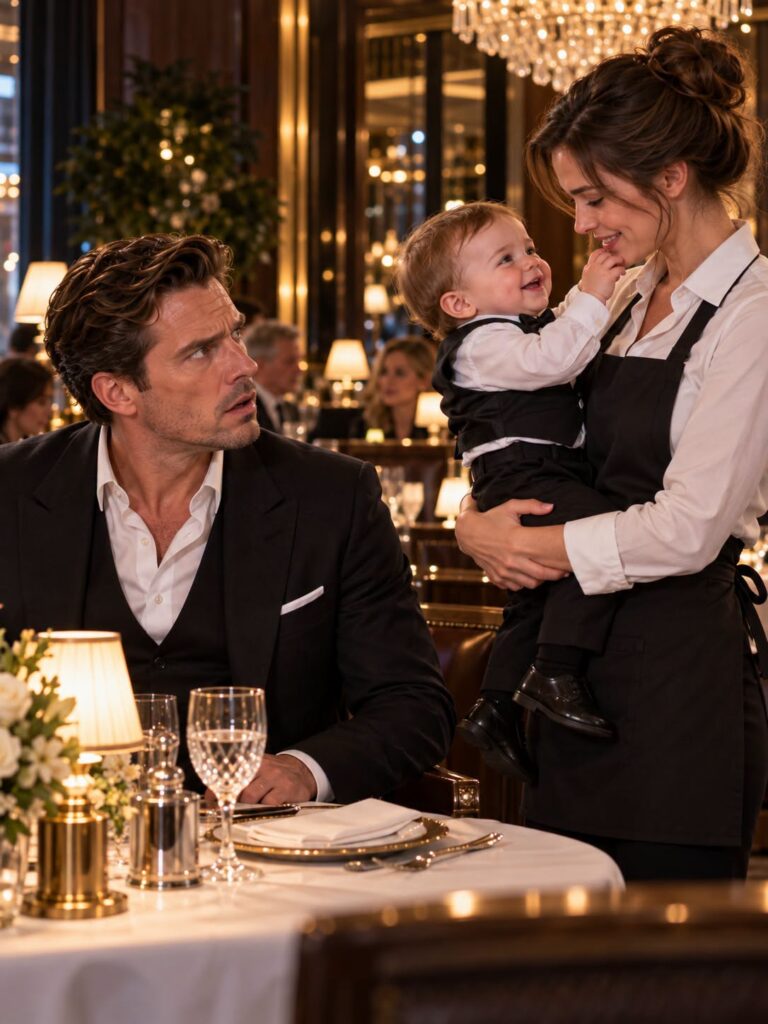
Her arms tightened instinctively around the baby.
The child sighed against her chest.
The man across from her noticed where she was looking.
His expression changed.
Slowly.
Dangerously.
“Put him down.”
Elina looked at him.
“What?”
“My son.”
The softness had vanished from his voice.
“Put him down.”
She immediately leaned toward him.
The baby reacted before she could transfer his weight.
His fingers twisted into her shirt.
His face crumpled.
“No—”
The word was barely formed, but clear enough.
The man froze.
So did Elina.
The bodyguard beside him whispered:
“He said no.”
The baby had not spoken.
Apparently not for months.
Elina looked at his father.
“What is his name?”
The man hesitated.
“Gabriel.”
She looked down.
“Gabriel.”
The baby lifted his face.
His eyes fixed on hers.
Then he pressed his cheek against her collarbone again.
The man across from her seemed to forget how to breathe.
Finally:
“My name is Roman DeLuca.”
Elina knew the name.
Everyone in Brooklyn knew it.
Owner of restaurants, construction companies, waterfront properties.
And, depending on who was speaking and how quietly, much more.
Roman looked toward the photograph behind the bar.
Then back at her.
“That woman was my wife.”
Elina swallowed.
“What was her name?”
“Alessia.”
Something cold moved through her.
Her mother had once whispered that name in her sleep.
Elina had been twelve.
She remembered because the sound woke her.
Alessia.
At breakfast, Elina asked who it was.
Her mother dropped a coffee cup.
Then said:
“Nobody.”
Elina had forgotten the moment until now.
“What was her last name?”
Roman’s eyes narrowed.
“Valdez.”
The room tilted.
Elina nearly lost her grip on Gabriel.
Roman stood instantly and steadied the baby with one hand.
“What?”
“My last name is Valdez.”
“I know.”
“No.”
She looked at the photograph again.
“My mother knew someone named Alessia.”
Roman’s entire posture changed.
“What is your mother’s name?”
Elina hesitated.
“Marisol.”
Roman went pale.
One of his bodyguards looked sharply toward him.
Elina noticed.
“You know her?”
Roman didn’t answer.
Instead he took out his phone.
He called someone.
“Bring the file from my office.”
A pause.
“The blue one.”
Another pause.
“No. Now.”
He ended the call.
Elina’s heart had started racing.
“What file?”
Roman looked at Gabriel.
The baby was still holding her.
“My wife spent the last year of her life trying to find a woman named Marisol Valdez.”
The sounds of the restaurant returned in fragments.
Silverware.
Glass.
Music.
Elina heard none of them clearly.
“Why?”
Roman looked at her.
“Because she believed Marisol was her mother.”
Elina stared.
“No.”
Roman said nothing.
“My mother only had one child.”
“Did she tell you that?”
“Yes.”
“When?”
Elina opened her mouth.
Then stopped.
Her mother had never said it directly.
She had simply lived as though Elina had always been the only one.
No baby photographs before age two.
No stories about pregnancy.
No grandparents.
No relatives.
Every question about the past ended the same way.
It was difficult.
Leave it alone.
Roman gestured toward a chair.
“Sit.”
Elina almost snapped that she wasn’t one of his employees.
Then Gabriel shifted against her and she sat anyway.
Roman sat opposite.
His men moved farther away.
Not gone.
Just distant enough that the conversation belonged to them.
“What happened to your wife?”
Elina asked.
Roman’s eyes hardened.
“Car accident.”
“When?”
“Nine months ago.”
“And Gabriel?”
“He was with her.”
Elina looked down at him.
Roman continued.
“She died at the scene.”
The words came without emotion.
That made them heavier.
“Gabriel survived with minor injuries.”
“And since then?”
“He rejects almost everyone.”
Roman looked at his son.
“Nannies. Nurses. My sister.”
“He lets you hold him.”
“Because he has no choice.”
That sentence hurt.
Roman knew it.
He looked away.
“He sleeps if he’s exhausted enough. Eats if I feed him. Screams if strangers get too close.”
“And me?”
“I don’t know.”
Then the blue file arrived.
A man placed it on the table.
Roman opened it.
The first page was a photocopy of a birth certificate.
Elina could not read everything from where she sat.
Then Roman turned it toward her.
Child:
Alessia Marie Valdez.
Mother:
Marisol Valdez.
Father:
Blank.
Elina’s fingers went cold.
“That could be anyone.”
Roman flipped the page.
A photograph.
Marisol.
Younger.
Maybe twenty.
Holding a newborn.
Elina recognized her immediately.
Her mother’s eyebrows.
Her hands.
The small scar near her wrist.
“That’s my mother.”
Roman nodded.
“My wife found the photograph through an adoption investigator.”
Elina stared.
“Adoption?”
“Alessia was placed with another family when she was six months old.”
“No.”
“She believed Marisol had no choice.”
“Why?”
Roman turned another page.
A statement written by Alessia.
She had discovered that Marisol was nineteen when she gave birth.
The baby’s father had been much older.
Married.
Powerful.
When Marisol tried to keep her daughter, his family threatened her.
According to the investigator, Marisol eventually agreed to what she was told would be a temporary guardianship.
It became a permanent adoption.
Elina’s eyes filled.
“This isn’t possible.”
Roman did not tell her it was.
He simply let her read.
That made it worse.
Alessia had found Marisol’s address eighteen months before the accident.
She never contacted her.
“Why not?”
Roman’s jaw tightened.
“Someone convinced her not to.”
“Who?”
He looked toward one of his men.
The bodyguard shifted uncomfortably.
Roman answered:
“My uncle.”
Elina looked up.
“Why would he care?”
“Because Alessia’s biological father was connected to my family.”
The answer carried weight Roman clearly disliked.
“Connected how?”
“His company worked with my father’s organization decades ago.”
