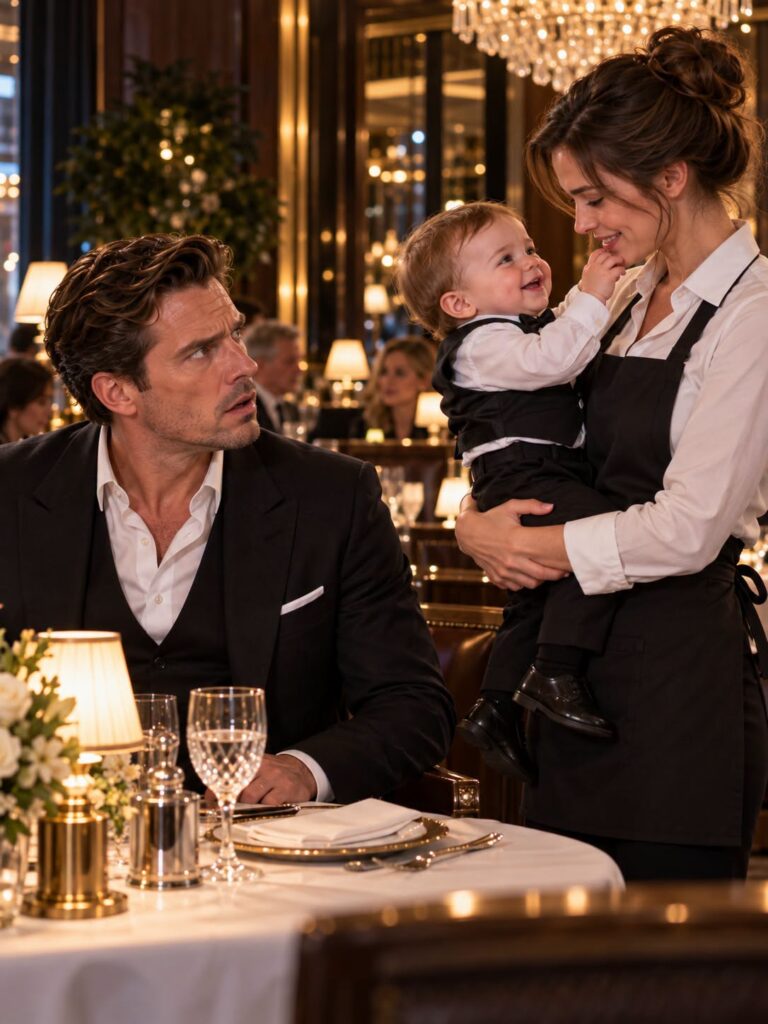
The reopened investigation ultimately found no proof that Alessia’s crash had been intentional.
It had been what authorities originally concluded:
A winter road.
A mechanical failure.
Tragedy.
Not every terrible event required a villain.
But Lorenzo’s interference was real.
So were financial irregularities connected to old companies and newer concealment efforts.
Roman turned everything over to outside counsel and authorities.
Lorenzo was removed from every legitimate DeLuca business role.
Civil claims followed.
So did investigations.
Roman did not make him disappear.
Elina noticed that.
“You could have,” she said months later.
They were sitting in Restorante Orelio after closing.
Gabriel was asleep in a high chair beside them.
Roman looked at her.
“Could have what?”
“Handled him the way people say you handle people.”
Roman looked toward his son.
“Alessia spent the last year of her life trying to uncover what men in my family hid.”
He paused.
“I wasn’t going to honor her by hiding something else.”
That answer changed how Elina saw him.
Not completely.
But enough.
Marisol met Gabriel the following Sunday.
She walked into Roman’s home carrying a toy rabbit and shaking so badly she nearly dropped it.
Gabriel stared at her.
Marisol began humming.
Three notes.
The same lullaby.
Gabriel’s face transformed.
He reached for her.
Marisol collapsed into tears.
Roman turned away.
Elina did too.
Some grief was too private even when everyone was witnessing it.
Elina kept working at Orelio.
That surprised Roman.
“You don’t have to.”
“Yes, I do.”
“Why?”
“Because I have rent.”
“I can fix that.”
She gave him a look.
Roman corrected himself.
“Right.”
He learned quickly.
Elina did not want rescuing.
She wanted the truth.
Eventually she accepted a different job—not from Roman, but with the nonprofit Alessia had quietly supported before her death, helping young mothers access legal aid and emergency housing.
The choice felt right.
Gabriel remained obsessed with her.
At two, he called her Lina.
At three, he learned Aunt Elina.
At four, he informed Roman that Elina made better pancakes.
Roman took this personally.
Marisol became part of Gabriel’s life slowly.
No forced titles.
No rewriting the past.
She was Grandma Mari because Gabriel decided she was.
And every year, on Alessia’s birthday, the family returned to Restorante Orelio.
The photograph stayed behind the bar.
Eventually another photograph appeared beside it.
Elina.
Marisol.
Gabriel between them.
Roman objected to being left out.
Elina told him he had enough photographs of himself in business magazines.
Years later, people still told the story about the night a feared mafia boss entered a restaurant carrying a baby nobody could soothe.
They remembered the broke waitress.
The child reaching for her.
Roman going pale.
Only his mother could do that.
Then the photograph.
The impossible resemblance.
But Elina remembered something smaller.
Gabriel’s hand against her neck.
That first sigh.
The strange trust of a child who could not possibly understand genetics, adoption records, intercepted letters, or decades of adult fear.
Maybe he recognized her face.
Maybe the shape of her eyes reminded him of Alessia.
Maybe her voice carried some familiar rhythm.
Maybe babies simply reach toward people for reasons adults will never fully explain.
It did not matter.
What mattered was that his reaching forced everyone else to look.
Roman looked at the woman he had almost dismissed as a waitress.
Elina looked at a photograph she had passed a hundred times.
Marisol looked at the daughter she had spent decades believing she lost forever.
And a family built around secrets finally learned that hiding the past does not erase it.
It only delays the moment someone recognizes the face.
The End.
