Behind him, Preston Hale whispered to Richard Kline.
I could not hear the sentence, but I saw Kline answer by touching two fingers to his cuff.
A signal.
Preston looked toward the west balcony.
A man there immediately walked away.
I had spent years in boardrooms where whole acquisitions turned on smaller gestures.
The gallery was communicating beneath its panic.
I looked at Owen.
He followed my gaze and saw it too.
“Track Kline’s contacts,” I said.
“Already started.”
Grant’s smile faltered.
“Paranoid now?”
“No.”
“Observant.”
The distinction made him angrier because observation was the one thing the room had denied me minutes earlier.
Now every movement mattered.
A waiter set down a tray with shaking hands.
A donor deleted messages and then stopped when an officer saw him.
A judge moved away from a politician he had arrived with.
An auctioneer quietly removed a flash drive from the podium and slipped it into his shoe.
Owen caught that too.
The drive was seized.
It contained nothing about my assault.
It contained bidder identities that were supposed to remain confidential.
Another crime had been hiding inside the same room before Grant ever touched me.
That was the second lesson of the lockdown.
When powerful people are prevented from leaving, secrets begin falling out of their pockets.
His face had gone pale, but his chin stayed lifted.
Men like Grant were trained from birth to survive humiliation by acting as if it had not happened.
He looked toward the black-uniformed security officers emerging from the hidden wall panels.
Then he looked back at me.
“You think locking a few doors makes you powerful?”
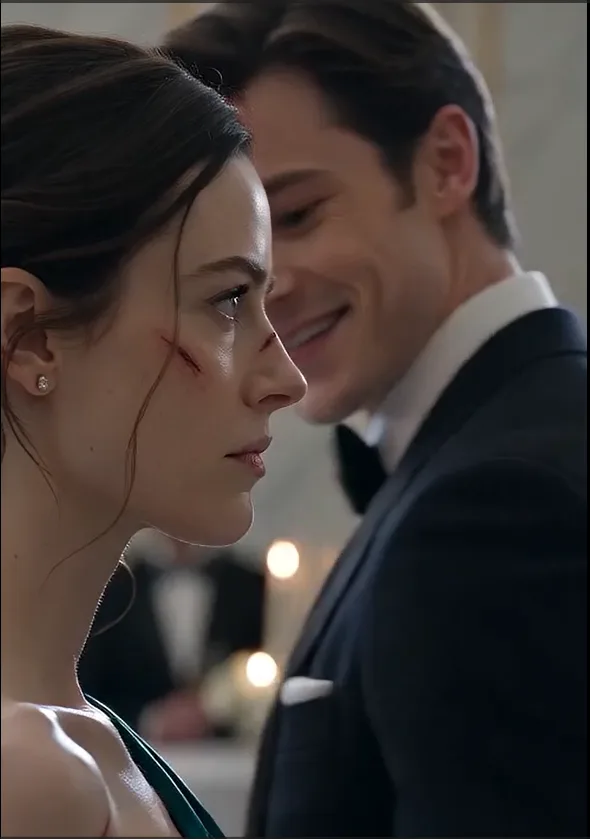
I touched the swelling beneath my eye.
“No.”
I lowered my hand.
“I think ninety-eight cameras, two hundred and fourteen witnesses, and a sealed evidence protocol make you careless.”
A ripple moved through the crowd.
Grant’s closest friend, Preston Hale, stopped smiling.
Preston was a private-equity heir who had once bought a Manhattan apartment because a restaurant had refused to move another customer from his preferred table.
He stepped away from Grant by half a pace.
Grant noticed.
So did I.
A woman near the front row lowered her champagne and took one careful step backward.
Her husband caught her elbow as if even distance from Grant needed permission.
I knew them both.
Howard and Julia Fenwick had donated twelve million dollars to the museum restoration fund and had once invited my parents to spend Christmas on their island.
Julia had watched Grant shove me into the pillar.
She had lifted one hand toward her mouth.
Then Howard had whispered something to her.
She had lowered the hand and turned away.
Now she would not meet my eyes.
That was the first lesson of the sealed gallery.
The steel doors did not create cowardice.
They only prevented it from leaving.
A security officer began collecting phones from museum staff whose access credentials touched the affected camera network.
Two technicians complied immediately.
A third protested that he had diplomatic messages on his device.
Owen told him the phone would be isolated, not searched without authorization.
The technician still refused.
Lena crossed the room and asked his name.
He gave it reluctantly.
She wrote it down.
That tiny act ended the argument.
People who believed themselves important were often less frightened by force than by records.
Grant understood that too.
He began walking through the room before Lena stopped him, touching shoulders, whispering to men who owed his father favors, and building a story one person at a time.
I watched his version of the night assemble in real time.
First I had provoked him.
Then I had grabbed him.
Then I had threatened to ruin his family.
By the time the fourth whisper crossed the gallery, I had apparently attacked him with a champagne flute.
My untouched flute still sat on the auction table twenty feet away.
Facts did not slow the story.
They rarely did when fear had better distribution.
I walked to the auction podium and picked up the microphone.
The feedback squeal cut through the room.
Everyone turned.
“You are not being asked to choose a side.”
My voice carried beneath the glass ceiling.
“You are being asked to tell the truth about what you saw.”
Judge Bell laughed softly.
“And if our recollection differs from yours?”
“Then the evidence will decide.”
I looked toward the cameras.
“And if the evidence has been tampered with, the tampering will become evidence too.”
That changed the room.
Not because they suddenly respected me.
Because people who had agreed to lie about a slap were less enthusiastic about becoming accessories to sabotage.
Three guests moved away from Grant’s group.
Preston Hale stayed.
His face had lost all humor.
Grant leaned close to him.
I could not hear the words.
But I saw Preston answer with a single shake of his head.
Grant gripped his shoulder harder.
Preston pulled free.
For the first time, Grant’s control was visibly slipping.
Then one of the museum’s youngest security guards approached me.
His name tag read BARNES.
He could not have been older than twenty-three.
“Ms. Vale, I think I saw someone near the camera hub before the incident.”
Owen turned.
“Who?”
Barnes looked across the room.
His eyes landed on a cluster of donors.
Before he could answer, a fire alarm panel flashed behind him.
A different officer called his name.
Barnes looked back for one second.
When he turned toward us again, he seemed to change his mind.
“I was probably mistaken.”
Then he walked away.
I watched him go.
Someone in that room had frightened him without moving.
That frightened me more than Grant ever had.
“Mara,” he said softly, “you are embarrassing yourself.”
“Then leave.”
His eyes shifted toward the steel barrier.
I let the pause breathe.
“Oh.”
“You can’t.”
The first security officer reached us.
His name was Owen Mercer.
He had been chief of protective operations for my father for seventeen years.