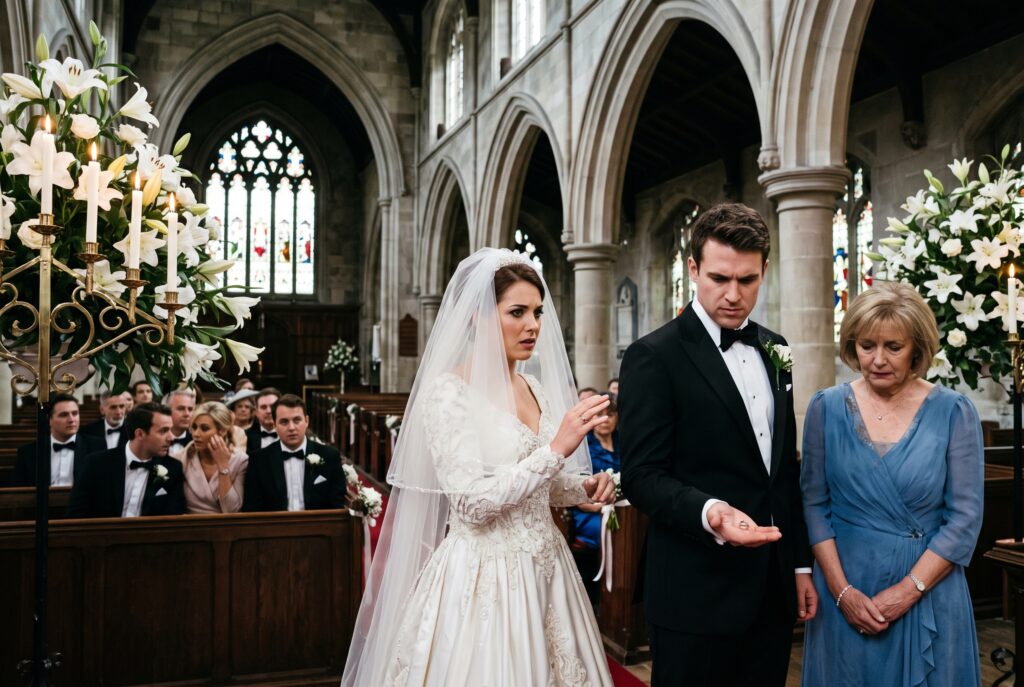
It was, “You smell like manure.”
Two hundred and sixty people heard her.
Stephanie Vale stood beneath an arch of white lilies at St. Mary’s, wearing a wedding gown that cost more than my first car, while my sixty-nine-year-old mother froze with her arms halfway around her.
Then Stephanie leaned back as if she had touched something rotten.
“Seriously, Charles,” she said, loud enough for the front six rows to hear. “Keep that peasant away from me.”
The church went silent.
Not quiet.
Silent.
The string quartet stopped so abruptly that the cellist’s bow remained suspended over the strings.
My mother, Margaret Hartwell, wore a blue dress she had altered herself at the kitchen table three nights earlier. She had my grandmother’s pearl earrings in her ears and a small white rose pinned over her heart.
Her hands slowly fell to her sides.
And then, unbelievably, she apologized.
“I’m sorry.”
That was the moment my wedding ended.
Not when I took off my boutonniere.
Not when Stephanie called me insane.
Not when her father threatened me.
It ended when the strongest person I had ever known apologized for taking up space in a room full of people who had never earned the right to make her feel small.
My mother had spent forty-three years on Willowbrook Farm in eastern Pennsylvania. She could repair a fence with baling wire in sleet, pull a calf at three in the morning, negotiate with a feed supplier, change the hydraulic line on a tractor, and tell from the smell of the wind whether a summer storm would miss us or tear half the shingles off the machine shed.
My father died suddenly when I was twelve.
A brain aneurysm.
One morning he was sitting at the kitchen table complaining that the coffee was weak. By dinner, my mother was a widow with a mortgage, a frightened boy, seventy-eight acres, twenty-six dairy cows, and three hundred dollars in the checking account.
She kept all of it alive.
Including me.
And now she was apologizing to Stephanie.
“I came straight from the farm,” Mom said softly. “I washed up, but maybe my shoes—”
“Mom.”
She looked at me.
There was humiliation in her face, but something worse was underneath it.
Resignation.
She had expected this.
Maybe not the words.
But the feeling.
I turned to Stephanie.
“Apologize.”
She stared at me.
“What?”
“To my mother.”
Stephanie’s expression shifted from surprise to irritation.
“Oh my God, Charles. It was a joke.”
“No, it wasn’t.”
“Don’t start this today.”
Behind her, her mother, Deborah, had already begun looking around the church as though the real problem was that people were witnessing an embarrassing family disagreement.
Richard Vale, Stephanie’s father, stood near the first pew in a custom navy suit. His mouth had flattened into the expression he used in business meetings when somebody lower in the hierarchy failed to understand his importance.
My mother touched my sleeve.
“Charlie, please.”
I looked at her.
“Please what?”
“Let it go.”
Her voice shook.
“This wedding cost so much money.”
That hurt worse than Stephanie’s insult.
Because I suddenly understood what I had spent the last two years teaching my mother.
Let it go.
When Richard had introduced me to friends at the country club as “the farm boy with the engineering degree,” I had laughed.
When Deborah suggested that Mom might “feel more comfortable” skipping their Christmas dinner because it was “a fairly formal crowd,” I told Mom not to take it personally.
When Stephanie corrected the way Mom pronounced hors d’oeuvres in front of eight people and then laughed when my mother flushed, I told Stephanie privately that it bothered me.
She said I was sensitive.
I apologized.
Not to Mom.
To Stephanie.
Every insult had arrived wearing a little costume.
A joke.
A misunderstanding.
Different backgrounds.
Different worlds.
They don’t mean it that way.
Standing beneath those lilies, I finally understood something so obvious I felt ashamed it had taken me thirty-eight years to learn it.
They meant it exactly that way.
I reached into the inside pocket of my jacket.
My fingers touched a thick cream envelope.
HAROLD WEISS, ATTORNEY AT LAW.
Harold had handled my father’s estate and every significant piece of paperwork connected to Willowbrook since I was a teenager. The envelope had arrived two weeks earlier with PLEASE CALL ME written across the front.
I had carried it around unopened because Stephanie had been furious that I was “distracted” during the final wedding preparations.
Flowers.
Seating charts.
Signature cocktails.
Guest favors.
I looked at the woman I had almost married.
“Take off the ring.”
Stephanie blinked.
“What?”
“The engagement ring.”
The color left her face.
“Charles.”
“This wedding is over.”
Somewhere behind us, a chair scraped against the stone floor.
Stephanie stared at me as if I had spoken another language.
“You cannot be serious.”
“I am.”
“Because of a joke?”
“Because of everything I kept pretending was a joke.”
Her voice dropped.
“Do not do this to me in front of everyone.”
That sentence finished whatever remained between us.
Not I’m sorry.
Not I hurt your mother.
Do not do this to me.
I held out my hand.
For several seconds, Stephanie did nothing.
Then she yanked off the ring and dropped it into my palm.
“You’ll regret this,” she whispered.
Maybe I would.
But for the first time all day, I knew exactly what I was doing.
I took my mother’s hand.
We walked down the center aisle together.
No music.
No applause.
Just the soft thunder of two hundred and sixty people beginning to whisper.
Mom blamed herself before we reached Willowbrook.
She lasted eleven miles.
Then she said, “I ruined your wedding.”
I kept driving.
“Mom.”
“She was nervous. Brides are nervous. People say things.”
“People don’t accidentally call someone a peasant.”
“She comes from a different world.”
Something in me snapped.
I pulled my truck onto the shoulder.
Mom gripped the door.
“What are you doing?”
I put the transmission in park.
“Look at me.”
