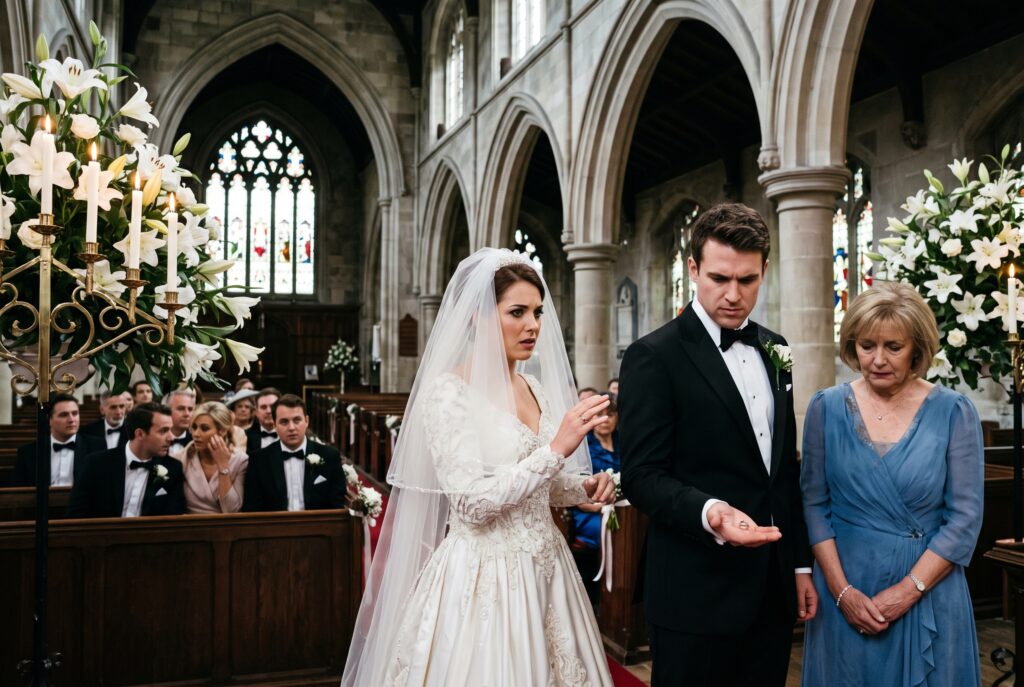
She did.
“You did not ruin my wedding.”
Her eyes filled.
“Charlie—”
“She insulted you.”
“It wasn’t worth ending a marriage over.”
“It wasn’t one insult.”
That silenced her.
“You know that,” I said.
She looked out the passenger window.
Cars hissed past us on wet pavement.
Finally she said, “You worked very hard to enter their world.”
“No, Mom.”
I waited until she looked at me again.
“I worked hard to become an engineer. I never worked hard to become somebody ashamed of you.”
Her mouth trembled.
I had not seen my mother cry at my father’s funeral.
She cried three weeks later when the milk truck came and Dad wasn’t there to argue about the price.
That afternoon, she turned toward the window so I would not see.
I let her.
By midnight my phone had become almost unusable.
Stephanie sent eleven messages.
Richard sent six.
The first two were furious.
The third demanded reimbursement for the wedding.
The fourth informed me that my behavior could have “substantial financial consequences.”
The fifth said, CALL ME BEFORE YOU MAKE THIS WORSE.
The sixth simply said:
You have no idea what you’ve done.
At 12:17 a.m., another message appeared.
From Emma.
Stephanie’s younger sister.
Charles, I think you need to know what Stephanie has really been planning.
I called immediately.
She answered on the second ring.
“Are you alone?” she whispered.
“Yes.”
“Is Margaret with you?”
“She’s asleep.”
A pause.
Then: “I should have told you sooner.”
My stomach tightened.
“Told me what?”
“Meet me at Stephanie’s apartment tomorrow morning.”
“Why?”
“Because there are documents you need to see.”
“What documents?”
Emma exhaled shakily.
“About your mother.”
I stood up from the kitchen table.
“What about my mother?”
“Charles, please. Not over the phone.”
“Emma.”
Another pause.
Then she said the sentence that kept me awake until sunrise.
“Dad is meeting someone tomorrow about your farm.”
At 8:58 the next morning, Emma unlocked Stephanie’s apartment.
She looked terrible.
No makeup. Hair tied back. Gray sweatshirt. Eyes swollen from either crying or not sleeping.
Maybe both.
Stephanie’s apartment occupied the nineteenth floor of a building in Philadelphia where the lobby always smelled faintly of eucalyptus and money.
I had spent hundreds of nights there.
I had never seen the office door open.
Stephanie called it her “private workspace.”
Emma led me directly to it.
The room was white marble, pale oak, and chrome.
The desk looked like somebody had abandoned it mid-crisis.
Folders.
Printed emails.
Legal pads.
A development brochure.
I saw my mother’s name before I reached the chair.
MARGARET HARTWELL.
MARGARET ELAINE HARTWELL.
M. E. HARTWELL.
Everywhere.
I picked up the first document.
DURABLE POWER OF ATTORNEY.
Halfway down the second page, my mouth went dry.
My mother’s signature appeared above a notary line.
Margaret E. Hartwell.
It looked right.
Almost.
The downward stroke on the H was wrong.
Mom had broken her wrist falling from the hayloft when she was seventeen. Ever since, she curled the last letter of her name inward.
This signature did not.
“Where did this come from?”
Emma shook her head.
“Keep looking.”
The next folder contained two medical evaluations.
Memory loss.
Episodes of confusion.
Poor executive function.
Possible early-stage dementia.
A recommendation that my mother no longer manage significant financial decisions without supervision.
I read both doctors’ names.
Never heard of them.
“Mom hasn’t seen either of these people.”
“I know.”
“How?”
“Because I asked her.”
I looked at Emma.
“When?”
“Three weeks ago.”
“You knew three weeks ago?”
Her face folded inward.
“I knew something was wrong. I didn’t know all of it.”
“You said nothing.”
“I was scared.”
“Of what?”
“My father.”
The answer came so quickly that I stopped.
Emma leaned against the desk.
“You know the version of Richard Vale he shows you. I know the other one.”
I wanted to be angry.
I was angry.
But there were more folders.
I opened the next.
PETITION FOR APPOINTMENT OF GUARDIAN.
My mother’s name appeared under alleged incapacitated person.
Stephanie Marie Vale appeared under proposed guardian.
My vision blurred.
I turned another page.
There was a brochure for Silver Pines, a private elder-care facility forty miles from Willowbrook.
The intake form had already been completed.
Margaret Hartwell.
Age sixty-nine.
Widowed.
Primary residence: Willowbrook Farm.
Property owner: Yes.
“Jesus.”
Emma said nothing.
I opened another folder.
Architectural drawings.
Wide stone houses lined curving streets.
A clubhouse.
A landscaped pond.
Decorative trees.
Walking paths.
At the top of the first rendering, in clean silver letters:
WILLOWBROOK ESTATES
PRELIMINARY DEVELOPMENT CONCEPT
Our red barn was gone.
The cornfield was gone.
The north pasture where my father taught me to drive the Ford tractor was gone.
The maple tree where my parents had been married in 1979 was gone.
In their place:
Fifty-eight luxury homes.
I sat down.
For a while, neither of us spoke.
Then Emma turned the laptop toward me.
“Read these.”
It was an email chain.
Richard.
Stephanie.
Two men whose names I didn’t recognize.
One used an email address connected to Hearthstone Acquisitions LLC.
Wedding in June. Guardianship proceedings begin in July. Property transfer by fall.
Another:
Charles will cooperate once the marriage is finalized.
Another:
Margaret is emotionally dependent on Charles. Once we are legally family, we can frame intervention as being for her safety.
Then:
Do not discuss development value with Charles until after the wedding.
My hands began to shake.
“How much?”
Emma swallowed.
“What?”
“How much is the land worth?”
She hesitated.
“Dad’s projection says the finished development could gross more than thirty million.”
I laughed once.
It sounded strange in the room.
Thirty million dollars.
My mother still cut coupons for detergent.
My phone rang.
RICHARD VALE.
Emma went pale.
I answered and put him on speaker.
“Charles.” His voice was controlled. “Finally.”
“What do you want?”
“There are things about this situation you don’t understand.”
I looked at the forged signature.
The fake medical evaluations.
The nursing-home paperwork.
