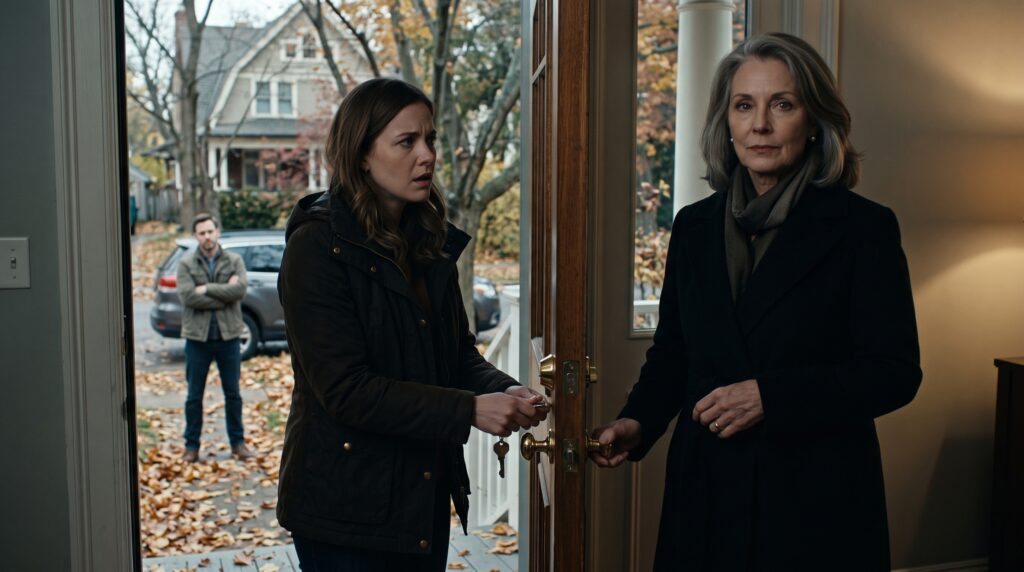
“Gerald,” I said when he picked up. “I need my locks changed today.”
He was quiet for a second.
“All of them?”
“Just the front and the back.”
“I’ll be there by noon.”
He was.
He brought new deadbolts, solid ones.
When he finished, he put two sets of keys on my kitchen table.
“One for me,” he said. “One spare.”
I decided then who the spare would not go to.
Lydia had a key to my house. She’d had one since Rey died.
She used it whenever she came over, which was not as often as I had once hoped, but was still often enough that I had never thought to question it.
She walked in the way adult children do when they’ve grown up in a house, like the door is more of a formality than a boundary.
That evening, I made dinner for one and ate it at the table with the television off.
I was not particularly sad. I was something more like clear.
The kind of clear you feel after a long illness finally breaks and you can breathe through both nostrils again.
Lydia didn’t call that night. Not by eight, not by nine.
At 10:20, my phone finally rang.
I watched her name light up the screen. I let it ring.
She called again five minutes later. Then once more.
Then a voicemail appeared.
I played it.
“Mom, it’s me. I’ve been trying to reach you. Something happened with the account, and I need to talk to you. Please call me back.”
I put the phone down and went to bed.
Two mornings later, a car pulled into my driveway.
I was in the kitchen when I heard it. I looked out the window.
Lydia and Garrett.
She was already walking fast toward the door. He stayed near the car with his arms crossed.
I watched her reach the front door. I watched her take her key out.
I watched her put it in the lock.
Then I watched her face when it didn’t turn.
She tried again, then again.
Then she knocked.
I walked to the door and opened it.
“Mom.”
Her voice had that flat, controlled quality people use when they are trying not to sound panicked.
“What is going on?”
“Good morning, Lydia.”
“The account. What did you do?”
“I took my money back.”
Her jaw tightened.
“That was our emergency fund.”
I used a careful voice.
“No. It was money I deposited into a joint account for your emergencies.”
“That’s the same thing.”
“I don’t think it is.”
Garrett came up behind her.
“Ruth, we had a trip.”
He said it like this was information I did not possess.
“I know. I saw the photographs.”
Lydia’s expression shifted. Something moved through it that might have been embarrassment if it had lasted longer.
“The caption, too.”
“Yes.”
She looked away.
“Mom, that was for Sandra. She’s been having a hard year.”
I waited.
“We wanted to do something nice for her.”
Scene 4: Uncovering the truth
“On my birthday.”
“It wasn’t about your birthday.”
“I know,” I said. “That was rather the point.”
The silence that followed was the kind where everyone knows what has been said, and nobody wants to be the first to admit what it means.
Lydia looked at the key in her hand. She looked at the lock.
“You changed the locks, too.”
“Yes.”
She pressed her lips together.
“You’re really doing this.”
I looked at her steadily.
“I already did it.”
Garrett spoke in that particular tone men use when they have decided to be reasonable.
“Ruth, you can’t just take that money. It was sitting there for both of you.”
“It was sitting there because I put it there,” I said. “All of it. Every dollar.”
He didn’t have an answer for that.
Lydia looked at me for a long time.
Then she said, “I need that money, Mom.”
“I know you think you do.”
She left without saying goodbye. Garrett followed.
I closed the door and stood in my hallway with my hands at my sides.
They were trembling, but not from fear.
They trembled the way they do after you have been holding something very heavy for a very long time and you have finally set it down.
About a week later, Frank called.
My son is careful and quiet and does not involve himself unless he is certain something needs to be said.
“Mom,” he started. “I found out something.”
He had been comparing notes the way siblings sometimes do without the other sibling knowing.
He had discovered that for the past 14 months, Garrett had been telling Frank that Frank was helping cover their car payment.
Garrett had mentioned it to mutual acquaintances, framing it as something Frank had quietly arranged.
But Frank hadn’t arranged anything. He hadn’t paid a single payment.
The payments had been coming from the joint account, from money I had put in, from the emergency fund.
I sat down.
“I’m sorry, Mom,” Frank said. “I didn’t know until I started looking.”
“Don’t apologize.”
“You gave them almost three years of money.”
“I know how long I gave it.”
He was quiet.
“Then you’re doing okay?”
“I’m doing better than I was last week.”
He let out a breath.
“That’s good.”
Lydia came back 10 days after that.
She came without Garrett this time.
She knocked.
Scene 5: Confrontation and boundaries
I noticed that she knocked.
I opened the door.
She said she needed help. The house was behind.
She gave me a number that was large enough to make my stomach tighten.
“If I could just put the money back, they could fix it,” she said.
The old version of me would have already been reaching for the phone.
“Bring me the paperwork.”
She blinked.
“What?”
“If the house is in immediate foreclosure, there will be a notice. Bring it to me tomorrow.”
“Mom, I don’t just have it lying around.”
