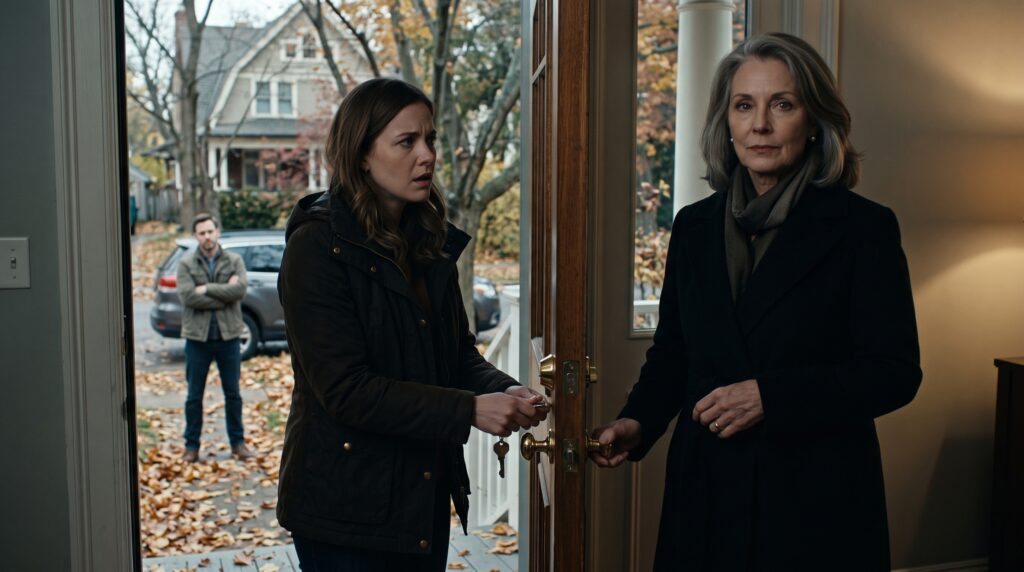
Lydia picked up additional hours at work. Garrett took on weekend work he had been avoiding.
Their lifestyle adjusted, not collapsed. Adjusted.
They were living the life that matched what they actually earned.
I didn’t feel good about their struggle, but I also didn’t feel responsible for ending it by giving them money to struggle in nicer circumstances.
Frank stopped by one Saturday to help me with the gutters.
We had coffee afterward.
“You seem different,” he said.
“I feel different.”
“Good different?”
“I think so.”
I looked at him.
“I think I had confused being needed with being valued.”
He nodded slowly.
“That’s a big thing to figure out.”
“It took me 63 years,” I said.
“Better late than not at all.”
He laughed.
That was the most I had laughed in months.
On a Sunday in late November, someone knocked on my front door.
It was late afternoon. I wasn’t expecting anyone.
I went to the window first.
Lydia.
She was standing on the porch with both hands around a paper bag.
She wasn’t trying the door. She wasn’t looking at the lock.
She was just standing there, waiting.
I opened the door.
She held up the bag.
“I made soup,” she said. “The chicken one.”
I looked at her.
She looked tired, not the sharp, defensive tired from our confrontation two months ago.
Something deeper than that.
The tired that comes after someone has stopped fighting something and started sitting with it.
“Can I come in?” she asked.
I stepped back.
We sat at the kitchen table.
She ladled soup into bowls, and we ate without speaking for a while.
The kitchen was warm.
Outside, it had started to rain.
Finally, she said, “I have been thinking a lot about the caption.”
I set my spoon down.
“I didn’t write it to hurt you.”
She looked at her bowl.
“But when I think about it now, on your birthday, I can see what it looked like. What it was.”
She looked up.
“I’m sorry, Mom.”
I waited.
“I’m not just saying that.”
She folded her hands on the table.
“I thought about why I wrote it. And the honest answer is, I wasn’t thinking about you at all.”
She said it quietly, without defensiveness.
“I was so focused on Garrett, on the trip, on Sandra being happy, that you weren’t in my head on your birthday.”
She shook her head.
“That is not something a good daughter does.”
The room was very quiet.
She continued.
“I also thought about the money, about what I knew. If I’m honest with myself about where it was going…”
She paused.
“I knew some of it was covering things we shouldn’t have been covering. I didn’t want to look at that, so I didn’t.”
I looked at my daughter.
She was 31 years old.
She looked in that moment like a person who had recently had to face something unflattering in the mirror and had decided not to look away.
“I love you,” I said.
“I know,” she said. “I love you, too. I’m sorry I made it so hard for you to feel that.”
Scene 8: Building new trust
“Things have to be different.”
She nodded.
“I know.”
“I won’t be the account you draw from when you’ve run out of your own money.”
“I know.”
“And if you need help, real help, you ask me. You don’t arrange it from a distance and hope I don’t notice.”
She looked at the table.
“I understand.”
I took a breath.
“When I help you in the future, it will be because I’ve chosen to, not because you’ve made it impossible for me to say no.”
She nodded.
“Okay.”
We finished the soup.
She washed the bowls without being asked.
Then she stood in the doorway of the room I had redone and looked at it for a long moment.
“This is new,” she said.
“Yes.”
“It’s beautiful.”
She turned to look at me.
“Is that your sewing machine?”
“Yes.”
She smiled a little.
“Dad always said you were going to make yourself a proper sewing room one day.”
I felt something tighten in my chest.
“He did say that.”
She looked around again.
“I’m glad you finally did.”
I didn’t say anything.
I didn’t trust myself to.
She hugged me before she left.
Not the quick, distracted hug of someone already thinking about the parking lot.
A real one.
Both arms, long enough that I could feel her breathe.
At the door, she stopped.
She had her hand on the frame.
She turned back to look at me.
“Mom,” she said. “I’ll call on your birthday this year. Actually call, not just a text.”
“I know you will,” I said. “And I’ll answer.”
She smiled.
Then she walked down the steps to her car.
I stood in the doorway and watched her go.
I didn’t feel triumphant. I didn’t feel vindicated.
I felt something quieter than either of those things.
Something like relief.
And underneath the relief, something like hope.
Not the desperate hope of someone waiting to be chosen.
A steadier kind.
The kind that comes from knowing yourself well enough to know what you will and will not accept.
Trust doesn’t come back all at once. I knew that.
It comes back in small increments.
A phone call kept. A promise honored. A boundary respected.
You don’t measure it in dramatic moments.
You measure it in the ordinary ones.
Whether she calls. Whether she knocks. Whether she asks instead of assumes.
Lydia knocks now.
That is not a small thing.
That knock tells me that she understands this is my home, my space, my life.
That she can come into it, but she cannot take it for granted.
That she has to wait for me to open the door.
The $47,000 is still in my savings account.
I have not touched it since I transferred it back.
