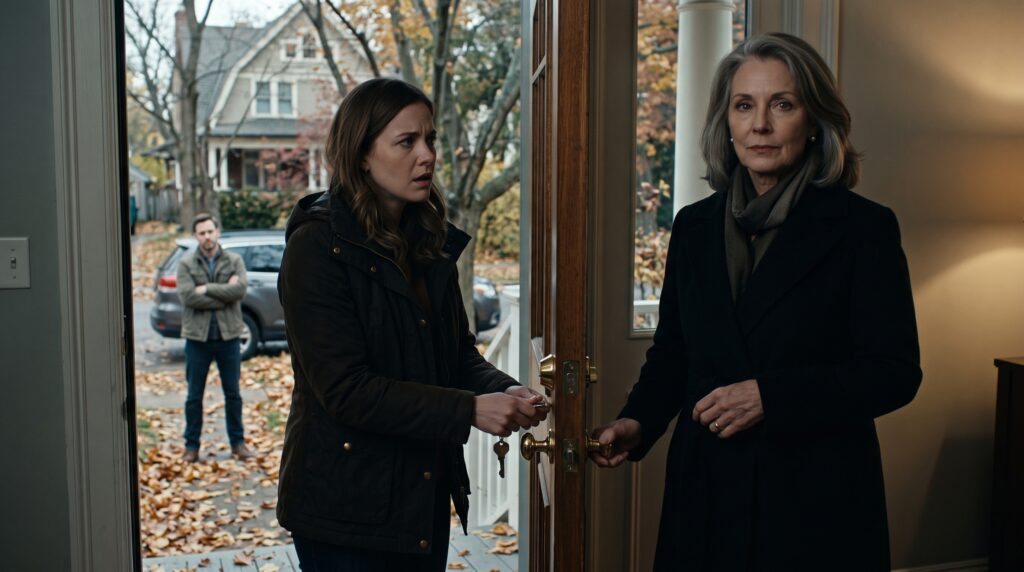
“Then find it and bring it.”
Her face hardened.
“You don’t believe me.”
“I believe that you believe you need help,” I said gently. “But I’ve learned that what I can verify and what I’ve been told are sometimes two different things.”
She stood in the doorway for a moment.
Then she said, in a voice I hadn’t heard from her since she was a teenager, “You’ve changed.”
“Yes,” I said. “I have.”
She never brought the paperwork.
A few days after that, Sandra came to my door.
I had met her maybe a dozen times over the years, always at holidays, always cordial in the way that people are cordial when they are not quite sure they like each other but are committed to behaving as though they might.
She was direct. I’ll give her that.
“Ruth,” she said, “what you’re doing to Lydia and Garrett is not fair.”
I held the door.
“What am I doing?”
“You’re punishing them for going on a trip.”
“I’m not punishing them.”
“You took the money.”
“I took my money.”
She crossed her arms.
“That money was their security.”
“It was my security that I offered to share with them,” I said. “I didn’t share it with them so they could take you to wine country.”
She had the grace to look uncomfortable.
“Lydia loves me.”
“I don’t doubt that.”
“Then why are you making her choose?”
“I’m not making her choose anything.”
I looked at Sandra steadily.
“I’m simply no longer choosing to disappear so that everyone else stays comfortable.”
She shook her head.
“You’re going to damage your relationship with your own daughter over money.”
“It wasn’t the money,” I said.
She frowned.
“Then what?”
I thought for a moment.
Then I said, “It was the caption.”
Sandra blinked.
“The one she wrote about the woman who had always shown them what real strength looks like.”
I paused.
“I have been her mother for 31 years. I raised her. I buried her father. I sat in the hospital with her. I funded three years of what I thought were their hard times.”
She smiled at her phone and wrote that caption about someone else on my birthday.
“And I’m not asking her to undo it. I’m just asking her to understand what it told me.”
Sandra was quiet for a long time.
When she spoke again, her voice was different.
“Lydia didn’t mean it that way.”
“Maybe not, but intentions don’t erase impact.”
She left without resolution.
I stood in the doorway and watched her car disappear down the street.
Scene 6: Reclaiming personal space
That afternoon, I went into the room that had been serving as a second guest room for years.
Lydia’s old things were in it: boxes of clothes she hadn’t taken, yearbooks, a lamp she had said she’d pick up eventually.
I had kept the room in a kind of suspended state, ready for her, waiting for her, as though she might one day need it.
I cleared it out, not cruelly.
I packed her things into labeled boxes and stacked them neatly in the garage, where she could collect them whenever she wanted.
Then I cleaned the room down to the baseboards.
I painted the walls a soft sage green.
I moved in my sewing machine, my two crates of fabric, my reading chair from the guest room, and a small bookshelf.
I hung curtains I had been saving for years, a creamy linen I had bought at an estate sale and never found a use for.
When I finished, I stood in the doorway and looked at it.
For 30 years, I had organized this house around the idea that other people might need pieces of it.
I had left rooms available. I had left the joint account available. I had left myself available.
All of it constantly available for needs that turned out not to be what I thought they were.
This room was mine. Just mine.
That was the first time in years I had made a space in my own home that didn’t have someone else in mind.
A week later, I drove to a small inn I had read about in the mountains of western North Carolina.
I hadn’t told anyone where I was going. I packed a bag, filled the car, and left on a Wednesday morning without announcing it.
The inn sat at the edge of a national forest. The room had a window overlooking a creek.
In the morning, mist came up off the water and hung between the trees like something from a painting.
I sat outside with my coffee each morning, and I asked myself questions I had been too busy or too afraid to ask before.
What do you want, Ruth?
I didn’t know.
That frightened me more than anything else that had happened.
What do you need?
Peace.
Real peace.
Not the temporary quiet between emergencies.
I needed to stop being the person other people called when they had run out of options. I needed to stop measuring my worth by how much I gave.
I also needed to stop believing that if I was generous enough, people would love me the way I deserved to be loved.
Generosity and love are not a transaction.
I had spent years treating them like they were.
On the third morning, I sat by that creek and understood something clearly.
I had not been a bad mother. I had been an erasing one.
I had erased myself so thoroughly, so consistently, that even I had stopped noticing I was gone.
I went home with something I hadn’t had in years.
Not happiness exactly.
More like solidity.
Like my feet were back on ground I trusted.
Scene 7: A shift in family dynamics
Things shifted for Lydia and Garrett in the weeks that followed.
The car, an expensive SUV that Garrett had insisted on, was gone by November. Too costly to maintain without the supplemental income.
