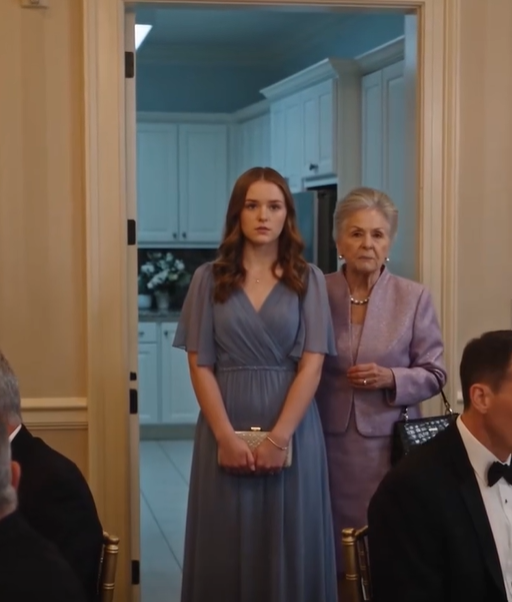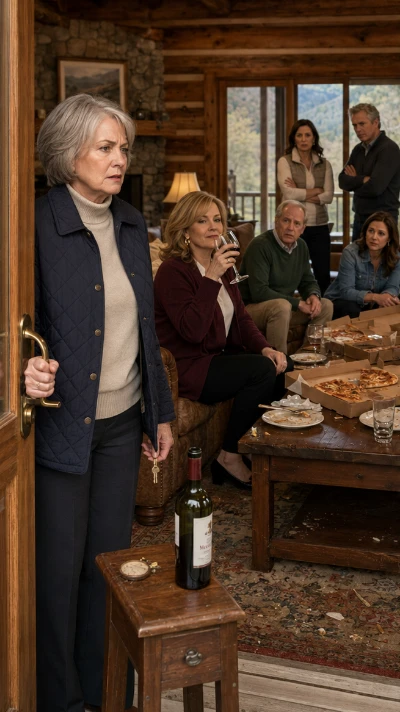
The moment Margaret Hale pushed open the door to her mountain cabin, she knew someone had crossed a line they could never uncross.
Music drifted through the living room.
Glasses clinked.
Laughter rolled toward her from inside the house she had spent years protecting, cleaning, and preserving as part of her retirement plan.
For one disorienting second, the sixty-nine-year-old widow wondered whether she had somehow unlocked the wrong cabin.
Then she saw them.
Her daughter-in-law Emily’s parents, Karen and Paul Dawson, were sprawled comfortably across Margaret’s furniture as if they had paid for every board, every window, and every quiet mountain view. Three relatives sat with them, laughing over open pizza boxes spread across the walnut coffee table Margaret and her late husband, Daniel, had chosen decades earlier.
A bottle of Margaret’s best Merlot stood open on the side table.
The kitchen sink overflowed with dirty dishes.
Crumbs covered the rug she had cleaned before locking the cabin for the season.
A suitcase lay open near the staircase.
And nobody looked ashamed.
Karen Dawson merely raised her wineglass and stared at Margaret as though Margaret were the one who had arrived without permission.
“Margaret,” she said, blinking slowly. “What are you doing here?”
Margaret tightened her grip on the spare key in her hand.
She had driven to the Smoky Mountains that morning with a notebook, a list of repairs, and a clear purpose. A realtor was supposed to meet her at the cabin so they could prepare it for a long-term tenant. The rental income would become an important part of her retirement, helping her cover future medical expenses without depending on anyone—not even her son.
She had worked too hard and planned too carefully to become a burden in old age.
Yet now strangers were drinking from her private collection and eating in her living room as though the house were already theirs.
Karen finally stood, though not to apologize. She walked toward Margaret with the calm confidence of someone who believed she had done nothing wrong.
“Emily told us we could use it,” she said. “Besides, this place is going to belong to her and Mark someday anyway.”
The room seemed to go silent, even though the music was still playing.
That sentence struck harder than an insult.
It was not the first time Emily had behaved as though Margaret’s belongings were available whenever she wanted them. Over the years, Emily had borrowed jewelry without asking, volunteered Margaret to host holidays, and treated every act of generosity as proof that greater generosity was owed.
But this was different.
This time, Emily had distributed access to Margaret’s property.
This time, her family had entered the cabin, opened the cabinets, used the furniture, consumed the food, and spoken openly about inheritance while Margaret was still alive.
Margaret looked around the room again.
Paul avoided her eyes. One relative slowly lowered a slice of pizza. Another reached for the speaker and reduced the volume.
Still, Karen appeared more inconvenienced than embarrassed.
Margaret did not feel the hot, explosive anger she might once have expected.
What settled inside her was colder.
Disappointment.
Her son Mark knew exactly what the cabin meant to her. He knew she planned to rent it. He knew she had calculated taxes, insurance, maintenance, and every other expense that could shape her future.
But Mark had always hated conflict.
Whenever Emily wanted something, he found a way to stay silent. He let Margaret’s kindness become Emily’s privilege because correcting his wife would have been uncomfortable.
That was how people like this took from you.
Not all at once.
First, they tested what you would tolerate.
Then they acted surprised when you objected.
Finally, they called your boundaries selfish.
Karen followed Margaret into the kitchen, still holding the glass of wine she had poured from Margaret’s bottle.
“Don’t get upset,” she said, lowering her voice as though she were calming an unreasonable child. “We’re only enjoying it a little early. Emily said the house is basically going to be hers and Mark’s eventually.”
Margaret stared at the wine in Karen’s hand, then at the dirty dishes piled inside her sink.
In that instant, everything became painfully clear.
These people were not confused guests.
They had not made an innocent mistake.
They were practicing ownership.
And they believed Margaret was too old, too quiet, and too devoted to her son to stop them.
Karen smiled and took another sip.
Margaret slowly placed her notebook on the counter.
Then she reached into her purse for her phone.
“What are you doing?” Karen asked.
“Calling the sheriff.”
The smile disappeared.
“Oh, for heaven’s sake.”
Margaret entered the number she had saved for the county’s non-emergency line.
Karen lowered her voice. “You’re going to call the police on family?”
“You are not my family.”