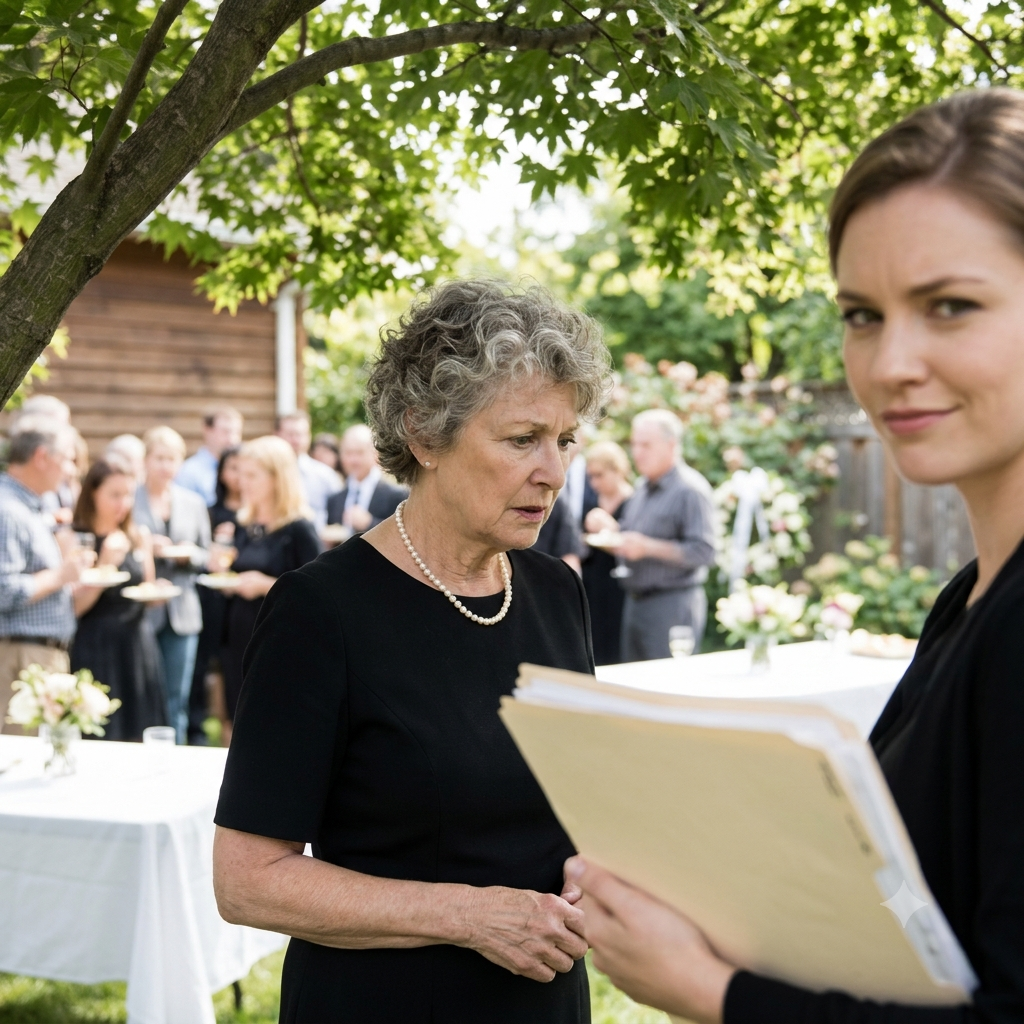
“You told me Daniel left me nothing.”
“I said sit down.”
“You told me the cabin was supposed to be mine.”
“It should have been!”
Emily’s face twisted with horror.
“You made me marry into this family.”
“I gave you an opportunity.”
“You made me believe they had taken everything from me!”
“And what would you have done without me?” Karen shouted. “Wait for that coward to claim you? Beg his widow for scraps?”
The courtroom became utterly silent.
Celia spoke into that silence.
“The person who robbed Emily Dawson was not Margaret Hale.”
She pointed to the witness stand.
“It was her own mother.”
Karen’s face collapsed.
Not with guilt.
With rage.
She turned toward Margaret.
“You had the life that should have been mine.”
Margaret stood slowly.
“No, Karen. You wanted the life you imagined I had. You never saw the miscarriages, the lies, the hospital rooms, or the years Daniel spent hiding what he had done. You wanted the house, the cabin, and the name.”
She looked at Emily.
“And you trained your daughter to mistake property for justice.”
The judge called for order.
Then Mark walked to the witness stand.
He testified that Margaret managed her finances independently, maintained her home, drove safely, scheduled medical appointments, and had never displayed confusion.
He admitted giving Emily the cabin key.
“I believed my wife when she told me my mother had agreed,” he said. “I should have called. I should have read the documents I signed. I should have challenged behavior I knew was wrong.”
Karen’s attorney asked, “Your wife claims you knew about the rental business.”
“I knew she had a rental-consulting company. I did not know she was renting my mother’s cabin.”
“Isn’t it true you stand to inherit if your mother remains in control?”
Mark looked at Margaret.
“No.”
The attorney frowned.
“How can you know that?”
“Because she told me this morning that I am no longer a beneficiary of the cabin.”
Margaret had said no such thing that morning.
But as Mark spoke, she realized he was giving her permission.
Permission to choose her own future without measuring it against his expectations.
The judge dismissed the conservatorship petition.
Then she referred the trust records, forged deed, false affidavits, and suspected financial crimes to the district attorney.
Two investigators waiting near the courtroom doors approached Karen.
Emily stepped away from her mother.
Karen looked at Paul.
“Do something.”
Paul stood.
For the first time in Margaret’s memory, he did not obey his wife.
“I already did,” he said.
He handed an investigator a flash drive.
“I copied the account records six months ago.”
Karen stared at him.
Paul’s voice shook.
“I knew the restaurant money came from somewhere. I didn’t know it was Emily’s trust until I found Daniel’s name. When I asked Karen, she threatened to tell Emily that I helped steal it.”
“You did help,” Emily whispered.
Paul looked at his daughter.
“Yes.”
Emily sank onto the bench.
The investigators escorted Karen from the courtroom.
As she passed Margaret, she leaned close.
“You think you won?”
Margaret met her eyes.
“No. None of us won. That is what people like you never understand.”
Karen was charged with trust embezzlement, fraud, conspiracy, perjury, and exploitation of an older adult.
Emily was charged separately for the forged deed, unauthorized rental income, identity theft, and fraudulent loan application.
Paul received reduced charges in exchange for cooperation and restitution.
The criminal cases continued for months.
Mark filed for divorce.
Emily did not contest it.
Before signing the final papers, she wrote him a letter.
She admitted that she had approached him because of Daniel. She also claimed that somewhere between the calculated meeting and their third date, she had begun to love him.
I kept thinking I could separate the lie that introduced us from the life we built afterward, she wrote. But every time I chose silence, I chose the lie again.
Mark did not answer.
Margaret understood why.
A love that becomes real does not erase the deception that created it.
Yet hatred did not come easily to him.
That, Margaret believed, was both his weakness and his finest quality.
He began therapy.
He moved into a small apartment near his office and visited Margaret every Sunday.
At first, their conversations were awkward. They spoke about weather, groceries, and repairs.
Then one afternoon, Mark brought the copied cabin key.
He placed it on the kitchen table.
“I should have returned this months ago.”
Margaret looked at it.
“It no longer works.”
“I know.”
He stared at his hands.
“I used to think being a good husband meant preventing Emily from being upset.”
“And being a good son?”
“I assumed you would forgive anything.”
Margaret’s throat tightened.
“Because I always had.”
“Yes.”