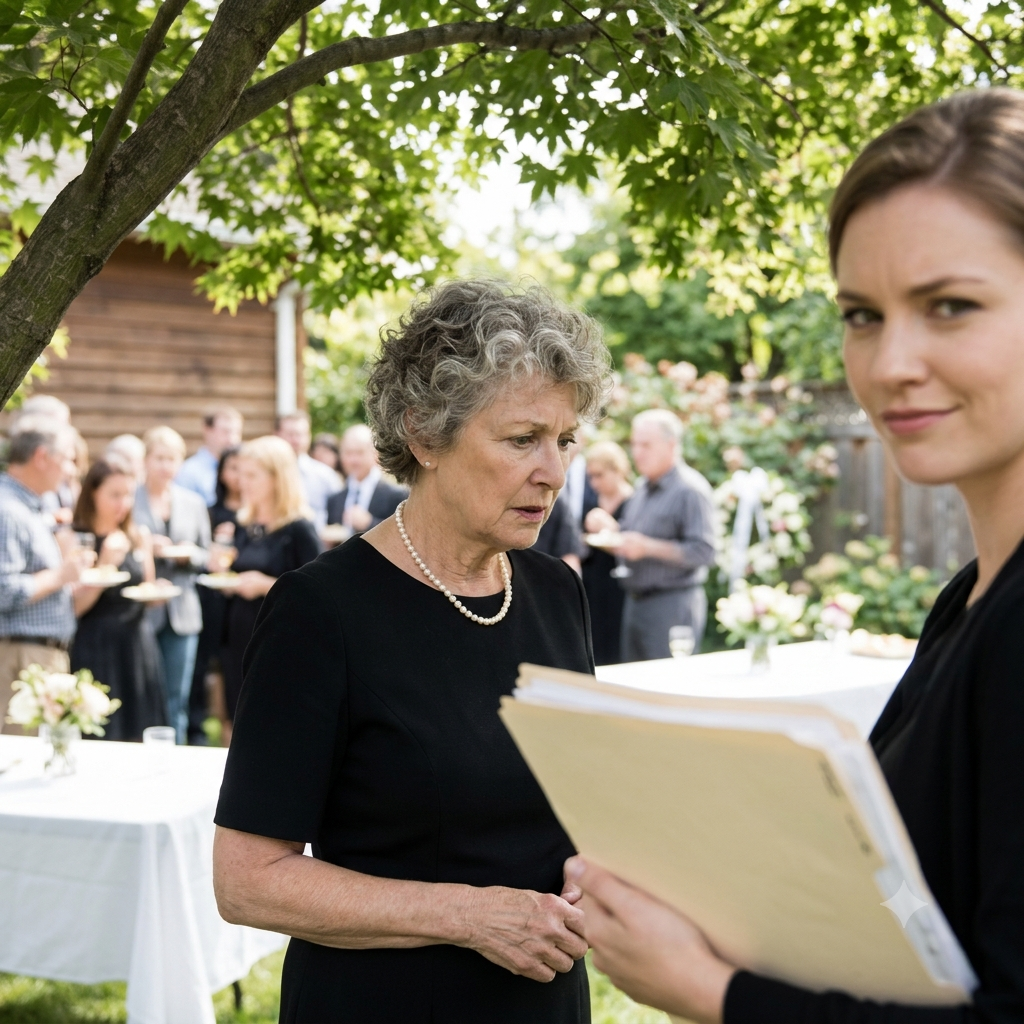
The words came out without anger, but they changed the temperature of the room.
Paul rose from the sofa.
“Margaret, let’s not make this bigger than it is.”
She looked at him. “Did you know I had given no one permission to be here?”
Paul opened his mouth, then glanced at his wife.
That glance answered the question.
Margaret spoke into the phone when the dispatcher responded.
“My name is Margaret Hale. I own a cabin on Briar Ridge Road. Several people have entered without my permission and are refusing to leave.”
“We are not refusing,” Karen snapped.
Margaret met her eyes.
“Then leave.”
Karen set the wineglass on the counter with enough force to spill a red crescent across the wood.
“You will regret embarrassing Emily.”
Margaret stared at the stain spreading into the grain Daniel had once sanded by hand.
“No,” she said quietly. “Emily is going to regret embarrassing me.”
Deputy Caleb Moss arrived twelve minutes later.
By then, Karen had called Emily twice and Mark once. She paced the living room, speaking loudly enough for Margaret to hear.
“She’s confused,” Karen said into the phone. “I think something is wrong with her. She came in screaming and threatening everyone.”
Margaret had not screamed once.
She stood near the fireplace with her arms folded, observing the room the way she had once examined financial records during her years as an office manager: without emotion, without assumption, and without overlooking details.
There were six place settings.
Two suitcases.
Groceries packed into her refrigerator.
Someone had opened the linen closet and removed the blankets.
They had not stopped for lunch.
They had come to stay.
Deputy Moss entered wearing a brown uniform and a wary expression.
Karen rushed toward him.
“Thank goodness. This woman is having some kind of episode.”
The deputy looked past her. “Which woman owns the property?”
“I do,” Margaret said.
She handed him her driver’s license, the county tax statement she had brought for the realtor, and the cabin insurance card.
Karen lifted her chin. “Our daughter is married to her son. We were invited.”
“By the owner?”
“By the future owner.”
Deputy Moss stared at her.
Margaret almost admired the silence he allowed to follow.
Finally, he said, “Ma’am, future ownership is not ownership.”
Karen flushed.
“She’s nearly seventy. Her son will inherit.”
“Not today, he won’t.”
The deputy turned to Margaret. “Do you want them removed?”
“Yes.”
“Do you want to pursue trespassing charges?”
The relatives froze.
Margaret looked around the room. She saw embarrassment on two faces, fear on another, and stubborn defiance on Karen’s.
Paul looked exhausted.
“Not if they leave immediately,” Margaret said. “But I want their names documented, and I want a report.”
Karen laughed bitterly. “A report? Against your own son’s family?”
Margaret stepped closer to her.
“You entered my home without permission. You drank my wine. You slept in my rooms. You spoke about taking possession of my property while I was alive. You did not misunderstand a boundary, Karen. You decided I was no longer entitled to have one.”
For the first time, Karen looked uncertain.
Only for a moment.
Then the uncertainty hardened into resentment.
Everyone began collecting their belongings.
One of the relatives apologized. Another carried the pizza boxes to the trash. Paul quietly washed the wineglass his wife had used, dried it, and returned it to the cabinet.
Karen left hers on the counter.
At the door, she turned to Margaret.
“Emily will never forgive you.”
Margaret stood beside Deputy Moss.
“That may be the first useful thing she has ever done for me.”
Karen walked out.
The tires of two vehicles scattered gravel as the unwanted guests drove away.
The silence left behind felt enormous.
Margaret closed the door, but she did not feel relief.
She smelled pizza grease, wine, and a sweet floral perfume that did not belong in the cabin.
Her private sanctuary had become unfamiliar.
Deputy Moss took photographs of the rooms while Margaret began documenting damaged and missing items. Two crystal glasses were chipped. A bedroom lamp was broken. Three unopened bottles of wine were gone.
Then Margaret entered the small office at the back of the cabin.
The top drawer of Daniel’s desk stood open.
Her breath stopped.
The drawer was usually locked.
Inside, she kept property records, insurance documents, and old receipts. Nothing valuable to an ordinary thief, but everything useful to someone interested in ownership.
The blue deed folder was missing.
“Deputy,” she called.
He entered and examined the lock. There were fresh scratches around it.
“Was anything else in here?”
“Documents. The original purchase papers. Survey maps. Tax records.”
“Who knew about them?”
“My son.”
“And his wife?”
Margaret looked at the empty drawer.
“I never told her.”
A car door slammed outside.