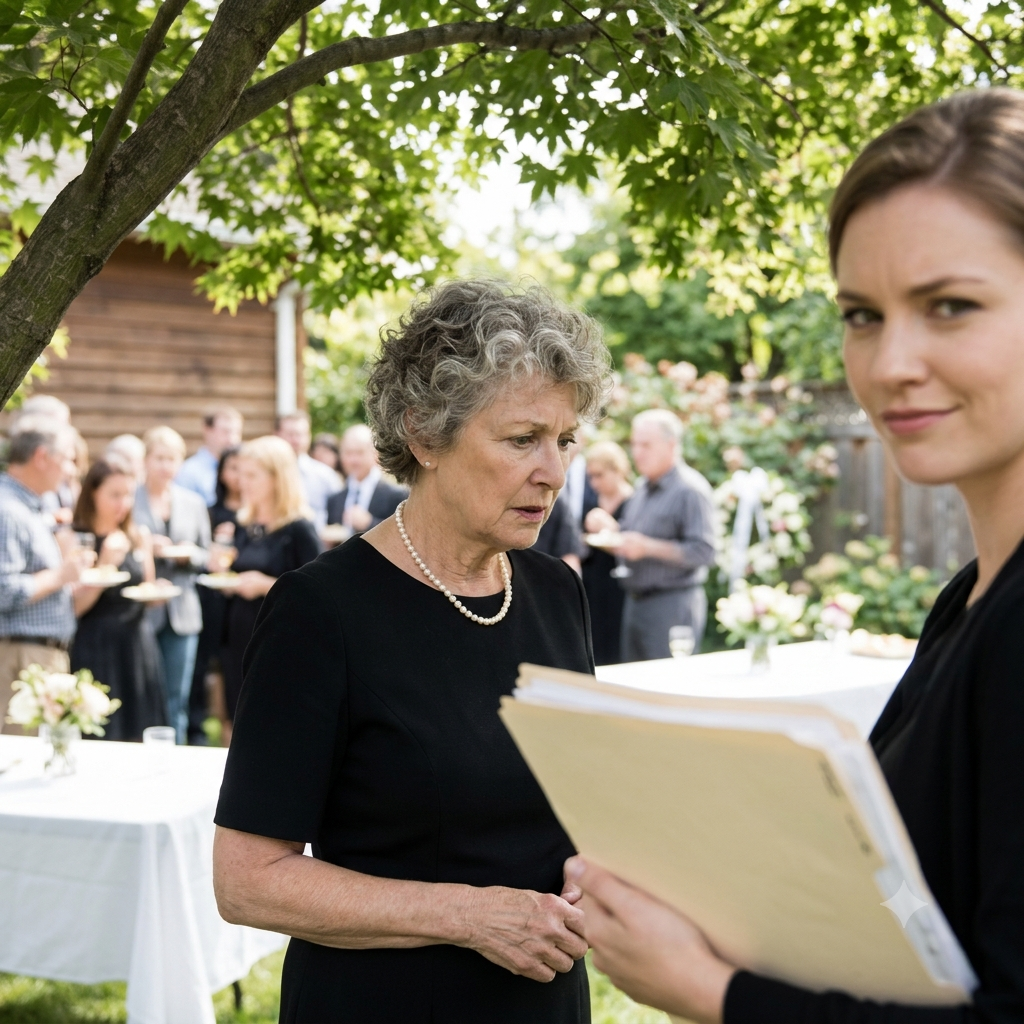
Margaret looked directly at Mark.
“Did you give your wife a key to the cabin?”
He hesitated.
Behind him, Emily whispered, “Mark.”
Margaret felt something break inside her.
Not loudly.
Not completely.
But enough.
“You gave her the key.”
“She told me you had agreed to let her use it for a weekend.”
“And you did not call me?”
“She said she had already talked to you.”
“You believed that?”
“I didn’t think—”
“No,” Margaret said. “You didn’t.”
Mark flinched.
Emily stepped forward. “He is your son. Stop talking to him like he’s a criminal.”
Margaret opened her handbag and removed the printed rental advertisement.
She held it out.
Mark took the paper.
His face changed as he read.
Emily said nothing.
Mark looked at her.
“What is this?”
“A misunderstanding.”
“There are six reviews.”
“I was testing the market.”
“With my property,” Margaret said.
Emily’s face tightened. “The cabin sits empty most of the year. It was a waste.”
“The money was deposited into an account controlled by Emily,” Margaret continued. “The sheriff is investigating.”
Karen swore.
Mark stared at his wife.
“You told me your consulting work was paying for the renovations.”
“I was going to tell you.”
“When?”
Emily’s eyes moved between them.
“When everyone could discuss it rationally.”
Margaret laughed once, softly.
It was the first sound she had made all day that frightened Emily.
“Where is the deed folder?”
Emily frowned. “What folder?”
“The folder you removed from Daniel’s desk.”
“I didn’t remove anything.”
Karen spoke from behind Mark. “Perhaps you misplaced it.”
Margaret turned toward her.
“You knew where the office was.”
“I used the restroom.”
“The office does not contain a restroom.”
Paul’s vehicle appeared at the end of the street.
He parked behind Karen’s car but did not get out.
Margaret noticed the way Karen glanced at him.
Fear passed across her face.
Tiny, quick, undeniable.
Then it vanished.
“Mom,” Mark said, “I’ll fix this.”
Margaret looked at him and saw the little boy who had once cried when a bird struck their kitchen window. The teenager who had called her from college because he had failed an exam. The young man who stood beside Daniel’s hospital bed and promised to look after her.
She loved him.
That was what made the truth unbearable.
“You cannot fix what you continue to defend.”
“I’m not defending it.”
“You gave Emily a key to my property without speaking to me.”
“I made a mistake.”
“You have been making the same mistake for twelve years, Mark. You call it keeping the peace. But the only peace you preserve is Emily’s. Everyone else pays for it.”
His face reddened.
Margaret continued before her love could weaken her resolve.
“I have changed the locks. The cabin will be placed under legal protection. Neither of you will receive access again.”
Emily’s composure cracked.
“You cannot cut Mark out of his own inheritance because of a weekend.”
Margaret stepped closer.
“Listen carefully. An inheritance is a gift from the dead, not a debt owed by the living. You own nothing of mine.”
Karen grabbed Emily’s arm.
“We’re leaving.”
Emily resisted. “No. She needs to understand—”
“She understands enough.”
Karen pulled her toward the car.
Before Emily got inside, she turned to Mark.
“Are you coming?”
He looked at Margaret.
Then at his wife.
The hesitation lasted only a second.
But Margaret would remember it for the rest of her life.
Mark walked toward Emily.
Margaret entered her house alone.
The next morning, Margaret sat in the office of Celia Hart, the attorney who had handled Daniel’s estate.
Celia was seventy-two, silver-haired, and sharp enough to make dishonest people uncomfortable before she spoke. She had known Margaret for thirty-five years.
She listened without interrupting as Margaret described the cabin, the rental advertisement, and the missing documents.
When Margaret finished, Celia removed her glasses.
“Did Daniel ever tell you about a woman named Karen Dawson?”
Margaret stared at her.
“What?”
Celia did not repeat the question.
Margaret leaned back.
“Karen was not part of our life before Emily married Mark.”
“Are you certain?”
“Yes.”
Celia studied her face for several seconds.
Then she turned to her computer.
“I ran a preliminary property search after your call last night.”
She rotated the screen.
A scanned document appeared.
At the top were the words QUITCLAIM DEED.
Margaret’s name was typed beneath the title.
The document claimed that she had transferred ownership of the cabin to a company called Hale Ridge Holdings, LLC.
The signature at the bottom resembled hers.
But it was not hers.
The filing had been rejected three days earlier because the notary’s registration number did not match state records.
Margaret’s hands went cold.
“Who owns the company?”
“Emily.”
Celia opened another record.
“Mark is listed as co-manager.”
Margaret closed her eyes.