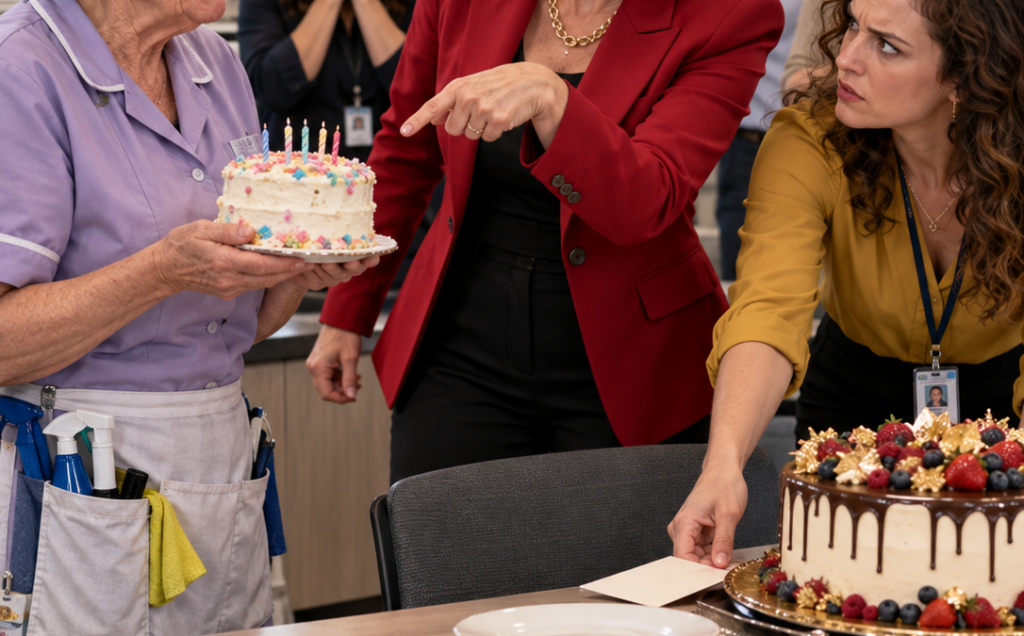
I found her in the supply closet at the end of the hallway.
She was sitting on an overturned bucket, holding a paper towel against her eyes.
The cake rested on a shelf beside several containers of cleaning solution.
“Oh, Hannah,” she said quickly. “I’m sorry. I’ll be out of here in a minute.”
“Mrs. Bell.”
She tried to smile.
“I suppose I shouldn’t have brought it. People have different tastes nowadays.”
I crouched beside her.
“Your cake was delicious.”
She looked down.
“It was Walter’s favorite.”
My throat tightened.
“I made it for his birthday every year we were married. Forty-one times.” Her voice trembled. “I haven’t baked it since he died. I thought maybe it would be nice to make it again for people I care about.”
She touched the plastic cake cover.
“I guess I got carried away.”
“No,” I said firmly. “You didn’t.”
She looked surprised.
“You did something kind. Monica did something cruel. Those are two different things.”
Mrs. Bell shook her head.
“Oh, sweetheart. Don’t cause yourself trouble over an old woman.”
But I couldn’t forget the sight of her sitting there.
And I couldn’t forgive myself for being silent.
That evening, I opened the folder on my laptop.
Forty-three entries.
I added a forty-fourth.
I documented exactly what Monica had said, who had witnessed it, and how Mrs. Bell had responded.
Then I called Priya.
“I think it’s time we did something.”
She was quiet for a moment.
“Do you really mean that?”
“Yes.”
“Then count me in.”
The following morning, I made a decision that would lead me somewhere I never expected.
Before work, I stopped at Duarte & Daughters, an elegant bakery on Main Street.
Everybody in town knew it.
Their wedding cakes appeared in local magazines, their pastries sold out before noon, and people drove from neighboring counties to purchase their signature desserts.
Monica adored the place.
She frequently brought cakes from Duarte & Daughters to management meetings, carefully reminding everyone how expensive they were.
I originally intended to purchase one for my seven-year work anniversary, which fell the following week, and use the occasion to make a point about how differently Monica treated people depending on where their food came from.
I hadn’t worked out the details.
Then I met Rosa Duarte.
Rosa owned the bakery.
She was a woman in her late forties with dark hair tied beneath a scarf and flour dusted across her apron.
“What can I get you?” she asked.
“I need a special cake.”
“For what occasion?”
I hesitated.
Then, for reasons I still can’t explain, I told her what had happened.
I described Mrs. Bell’s birthday.
The pink cardigan.
The beautiful homemade cake.
And the cruel words that sent her away in tears.
Rosa listened without interrupting.
When I finished, her expression had changed.
“What did you say the woman’s name was?”
“Eleanor Bell.”
Rosa gripped the edge of the counter.
“Eleanor Bell?”
“Yes. Do you know her?”
She didn’t answer immediately.
Instead, she asked me to describe the cake.
I told her about the two layers, the white frosting, and the pink roses.
When I mentioned the delicate lemon flavor, Rosa closed her eyes.
“Oh, my goodness,” she whispered.
She walked toward the back wall and removed an old framed photograph.
In it stood a younger Eleanor beside a tall man wearing a baker’s apron.
Above them was a wooden sign.
Bell’s Bakery — Established 1971.
I stared at the picture.
“That’s Mrs. Bell.”
Rosa nodded.
“And that’s Walter, her husband.”
She explained that Bell’s Bakery had once been one of the most beloved businesses in town.
For more than thirty years, Walter and Eleanor baked wedding cakes, birthday cakes, pies, breads, and pastries.
Rosa herself had worked there as a teenager.
“My father left when I was fifteen,” she told me. “I was getting into trouble, skipping school. Eleanor gave me a job washing dishes.”
She smiled through gathering tears.
“Then she taught me how to bake.”
Eleanor had taught her everything from preparing buttercream to decorating elaborate wedding cakes.
When Rosa graduated from high school, Walter and Eleanor attended the ceremony.
Years later, when she opened her own bakery, she built much of her business around the skills Eleanor had given her.
“But when Walter became ill, they sold the bakery to pay their debts,” Rosa explained. “Eventually I lost touch with her. I thought she’d moved away.”
“She’s been cleaning our office for eight years,” I said.
Rosa stared at me.
“Eight years?”
I nodded.
She turned toward the large chalkboard menu behind the counter.
At the top was the bakery’s most famous offering.
The Walter — Signature Vanilla Butter Cake — $95.
“That cake,” Rosa said quietly, “is Eleanor’s recipe.”
I looked from the chalkboard to the photograph.
“You’re telling me Mrs. Bell invented your signature cake?”
“She created it for Walter’s birthday when they were first married. She taught me to make it exactly the same way.”
Rosa paused.
“People have offered me thousands for that recipe. I’ve never sold it.”
Then she told me something that made me grip the counter.
“There’s a woman who orders one every year for her birthday. Very particular. Blonde hair. Always wants extra decoration.”
My heart began racing.
“Monica Strand?”
Rosa’s eyebrows rose.
“You know her?”
“She’s my boss.”
“Well, she once told me The Walter was the best cake she’d ever tasted.”
For several seconds, neither of us spoke.
The irony was almost unbelievable.
Monica had humiliated the woman who created the dessert she considered the height of sophistication.
All because one cake had come from an ordinary kitchen instead of an expensive bakery box.
I looked at Rosa.
“I think there’s something we should do.”
She folded her arms.
“I’m listening.”
That Friday, Rosa went to see Eleanor.
She later told me that when Mrs. Bell opened her apartment door, she stared at Rosa for several seconds before recognizing her.
Then both women began crying.
