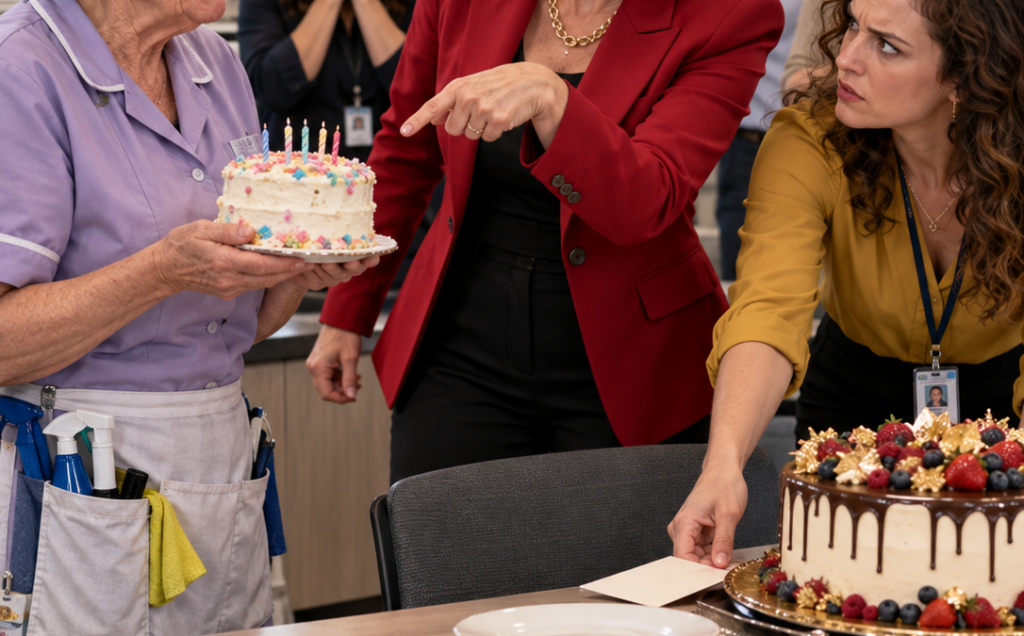
And Monica, desperate to avoid embarrassment, pretended she didn’t know her.
Her mother overheard.
She quietly left the cake and walked away.
“She never brought another one,” Monica whispered.
Her voice broke.
“She died years later. I never apologized.”
Mrs. Bell reached across the table and placed a hand over hers.
“I’m sorry about your mother.”
Monica shook her head.
“When I saw you standing there with that homemade cake, I remembered everything. I hated how embarrassed I’d been. And instead of remembering how much my mother loved me, I treated you the same way those children treated her.”
She began crying harder.
I felt my anger soften into something more complicated.
I could understand how shame had followed Monica into adulthood.
But understanding wasn’t the same as excusing her behavior.
She had spent years hurting people who depended on their jobs.
And those people deserved accountability.
That morning, Gloria Pace arrived from corporate.
She spent the day interviewing employees and reviewing the evidence.
By late afternoon, Monica had been placed on administrative leave pending a formal investigation.
Several weeks later, she resigned.
There was no dramatic confrontation at the end.
No screaming.
No security guards escorting her out.
Just a quiet departure after the investigation confirmed a pattern of inappropriate behavior.
And strangely enough, I didn’t feel victorious.
I felt relieved.
I also felt sad.
Because I couldn’t stop thinking about the eleven-year-old girl who had been ashamed of her mother, and the grown woman who had never learned how to forgive herself.
But the biggest changes happened after Monica left.
Priya no longer worried about how she sounded on the telephone.
Brittany transferred to another department, where she began rebuilding her confidence.
Marcus received a personal apology from company leadership.
And Mrs. Bell finally received the recognition she’d deserved for years.
After learning about her long service, Gloria helped arrange a direct employment opportunity with better pay, health benefits, and reduced hours.
For the first time in more than a decade, Eleanor didn’t have to worry about choosing between groceries and medication.
But Rosa had an even bigger surprise.
She invited Eleanor to teach a baking class every Saturday.
The first class sold out in three days.
The second sold out even faster.
Soon people were driving from neighboring towns to learn how to make traditional butter cakes, homemade pies, and the delicate pink frosting roses Eleanor had perfected decades earlier.
Rosa named the program Eleanor’s Kitchen.
And on the bakery’s menu, beneath The Walter, she added a line.
Original recipe created by Eleanor Bell in 1971.
I visited one Saturday afternoon and watched Eleanor teaching a group of twelve students.
She wore a white apron embroidered with her name.
Her hair was pinned neatly.
Her cheeks were pink.
And she looked happier than I’d ever seen her.
“Remember,” she told the class, “good baking takes patience. You can’t rush butter into becoming something wonderful.”
Everyone laughed.
I stood near the doorway, smiling.
Mrs. Bell spotted me and waved.
“Hannah, sweetheart! Come taste this frosting.”
I walked over.
She handed me a spoon.
It tasted like vanilla, butter, and childhood memories.
“Perfect,” I said.
She smiled.
“Oh, nonsense. It needs another pinch of salt.”
That became our little tradition.
Every Saturday I could, I’d stop by the bakery after her class.
We would drink coffee by the front window, and she would tell me stories about Walter.
Sometimes we laughed.
Sometimes she cried.
But she no longer spoke as though the best part of her life had ended when her husband died.
She was building something new.
Four months after Monica resigned, I arrived at the bakery earlier than usual.
The shop was quiet.
I walked toward the kitchen, expecting to find Eleanor cleaning up after her class.
Instead, I heard a familiar voice.
“Are you sure I’m doing this right?”
I stopped.
Monica stood at the counter wearing jeans and an old T-shirt.
Her hair was pulled into a simple ponytail.
There wasn’t a trace of her usual expensive makeup.
She was holding a wooden spoon, stirring a bowl of cake batter.
Mrs. Bell stood beside her.
“Keep going, dear. Another minute.”
“My arm is killing me.”
“That’s how you know you’re working.”
Monica laughed.
It was the first genuine laugh I’d ever heard from her.
I stepped back before they noticed me.
Later, over coffee, I asked Eleanor what was happening.
She stirred her tea.
“Monica called me about a month ago.”
I raised my eyebrows.
“She called you?”
“Yes.”
“What did she want?”
Mrs. Bell looked toward the kitchen.
“She said she’d been speaking to a counselor and trying to understand why she’d treated people so badly. She didn’t ask me to excuse what happened. She just wanted to learn how to make her mother’s birthday cake.”
I thought about that.
“And you agreed?”
Eleanor smiled gently.
“Why wouldn’t I?”
“Because she humiliated you.”
“Yes, she did.”
“Because she was cruel.”
“Yes, she was.”
Mrs. Bell set down her cup.
“Hannah, forgiving someone doesn’t mean pretending they never hurt you. And helping someone become better doesn’t mean they escape the consequences of what they’ve done.”
I sat quietly.
“Monica has lost a great deal because of her choices,” Eleanor continued. “I can’t change that. But I can teach her how to bake a cake.”
I smiled.
“You’re something else, Mrs. Bell.”
She laughed.
“Oh, honey. I’m just an old baker who happened to spend a few years cleaning offices.”
The following March, Eleanor turned seventy-four.
This time, we planned the celebration ourselves.
At three o’clock, every employee gathered in the break room.
Rosa arrived from the bakery.
Marcus stopped by during his delivery route.
Even Gloria joined us by video call.
In the center of the table sat a homemade cake.
Two layers.
White frosting.
Pink roses.
And the same two words written across the top.
Thank You.
Mrs. Bell stared at it.
Then she looked at me.
“Who made this?”
I smiled.
