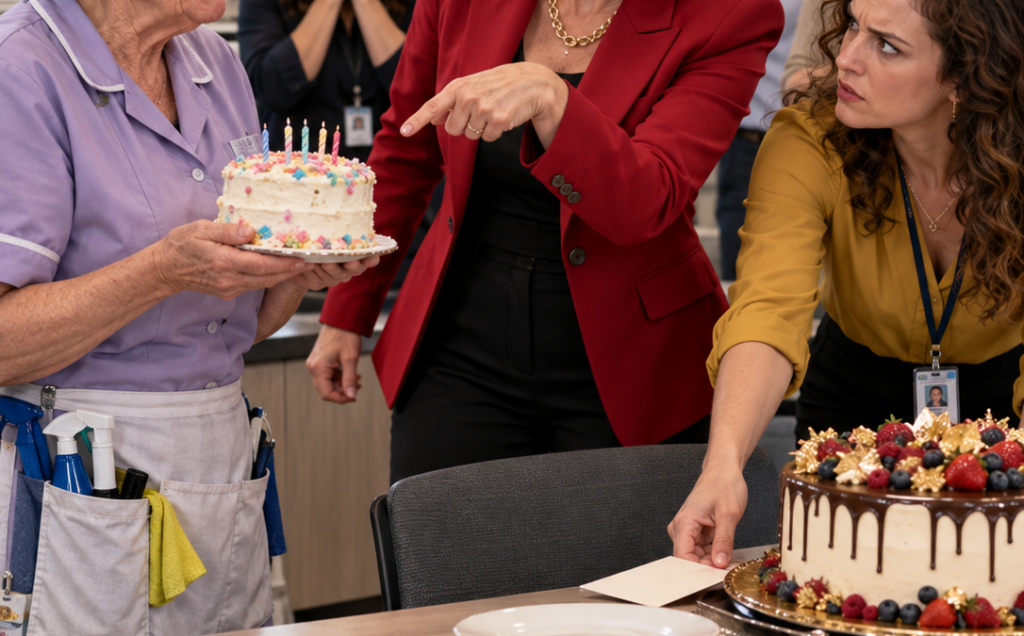
They spent the afternoon talking about Walter, the old bakery, and the years they’d missed.
Rosa showed Eleanor photographs of Duarte & Daughters.
When she explained that The Walter had become her most popular cake, Mrs. Bell could hardly believe it.
“I thought everyone had forgotten us,” she whispered.
Rosa took her hand.
“Some of us never did.”
That evening, after the bakery closed, Eleanor returned to a professional kitchen for the first time in years.
She tied on an apron.
Measured the ingredients.
Creamed the butter.
And baked the same cake she’d made for Walter throughout their marriage.
Rosa helped decorate it with pink roses.
Then they placed it inside one of Duarte & Daughters’ beautiful striped boxes.
Meanwhile, I was busy with something else.
Priya, Dev, and Karen from accounting came to my apartment.
I showed them the documentation I’d collected.
Forty-four incidents.
Four years of humiliations, inappropriate remarks, and mistreatment.
Then I showed them our company’s employee conduct policy.
It clearly required respectful treatment of workers, contractors, visitors, and vendors.
I told them I intended to file a formal complaint with corporate human resources.
“I won’t blame anyone who doesn’t want to sign,” I said. “I know what’s at stake.”
Karen looked at the documents.
“If Monica finds out, she could make our lives miserable.”
Priya gave a tired laugh.
“She already does.”
Dev picked up a pen.
“Where do I sign?”
By Sunday evening, seventeen employees had agreed to provide statements or support the complaint.
Even Brittany contacted me.
She was crying when I answered.
“I didn’t mean what I said about the cake,” she whispered.
I remained quiet.
“I didn’t even taste it. I just laughed because Monica laughed.”
“That doesn’t make it right, Brittany.”
“I know.”
Her voice broke.
“Mrs. Bell helped me when I first started. I was overwhelmed, and she brought me tea. I was so grateful. Then I stood there and insulted her.”
Brittany admitted she’d endured months of Monica’s criticism herself.
She also had work emails containing unprofessional comments about employees.
She agreed to submit copies through the proper company channels.
By Monday morning, we had assembled a detailed complaint.
I sent it directly to the regional vice president, Gloria Pace, and the corporate human resources department.
Then I went to work.
At nine-fifteen, I placed the striped bakery box on the break room table.
Several employees gathered around.
Monica appeared a few minutes later.
She noticed the gold bakery label immediately.
“Duarte & Daughters?” she said brightly. “Well, Hannah, you certainly have good taste.”
“It’s my seventh anniversary with the company,” I explained. “I thought we could celebrate.”
“How thoughtful.”
I opened the box.
Inside sat the beautiful white cake with its delicate pink roses.
Monica smiled.
“Oh! You’ve bought The Walter.”
“Yes.”
“Excellent choice. That’s the finest cake in town.”
I cut the first slice and placed it on a white plate.
“For you, Monica.”
She accepted it graciously.
Then she took a bite.
Her eyes closed.
“Absolutely perfect.”
Around us, the room went quiet.
I waited until she took another bite.
“Monica, there’s something under your plate.”
She lifted it.
Beneath was a folded card from Rosa.
On one side was the old photograph of Walter and Eleanor standing outside Bell’s Bakery.
On the other was a short explanation of the cake’s history.
Monica read it.
Her smile disappeared.
She looked at me.
Then at the photograph.
Then at her half-eaten cake.
“What’s this?”
“That’s Eleanor Bell,” I said. “The woman whose birthday cake you insulted on Thursday.”
Monica frowned.
“What does she have to do with this?”
“She created the recipe you’re eating.”
Monica stared at me.
“That’s impossible.”
“Rosa Duarte learned to bake from Eleanor. This cake came from Rosa’s bakery, but Mrs. Bell made it herself.”
I paused.
“It’s the same cake you called embarrassing. The only difference is the box.”
Monica looked down again.
Nobody spoke.
Then I placed another document beside her plate.
It was the cover page of our formal complaint, listing the incidents under review and the employees who had provided statements.
“I also wanted you to know,” I said, “that we’ve reported the way people have been treated in this office.”
Monica read the page.
Her face went pale.
“You’ve gone behind my back?”
“We followed company policy.”
She looked around the room.
Seventeen names.
Seventeen people who had finally decided to speak.
Her eyes settled on Brittany.
“You too?”
Brittany stood near the doorway, trembling.
But she nodded.
“Yes.”
Monica pushed back her chair.
“You have no idea what you’ve done.”
Before I could answer, a familiar voice came from the hallway.
“Perhaps we should let everyone finish their cake.”
Mrs. Bell stood beside Rosa.
She wore the same pink cardigan she’d worn on Thursday.
Monica stared at her.
For a moment, I thought she might become angry again.
Instead, Mrs. Bell walked slowly toward the table.
She looked at Monica’s plate.
“Did you enjoy it, dear?”
Monica swallowed.
“Yes.”
“I’m glad.”
Mrs. Bell smiled sadly.
“It’s Walter’s favorite. I always hoped other people might enjoy it too.”
Monica’s eyes filled.
Then she whispered, “I’m sorry.”
Nobody moved.
Mrs. Bell pulled out a chair.
“May I ask you something, Monica?”
Monica nodded.
“Why did you say those things to me?”
There was no anger in Eleanor’s voice.
Only genuine sadness.
“I worked very hard on that cake. I thought everyone would like it.”
Monica covered her face.
For several seconds, she said nothing.
Then something none of us expected happened.
She began crying.
“My mother used to clean offices,” she whispered.
We stood motionless.
Monica told us about growing up in a struggling family in Indiana.
Her mother worked nights cleaning buildings and baked homemade birthday cakes every year.
When Monica was eleven, her mother arrived at school carrying a cake she’d made.
She was still wearing her cleaning uniform.
Several classmates laughed.
One girl asked whether Monica’s mother had come to scrub the floors.
