Then she sank onto the kitchen floor.
For the first time in my life, I watched Vivien Cooper cry without trying to hide it.
Not graceful tears.
She sobbed.
Shoulders shaking.
Hands over her face.
I stood in the doorway.
Terrified.
Then Ethan appeared.
He had his yellow cup.
The one Grandma always placed beside his breakfast.
He walked slowly into the kitchen.
Did not speak.
Did not touch her.
He simply placed the cup on the floor beside her knee.
Then returned to the living room.
Grandma looked at it.
Her crying gradually softened.
At ten years old, I somehow understood.
The cup mattered to Ethan.
It meant familiarity.
Safety.
Something that belonged in the correct place.
And he had given it to her.
His version of:
I see you.
You matter.
You can have something safe too.
That was the night my anger moved.
Away from Ethan.
Toward our mother.
Rachel had abandoned a child I was only beginning to understand.
And he, without saying a single word, had understood Grandma’s pain better than I had.
After that, our house found its rhythm.
Breakfast at the same time.
Yellow cup on the right.
School at 7:45.
Maple Street.
Left on Grove.
Past the bakery.
Bed at nine.
No exceptions unless absolutely necessary.
What looked restrictive from outside gave Ethan enough predictability to learn everything else.
By six, he arranged toys into patterns.
Not merely colors.
Gradients.
Red into orange.
Orange into yellow.
Tiny changes most children ignored.
At seven, he filled notebooks with marks.
At eight, the marks became words.
Egg.
Toast.
Home.
Then short statements.
Grandma drove same road.
Daniel quiet.
Teacher said good job.
By nine, he was logging entire days.
Times.
Meals.
Routes.
Statements.
Events.
Not feelings.
Facts.
I teased him once.
“Why do you write everything down?”
He thought about it.
“Because then I know what happened.”
Simple answer.
Years later, I understood its importance.
Ethan grew up in a family where one person had vanished and left everybody else trying to explain why.
Recording reality made the world feel stable.
If something happened at 7:15, he wrote 7:15.
If Grandma called Mom and got no answer, he recorded that too.
Truth became another kind of routine.
At eight, he asked:
“Why did Mom leave?”
He had not spoken a sentence that long in weeks.
Grandma stopped cooking.
“She said she couldn’t handle things anymore.”
No comforting lie.
No:
She loved you too much.
No:
She had no choice.
“She said she couldn’t handle it.”
Ethan nodded.
Opened his notebook.
Wrote something.
Then kept eating.
I was almost offended.
“Doesn’t that make you mad?”
He did not answer.
Grandma touched my shoulder.
“Let him process it his way.”
That phrase became another rule in our house.
His way.
Not the school’s.
Not mine.
Not what strangers found normal.
His.
That mattered most when the school decided Ethan was inconvenient.
At nine, the principal wanted him transferred into a more restrictive classroom.
She spoke carefully.
“He doesn’t participate normally.”
“He avoids eye contact.”
“He covers his ears during music.”
Then:
“It makes the teacher uncomfortable.”
Grandma’s expression hardened.
“You don’t move a child because he makes an adult uncomfortable.”
The meeting lasted more than two hours.
She arrived home carrying a stack of reports.
Therapy records.
Medical evaluations.
School notes.
Meeting summaries.
She built a binder.
Tabs.
Dates.
Categories.
I thought she was being obsessive.
Then Ethan, ten years old by then, stood beside her.
“Sort by date first.”
Grandma looked up.
“What?”
“Then type.”
He pointed.
“School separate from therapy.”
She handed him several pages.
“Show me.”
He did.
Within twenty minutes, her chaotic stack had become a system.
That was the moment I began understanding my brother’s mind differently.
He was not failing to fit other people’s structures.
He was exceptionally good at building structures that made sense.
Grandma was teaching him how to survive systems that underestimated him.
Ethan was learning how to prove what those systems had actually done.
Neither of them knew how important that would become.
Part 3: Ethan built his software because he hated watching people change the truth after the fact.
At twelve, Ethan discovered an old laptop in Grandma’s closet.
Heavy silver thing.
Battery barely worked.
Fan sounded like a vacuum cleaner.
He became obsessed.
Not with games.
Code.
One afternoon I walked behind him.
Black screen.
Lines of symbols.
“What is that?”
“Python.”
“Why?”
He stared at the laptop.
Then said:
“I don’t like when people lie and deny it later.”
I stopped.
“I want a way to show what changed.”
At first, he built tiny tools.
A program that logged oven temperature after Grandma burned another batch of cookies.
A basic database for her binders.
Search by date.
Search by category.
Then he became interested in contradictions.
Could a system compare statements?
Could it find dates that did not line up?
Could it tell when a digital document was created later than somebody claimed?
By thirteen, our scanner ran every afternoon.
Therapy notes.
School letters.
Medical receipts.
Phone bills.
Old correspondence.
Even grocery receipts.
Once I caught him scanning a wrinkled receipt for eggs and bread.
“Why?”
“Pattern.”
“What pattern?”
“All of it.”
He created folders.
MEDICAL.
EDUCATION.
THERAPY.
EXPENSES.
CALLS TO MOM — NO ANSWER.
That folder hurt.
Dates.
Times.
Voicemails.
Years.
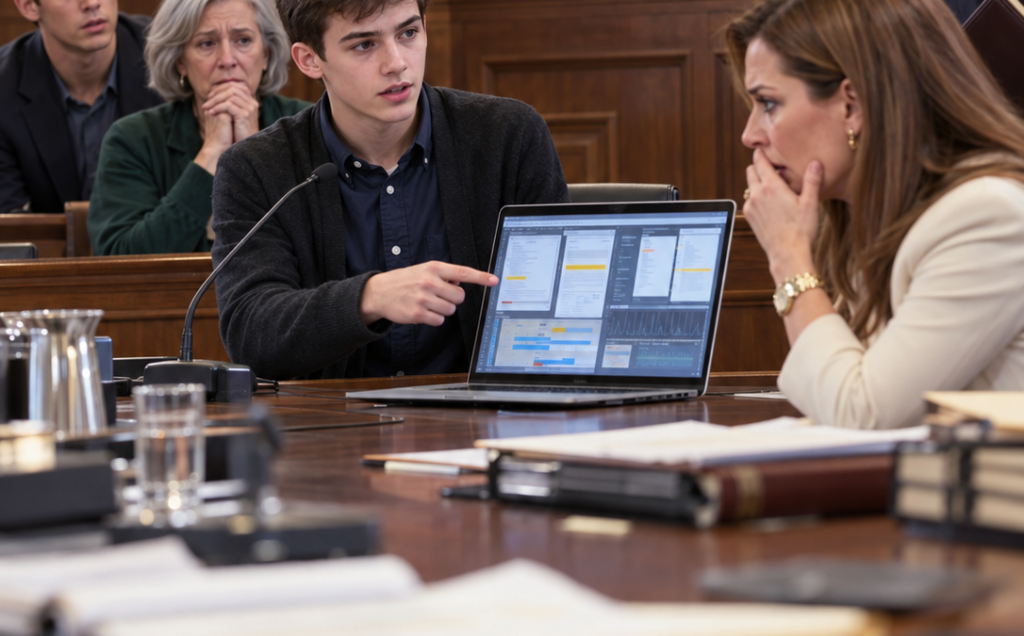
At fourteen, he began developing the software that would change everything.
Document integrity.
Metadata analysis.
Version histories.
Modification timestamps.
Signature-comparison assistance.
Not magic.
Not a machine that could announce guilt.
A tool capable of flagging inconsistencies for human investigators.
He demonstrated it using an old letter.
Changed one word.
Ran the program.
A warning appeared.
MODIFIED — INTEGRITY CHECK FAILED.
Then file history.
Creation date.
Modification date.
Signature-comparison score.
I laughed.
“With this thing, liars are finished.”
Ethan did not laugh.
“Yes.”
That answer stayed with me.
He was not interested in humiliating anyone.
He wanted a stable record.
Something that could not be emotionally pressured.
