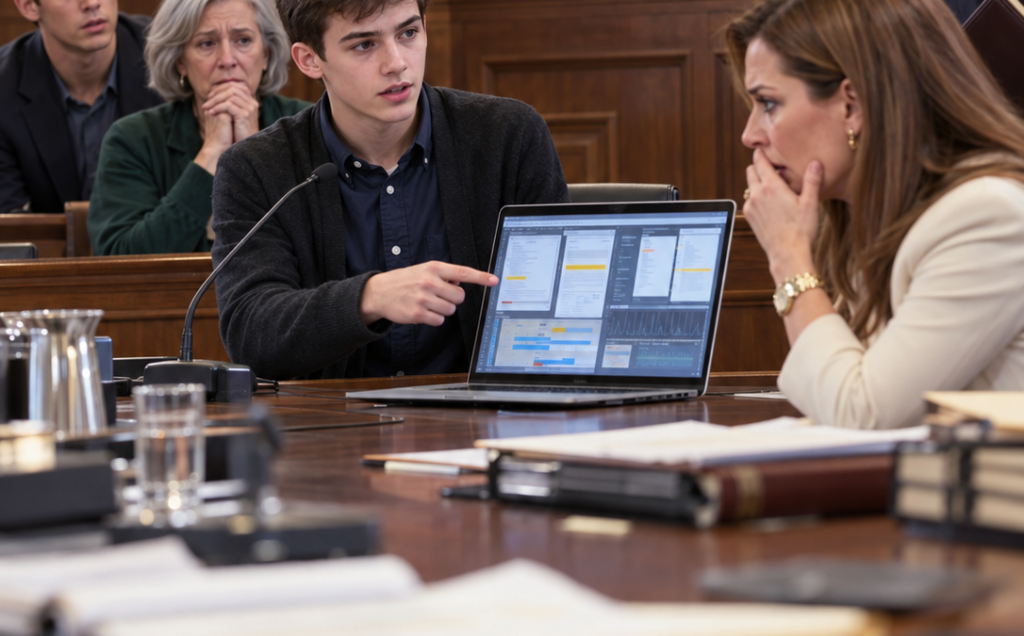
Ethan did not hire people because he felt sorry for them.
He hated pity.
He hired them because they were good.
Then designed the workplace so they could actually work.
Predictable schedules.
Written expectations.
Quiet rooms.
No mandatory small talk.
Lighting options.
Clear meeting agendas.
Remote participation.
The first office was Grandma’s living room.
Laptops everywhere.
Soft typing.
Occasional humming.
Nobody caring.
I visited one afternoon and stood in the doorway.
The child whose teachers once said he could not function in group activities was now paying salaries to a team he had designed around clarity rather than performance.
“You built your own school.”
He looked at me.
“No.”
Pause.
“Better chairs.”
Fair.
Grandma brought snacks.
Always labeled.
Nobody touched Ethan’s yellow cup.
Yes.
He still had it.
Old.
Scratched.
Faded.
He did not use it every day anymore.
It sat on a shelf beside the first notebook he ever filled with logs.
One afternoon I asked:
“Why keep it?”
He shrugged.
“Grandma gave it to me.”
Enough.
Part 7: I saw our mother again and realized consequences are not the same thing as transformation.
Months after court, I learned Rachel had begun serving part of her community-service requirement at a center supporting autistic children.
At first, the irony made me angry.
Of all places.
Then curiosity got the better of me.
I went once.
Did not announce myself.
Did not speak to her.
She sat at a small table with a boy who appeared non-speaking.
He tapped his fingers repeatedly.
Years earlier, Rachel might have told Ethan to stop.
That afternoon, she waited.
Turned one page in a picture book only after the boy looked toward it again.
No rush.
No frustration.
I watched from the hallway.
For one second, I saw the woman who left Ethan on a porch.
Then I saw somebody older.
Smaller.
Maybe learning.
Maybe simply performing what she had been taught during training.
I honestly did not know.
And that uncertainty mattered.
I used to think forgiveness required a verdict.
Good person.
Bad person.
Forgiven.
Not forgiven.
Life did not work that cleanly.
Rachel could have failed catastrophically as a mother and still change some behavior later.
Change would not erase abandonment.
Understanding autistic children now would not restore Ethan’s missing birthdays.
I did not need to decide her entire moral future.
I left before she saw me.
That evening, we ate dinner at Grandma’s.
Eggs.
Toast.
Warm milk.
Not because Ethan still required that exact meal every night.
Because sometimes routine becomes tradition after survival is over.
Halfway through dinner, Ethan looked at Grandma.
“Grandma.”
She looked up.
“You didn’t leave me.”
Her hand stopped beside her plate.
He continued.
“I know that now.”
Grandma’s eyes filled.
She did not make a speech.
Neither did he.
Her hand rested near his.
After a few seconds, Ethan placed two fingers over hers.
That was enough.
Their version of:
I love you.
I still had complicated feelings about Rachel.
Part of me remained the ten-year-old boy who watched his mother walk away.
I was not even the child she left on the porch, yet abandonment rearranged my life too.
Grandma’s attention changed.
Our routines changed.
I had to grow up beside a crisis I did not understand.
For years, I quietly resented Ethan for needing so much.
It took maturity to understand that a five-year-old did not create the situation.
An adult did.
That became important as Ethan’s company grew.
People wanted inspirational stories.
The abandoned autistic genius.
The child nobody believed in.
He hated that framing.
Once, a journalist asked:
“Do you think autism gave you your gift?”
Ethan looked irritated.
“It gave me autism.”
I nearly laughed aloud.
Then:
“I learned coding because I liked systems.”
That answer should probably be printed in every article ever written about him.
His achievements did not turn autism into a superpower.
His struggles did not make autism tragedy.
He was Ethan.
Specific.
Complicated.
Capable.
Sometimes overwhelmed.
Sometimes brilliant.
Sometimes stubborn enough to make Grandma walk into another room and count to ten.
Human.
That was all he had needed people to recognize from the beginning.
Part 8: Grandma stayed, and Ethan built a life where staying no longer required anyone to become someone else.
Years later, when I think about the beginning, I do not first remember the courtroom.
Or the $3.2 million.
Or even Rachel standing at the door with a lawyer.
I remember the backpack.
Blue.
Small.
Dropped beside Grandma’s front door.
I remember Ethan covering his ears.
I remember thinking he was difficult.
I remember Grandma saying:
“You’re safe here.”
She had no idea whether she could actually make that promise true.
She made it anyway.
Then proved it every day.
She learned.
That was the thing people misunderstand when they talk about devotion.
Grandma did not magically know how to raise an autistic child.
She learned.
She listened to doctors.
Then learned when doctors underestimated him.
She fought school administrators.
Changed breakfast plates.
Checked traffic routes.
Stopped demanding hugs.
Built binders.
Asked questions twice.
Admitted mistakes.
Stayed.
Rachel shared Ethan’s blood.
Vivien shared his life.
The court eventually recognized that difference because documentation made it visible.
But Ethan knew long before a judge did.
That Christmas Eve when Grandma collapsed onto the kitchen floor, five-year-old Ethan did not know the language for grief.
He knew his yellow cup represented safety.
So he gave it to her.
That was family.
Not biology.
Reciprocity.
Presence.
Knowing what matters to another person and showing up with it.
As adults, Ethan and I talked once about whether he hated Rachel.
He answered immediately.
“No.”
That surprised me.
“Why not?”
“Hate takes a lot of time.”
I laughed.
“Is that your reason?”
“Yes.”
Then he added:
“She left.”
Simple.
No philosophical speech.
She left.
Grandma stayed.
Those were the two facts around which everything else organized itself.
His company eventually moved out of Grandma’s living room.
Real office.
Still quiet.
Still structured.
The yellow cup came with him.
