That mattered.
Rachel testified first.
She spoke beautifully.
That was almost the worst part.
“I never abandoned my son.”
She explained that she had been overwhelmed.
Young.
Financially unstable.
Grandma offered a safer environment.
She supported Ethan remotely.
Sent money.
Called.
Tried to visit.
But Vivien allegedly made communication difficult.
I watched Grandma’s hands curl together.
Rachel continued.
“I always intended to return when I could provide the life Ethan deserved.”
Then:
“When I learned about his success, I realized he now needed his mother more than ever.”
Her attorney submitted documents.
Receipts.
Letters.
Statements.
If I had not lived inside the missing years myself, I might have believed her.
Then Linda began.
She did not start dramatically.
She began with Grandma’s records.
Medical appointments.
Therapy.
School meetings.
Costs.
Phone logs.
Eleven years.
Not one dramatic piece.
Thousands of ordinary pieces.
The judge listened.
Then said something that frightened me.
“These establish Mrs. Cooper’s significant caregiving role.”
Pause.
“They do not, standing alone, resolve every legal question concerning parental authority.”
Rachel’s attorney relaxed slightly.
Grandma looked smaller.
Then Linda asked to present authenticity evidence.
The forensic specialist explained the signatures.
Certain questioned documents showed characteristics inconsistent with older known examples.
Digital files contained creation and modification metadata incompatible with the dates printed on them.
Bank records contained no matching deposits for supposed support payments.
Telephone records showed repeated outgoing calls from Grandma to Rachel.
Almost no corresponding contact.
Then the judge looked toward Ethan.
“Would you like to speak?”
Ethan stood.
Slowly.
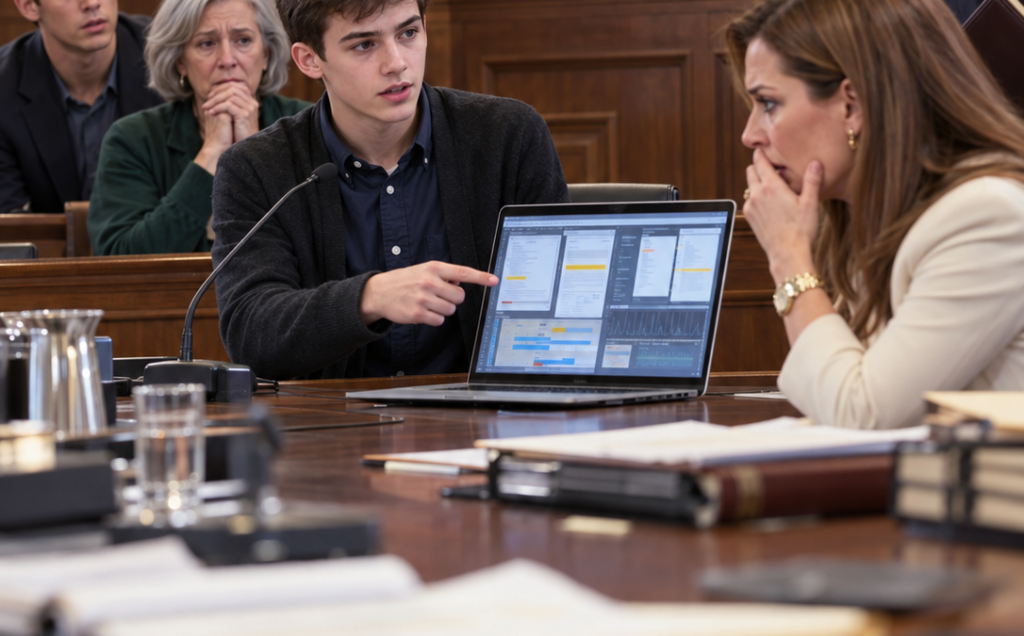
Laptop in both hands.
“Yes.”
He was sworn.
Then sat.
The judge asked Linda to proceed carefully.
Ethan opened his timeline.
“This file says it was created in 2014.”
He pointed.
“The original electronic file was created fourteen days after the television report.”
His mother’s face changed.
He continued.
“This says she visited my birthday.”
Click.
“My therapy appointment happened at two.”
Click.
“Grandma bought cake ingredients at 3:15.”
Click.
“There’s a photograph from dinner.”
Click.
“She isn’t there.”
His voice remained flat.
Not angry.
Almost painfully precise.
The judge asked:
“Were you keeping these records specifically for court?”
“No.”
“Why did you keep them?”
Ethan paused.
“Because people forget.”
Then:
“And sometimes they say something different later.”
That answer silenced the room.
His attorney asked about the phone logs.
Ethan opened the folder.
“Grandma called.”
Date after date.
No answer.
“She left voicemails.”
More dates.
Then:
“My mother’s records say she regularly contacted me.”
He looked toward Rachel.
“I don’t remember that.”
Rachel began crying.
Her attorney requested a recess.
The judge denied the interruption until the current question was answered.
Then Rachel’s own attorney tried to separate her from the paperwork.
Perhaps a consultant assembled records incorrectly.
Perhaps metadata changed during migration.
Possible.
Linda did not overstate.
Neither did Ethan.
That mattered.
They did not need one digital alert to decide the case.
They had the full pattern.
No real deposits.
No school contact.
No therapy contact.
No birthday presence.
Years of unanswered calls.
Documents created recently while claiming to be old.
Questionable signatures.
And a mother returning immediately after national publicity about money.
The judge recessed.
When he returned, his ruling did not sound cinematic.
Real legal decisions rarely do.
He found compelling evidence that Grandma had acted as Ethan’s primary caregiver for more than a decade.
He found Rachel’s claims of continuous support unsupported and portions of her submitted evidence sufficiently questionable to warrant further investigation.
Given Ethan’s age, documented preferences, longstanding residence, support needs, and the evidence surrounding Rachel’s absence and sudden return, the court granted Vivien formal guardianship and control over the decisions at issue, subject to professional financial safeguards protecting Ethan’s assets.
Then came the sentence that made Grandma inhale sharply.
The disputed evidence would be referred to appropriate authorities for review.
Rachel stood.
“Your Honor—”
The judge stopped her.
“Sit down.”
She did.
Ethan closed his laptop.
Looked at Grandma.
“It’s over.”
Grandma covered her face.
And cried.
Part 6: The child Grandma spent eleven years protecting became the person who protected her.
Outside the courthouse, sunlight hit the steps.
Grandma held Ethan’s hand.
He normally disliked unexpected touch.
That day, he let her.
She cried again.
Not like Christmas Eve.
Those tears had been grief.
These were release.
Eleven years of responsibility escaping all at once.
I stood beside them and finally understood the shape of their relationship.
Grandma had spent years standing between Ethan and people determined to misunderstand him.
Teachers.
Systems.
Our mother’s absence.
Strangers who spoke about him as if he were not standing there.
Then in court, Ethan did the same thing for her.
Not with shouting.
Not revenge.
Documentation.
Truth.
Precision.
The skills he developed partly because the world felt unpredictable had become armor.
Rachel’s legal consequences unfolded separately.
Investigators reviewed the questionable records.
The case resolved without the grand punishment I imagined when I was angry.
There were penalties.
Court supervision.
Community service.
The financial arrangements remained entirely outside her control.
The punishment mattered less to me than the boundary.
She could no longer return after eleven years and simply reclaim authority because biology gave her a title.
Ethan’s money was professionally managed.
Safeguards protected it.
Grandma was recognized legally in the role she had already lived for more than a decade.
Then life became quiet again.
Not empty.
Quiet.
There is a difference.
Ethan had signed contractual restrictions related to the software he sold.
He could not simply recreate the same commercial product immediately.
So he looked elsewhere.
Software testing.
Quality assurance.
Bug detection.
Structured analytical work.
Then he did something I had not expected.
He started a company.
Tiny at first.
Five employees.
His hiring choices were deliberate.
An autistic programmer who had been repeatedly rejected after interviews.
A developer with ADHD who struggled in open-plan offices.
A brilliant tester with a severe stutter who had stopped speaking in class as a teenager because other students mocked him.
Others who had been described as:
Difficult.
Awkward.
Poor culture fit.
