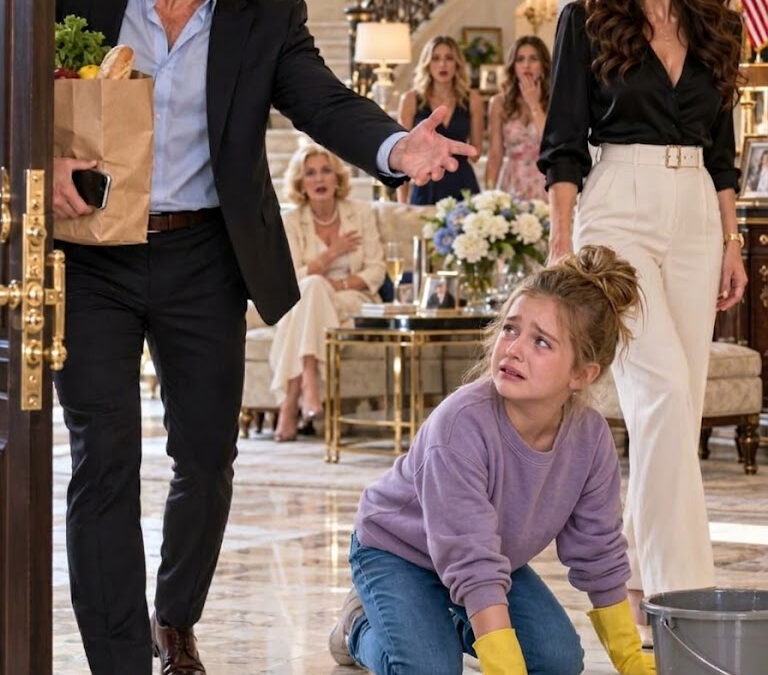
My twelve-year-old daughter was on her knees scrubbing our entryway when I came home hours earlier than expected, while my wife and her friends drank wine in the next room. She looked at my wife before she dared put down the brush. Then her English teacher stood up and asked why my wife had introduced her as a neighbor’s teenager. I had forty-seven seconds of video, but no idea how much I’d missed…
The first thing my daughter said when I came home early was, “Careful, Dad. It’s wet. I’m almost done.”
She was twelve years old, kneeling on our entryway tile with a scrub brush in her hand. Yellow rubber gloves covered her fingers, and a gray bucket sat beside her knees. From the living room came the sound of women laughing over glasses of wine.
One of those women was my daughter’s English teacher.
My name is Greg Holloway. I was forty-one years old, a regional sales manager living in Plano, Texas. I could walk into a room full of unhappy customers and usually figure out what was wrong within five minutes.
But for nearly two years, I had been coming home to a daughter who was growing quieter, and I’d convinced myself everything was fine.
Maya was the only child from my first marriage. Her mother, Kelly, had accepted a hospital position in Phoenix, and we’d agreed Maya should stay in Plano during the school year. Her friends were here, her school was here, and my mother lived only fifteen minutes away.
Kelly had summers, school breaks, and three scheduled video calls each week. We were divorced, but we had always tried to make sure Maya knew she had two parents who loved her.
At least, that was what I believed we were doing.
Two years earlier, I’d married Tiffany. She was thirty-six at the time, energetic and organized, the kind of woman who labeled storage bins and planned family vacations before the school calendar came out.
She had a daughter named Hailey, who lived primarily with her father and visited us every other weekend.
When Tiffany and I were dating, she remembered every little thing about Maya. She bought the cereal Maya liked, listened to her talk about soccer, and once stayed up late helping her finish a school project.
I took those things as evidence that we’d make a good blended family.
Before the wedding, Tiffany showed me a chore chart she’d made for the girls. Maya would keep her bedroom clean, take out the kitchen trash, and help with dishes a couple of nights each week. Hailey would have comparable responsibilities whenever she stayed with us.
“Everybody contributes,” Tiffany said.
I agreed. My mother raised me to wash my own dishes and make my bed. I believed children needed responsibility, and nothing about that first chart seemed unreasonable.
What I didn’t understand was how much those responsibilities would change when I wasn’t home.
My job required regular trips to Houston. Some weeks I left Tuesday morning and didn’t return until Thursday evening. Other weeks I had client dinners, conferences, or unexpected meetings.
Tiffany handled the school pickups and most of our weekday routine. I thanked her often. I also let myself believe that thanking her was the same as checking whether things were going well.
It wasn’t.
That fall, Maya quit soccer.
She’d played since elementary school. I still remembered standing along the sidelines with a travel mug of coffee, watching her run after a ball with her ponytail bouncing behind her.
She wasn’t the best player on the team. She was the one who cheered the loudest when somebody else scored.
When I asked why she wanted to quit, Tiffany said Maya had lost interest. Maya stood beside the kitchen counter and said, “It’s okay, Dad.”
So I accepted it.
A few weeks later, I found her asleep at the kitchen table with her spelling homework under her cheek. I carried her upstairs, tucked her in, and blamed the long school day.
Kelly mentioned during one of our calls that Maya looked exhausted.
I told her middle school was harder than we remembered.
My mother noticed something too. She said Maya had become strangely nervous about spilling anything, even a glass of water.
.
“She’s getting older, Mom,” I said. “Maybe she’s just more careful.”
Looking back, I can hear how ridiculous I sounded.
Every explanation protected my comfortable belief that our household was working.
The Thursday everything changed began with a delayed flight.
I’d been in Houston visiting clients. Storms had stranded the aircraft scheduled to take me home, and around noon I texted Tiffany that I probably wouldn’t arrive until eight that evening.
She replied with a simple message telling me to travel safely.
Then the airline canceled my flight altogether.
I could have stayed another night, but the roads north were clear, so I rented a car. Along the way, I stopped for gas and saw a tray of cinnamon rolls behind the counter.
Maya used to love those things.
When she was younger, she called them breakfast presents. I’d bring them home after trips, and she’d insist we warm them for exactly twelve seconds so the icing got soft without disappearing.
I bought two, thinking we’d eat them after dinner.
I didn’t tell Tiffany about the change in plans. I imagined walking through the door and surprising my daughter.
It was 4:35 when I reached our house.
I carried my overnight bag in one hand and the paper bag of cinnamon rolls in the other. Before I even closed the front door, I heard laughter coming from the living room.
Then I heard Tiffany.
.
“That’s why I tell her a little responsibility won’t kill her.”
I looked down.
Maya was kneeling on the entryway tile, scrubbing the grout between the squares. She wore old sweatpants and an oversized T-shirt, and her hair was tied back with a stretched-out elastic.
A folded towel lay across the hallway to keep anyone from walking onto the wet floor.
