When she said she didn’t want to do something, I tried to understand before deciding whether it was reasonable.
I was still her father. She still needed rules, homework, bedtime, and guidance.
But I wanted her to learn that disagreement was not the same as disobedience, and that asking for help was not a failure.
One afternoon, June Callahan called me after school.
She said Maya had begun participating in class again. She’d volunteered to read aloud and had turned in an essay she was proud of.
June also apologized for having missed earlier signs that something might be wrong.
I thanked her for speaking up in our living room.
She said, “I almost didn’t. I thought it wasn’t my place.”
I understood that feeling better than I wanted to.
We’d all spent time convincing ourselves that someone else knew more than we did.
By spring, the divorce proceedings were moving forward. Tiffany and I communicated through our attorneys about the remaining practical issues.
She continued individual counseling and sent me a letter acknowledging that she had used Maya’s willingness to please as an excuse to keep assigning more work.
She also apologized for lying to her friends.
I read it carefully.
I didn’t show it to Maya immediately or tell her what she should feel. Eventually, when she asked whether Tiffany had said anything about her, I explained that Tiffany had apologized and offered to let her read the letter.
Maya said she wasn’t ready.
That was her decision.
I didn’t believe an apology, however sincere, created an obligation to forgive.
Kelly and I became better at co-parenting, though we still disagreed sometimes.
She remained in Phoenix, and Maya continued living primarily with me in Plano. Kelly visited more often when her schedule allowed, and Maya still spent school breaks with her.
We stopped treating the custody agreement as proof that we’d done enough.
We talked regularly about school, friends, sleep, activities, and the things Maya wasn’t saying.
My mother kept helping, too. She and Maya started baking together on some Saturdays.
They made cinnamon rolls from scratch one weekend, and my kitchen looked as though somebody had overturned a flour truck.
I walked in to find flour on the floor, icing on the counter, and my mother laughing so hard she could barely speak.
Maya glanced at me.
For an instant, I saw the old worry return.
Then I picked up a dish towel and said, “Looks like you two had fun.”
My mother handed me a spoon covered in icing.
“Try this before you start cleaning.”
So I did.
I still remember the afternoon I came home early the following November.
There was no special reason. A client canceled, traffic was light, and I decided to get home before Maya returned from practice.
She came through the door later carrying her soccer bag, calling out that she was starving.
She dropped her cleats beside the entryway and headed toward the kitchen.
One shoe tipped over, leaving a small clump of dried mud on the tile.
She noticed it and stopped.
I saw her glance at the floor, then at me.
A year earlier, she would have rushed for cleaning supplies and apologized until I told her to stop.
This time she said, “Oops. I’ll get that after I eat.”
I smiled.
“Sounds good.”
She walked into the kitchen and opened the refrigerator.
Such a small thing. A dirty floor and a child who was no longer afraid of it.
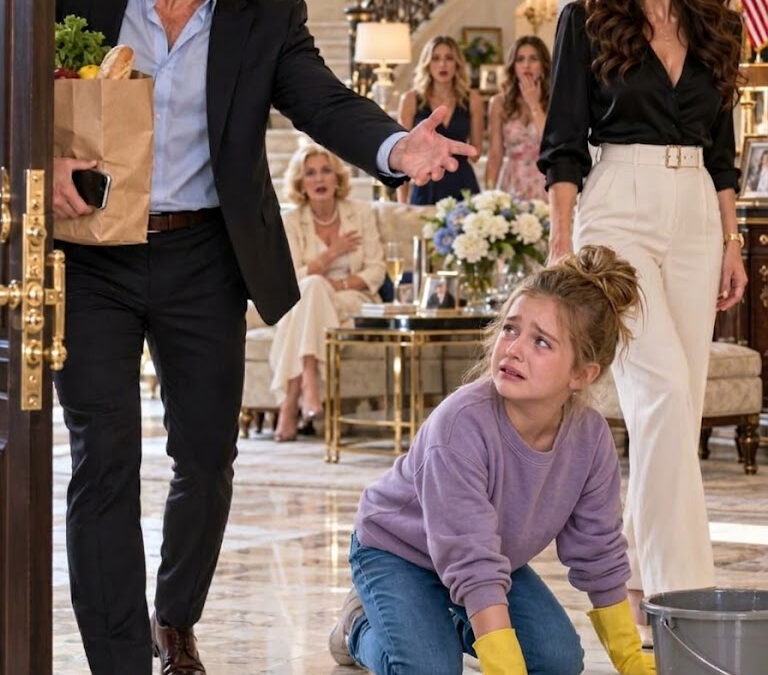
I thought about the forty-seven-second video still saved on my phone. I had watched it more times than I wanted to admit.
At first, I’d watched because I needed evidence of what happened.
Later, I’d watched because I couldn’t understand how I’d missed the warning signs.
Eventually, I stopped playing it.
There was nothing new to learn from watching Maya kneel on the floor. What mattered was noticing the daughter standing in front of me now.
That evening, she and I made dinner together.
She chopped vegetables while I cooked chicken. She told me about a classmate who had embarrassed himself trying to impress a girl. I pretended not to understand the joke, and she groaned at me.
After we ate, she put her plate in the dishwasher without being asked.
“Dad?”
“Yeah?”
“Can we get cinnamon rolls tomorrow?”
“Store-bought or Grandma’s?”
She thought about it.
“Store-bought. The really sticky ones.”
I laughed.
“Deal.”
She went upstairs to finish her homework, leaving her soccer bag near the stairs and a half-finished glass of water on the table.
I left them there until she came back down.
I used to think being a good father meant keeping a roof over my daughter’s head, making sure the bills were paid, and trusting the person I’d chosen to share our home.
Now I know trust doesn’t mean surrendering responsibility.
A child can say she’s fine because she doesn’t want to disappoint you. She can give up something she loves because she’s afraid asking for it will cause trouble. She can learn to make herself useful enough that nobody has to notice what she’s feeling.
Maya hadn’t needed me to come home with gifts.
She’d needed me to come home with enough attention to see what was happening right in front of me.
I can’t give her back those afternoons when she should have been playing soccer or doing homework or simply being twelve.
I can give her something different now.
A home where her voice matters. Where she can make a mess, disagree with an adult, and ask for help without wondering what it will cost her.
And I can be there to prove it, on ordinary Thursdays as well as the important days.
The memory that stays with me isn’t Tiffany’s face when June Callahan exposed her lie.
It’s Maya looking toward the living room before she dared put down that scrub brush.
I spent a long time wishing I’d come home sooner.
