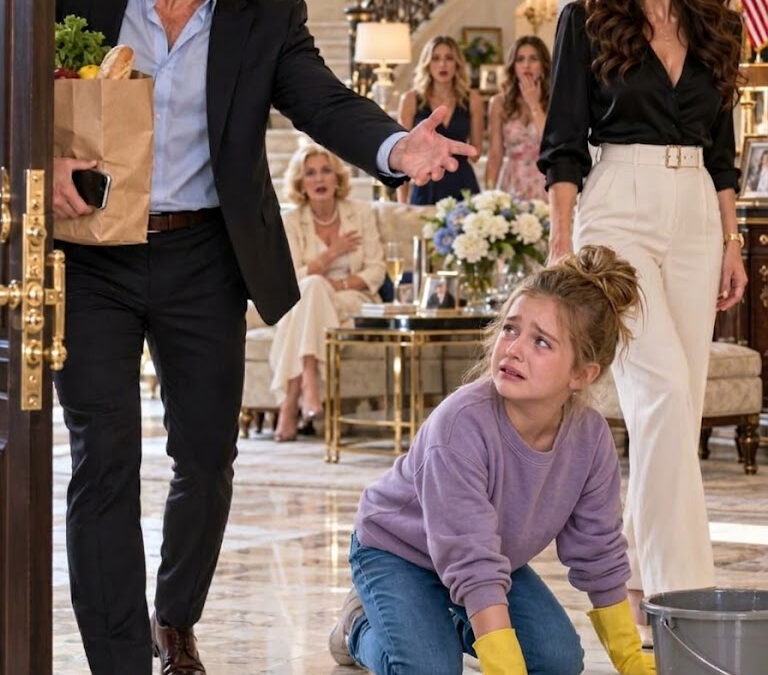
She hadn’t noticed me.
“Sweetie, we’re out of ice,” a woman called from the living room.
Maya immediately placed the brush beside the bucket and started to stand.
That’s when I saw the coffee table beyond her.
There were wineglasses, a platter of crackers, and four copies of the same novel. Four women were sitting comfortably on our furniture, talking as if they had nothing more pressing to do.
My daughter was on her knees cleaning the floor in front of them.
I pulled out my phone and started recording.
I didn’t know exactly what I was seeing, and I didn’t want the situation explained away later as something different. I recorded the bucket, the brush, the wet floor, and the women inside.
Then Maya turned.
“Careful, Dad. It’s wet. I’m almost done.”
She sounded apologetic.
I stepped onto the dry tile beside her.
“Sweetheart, you’re done now.”
She glanced toward the living room.
That small movement nearly broke me. My daughter had heard me tell her to stop, but she was checking someone else’s face to see whether she could obey.
“Maya, put down the brush,” I said gently.
She did. I helped her to her feet.
There were red marks around her wrists where the gloves ended. She flexed her fingers as I took the gloves from her, and for a moment I remembered those same little hands gripping my jacket when she was learning to ride a bicycle.
I stood my phone upright on the entry table, still recording.
Tiffany appeared in the doorway holding a half-full glass of wine.
“Greg! You said you’d be late.”
“My flight was canceled. I drove.”
She glanced at Maya, then at the bucket.
“Well, this is awkward. We were just finishing up.”
I looked past her at the women on the sofa.
One of them wore a blue cardigan. She had straight brown hair tucked behind one ear and a copy of the novel resting on her lap.
I recognized her from a photograph on Maya’s school website.
June Callahan. Maya’s seventh-grade English teacher.
The woman looked at my daughter, then at the scrub brush.
“Maya?”
Maya’s shoulders drew inward.
“Hi, Mrs. Callahan.”
June stood so abruptly that the book slipped from her lap onto the carpet.
Nobody picked it up.
Tiffany gave an uncomfortable little laugh.
“She looks different outside of school, doesn’t she?”
I stopped recording. The video was forty-seven seconds long. I slipped the phone into my pocket, realizing my hands were shaking.
“Maya,” I said, “go wash your hands. Then come sit with me in the kitchen.”
She looked down at the floor.
“But I haven’t finished.”
“I’ll take care of the floor.”
She opened her mouth, then closed it. Finally she removed the gloves and walked toward the kitchen sink.
I watched her go.
There was something terrible about how carefully she moved around the wet tiles, as though leaving a single footprint might create another problem for her later.
Tiffany stepped closer and lowered her voice.
“Greg, you’re embarrassing me in front of my friends.”
I looked at her, waiting for her to explain why my daughter had been cleaning on her hands and knees while adults asked her to fetch ice.
Instead she said, “It’s not what you think.”
“What should I think?”
“She was helping. That’s all. She made a mess earlier, and I asked her to clean it.”
I glanced at the grout lines. The section Maya had finished was bright and clean. The rest showed the ordinary discoloration that comes from years of shoes, dust, and Texas weather.
That was no recent spill.
“You asked her to scrub the entryway during your visit?”
“Greg, don’t make a scene.”
I remembered the cinnamon rolls in my hand. The paper bag had crumpled, and icing was beginning to show through one corner.
I’d driven four hours thinking about surprising Maya with something sweet. While I imagined us eating dinner together, she’d been working toward permission to sit down.
“The visit is over,” I said. “Please ask everyone to leave.”
One woman immediately reached for her purse. Another stared at her wineglass.
Tiffany looked at me as though I’d insulted her in front of people whose opinions mattered more than what I’d just found.
“Are you serious?”
“Yes.”
June Callahan hadn’t moved.
She stood beside the sofa, her face pale, looking toward the kitchen where Maya was washing her hands.
Then she turned to Tiffany.
“Tiffany, you told us the girl helping today was a neighbor’s teenager.”
Nobody spoke.
I looked at my wife.
“A neighbor’s teenager?”
Tiffany’s mouth opened, but nothing came out.
June continued quietly. “You said somebody from down the street came by after school to help with cleaning. I didn’t recognize her from the back.”
I felt the room tilt.
These women had been sitting in my home, accepting drinks and talking about books, while my daughter scrubbed the floor.
And my wife had let them believe she was somebody else’s child.
I looked toward the kitchen. Maya was standing by the sink with her hands under the running water, her shoulders hunched.
She hadn’t turned around.
Tiffany finally whispered, “Greg, please. We can talk about this later.”
For the first time that afternoon, she looked genuinely frightened.
And I realized she wasn’t frightened because I had caught Maya doing chores.
She was frightened because someone else had just told me how carefully she’d hidden what those chores had become.
3. Full story continuation
June looked as though she wished she could take back what she’d said, not because it was untrue, but because she had just realized how much it mattered.
One of the other women set down her glass.
“I thought she was being paid,” she said quietly.
I turned toward her. “Paid?”
She looked uncomfortable. “Tiffany said she had someone helping with the house.”
My wife closed her eyes.
