I sat down on the edge of the bed and held the photograph against my chest.
For the first time since coming home, I cried.
Arthur Langford had adopted me when I was four years old.
My birth father had died in a car accident, and my mother, overwhelmed by grief and her own struggles, had been unable to care for me.
I remembered very little from those early years.
What I remembered clearly was Arthur.
He’d walked into the social worker’s office, knelt in front of me, and introduced himself.
“Hello, Elena. My name’s Arthur. I knew your daddy.”
He’d smiled.
“I’d like you to come home with me.”
I had stared at him for several seconds.
Then I’d reached for his hand.
That was the beginning of my real childhood.
Dad taught me to ride a bicycle, helped me with homework, and attended every school event he could manage.
When I developed an interest in engineering, he bought me drafting tools and old construction manuals.
We spent weekends studying bridges, building model structures, and arguing about the strongest way to support a roof.
He never once made me feel adopted.
When someone called me his foster daughter at a school event, he corrected them immediately.
“She’s my daughter. That’s all there is to it.”
Diane entered our lives two years later.
She was beautiful, sophisticated, and already had a little girl named Chloe.
For a while, I hoped I’d finally have a mother and sister.
But Diane never warmed to me.
She wasn’t openly cruel when Dad was around.
Her criticism came through little comments that sounded harmless until you heard enough of them.
When Chloe received expensive birthday presents, Diane explained that I should be grateful for what I already had.
When Chloe struggled in school, Diane hired private tutors.
When I earned a B-plus in chemistry, she suggested college might be too ambitious for someone with my background.
Dad always defended me when he knew what had happened.
But I gradually learned how to hide the worst of it.
I didn’t want him fighting with his wife because of me.
As I grew older, I found comfort in school, sports, and eventually the military.
Dad encouraged every step.
On my eighteenth birthday, he gave me a small ownership interest in the company that held title to the lake property.
Ten percent.
He explained that it would give me a permanent financial stake in the home we’d shared.
“This place will always mean something to you,” he said. “I want that protected.”
Diane was furious.
She argued that Chloe deserved equal treatment.
Dad reminded her that the property had been his before their marriage and that he’d provided separately for Chloe’s education and future.
The argument lasted for weeks.
But the ownership transfer stood.
Now, fourteen years later, I lay in my childhood bedroom listening to dinner guests leave downstairs.
I wondered what Dad would have said if he’d heard Diane describe me as a charity project.
Then I remembered something he’d given me shortly before he died.
An envelope.
It was still in my duffel bag.
Dad had been dying of pancreatic cancer when he handed it to me.
I was sitting beside his hospital bed, holding his hand.
“Elena,” he’d whispered, “I need you to promise me something.”
“Anything.”
He’d reached beneath his pillow and produced a plain white envelope with my name written across the front.
“Don’t open this unless Diane asks you for money or wants you to sign something important.”
I’d frowned.
“Why would she?”
He’d looked at me for a long time.
“Just promise.”
I had.
Then he’d squeezed my hand.
“You were never anyone’s charity, kiddo. Don’t ever forget that.”
Six days later, he was gone.
I carried that envelope overseas and brought it home unopened.
That night, I took it out and stared at my name.
But I couldn’t bring myself to break the seal.
Not yet.
I fell asleep holding Dad’s photograph.
The next morning, Diane invited me downstairs for coffee.
She was wearing a white silk robe and smiling with unusual warmth.
“I made it just the way you like it,” she said, sliding a mug across the kitchen island.
That alone should have warned me.
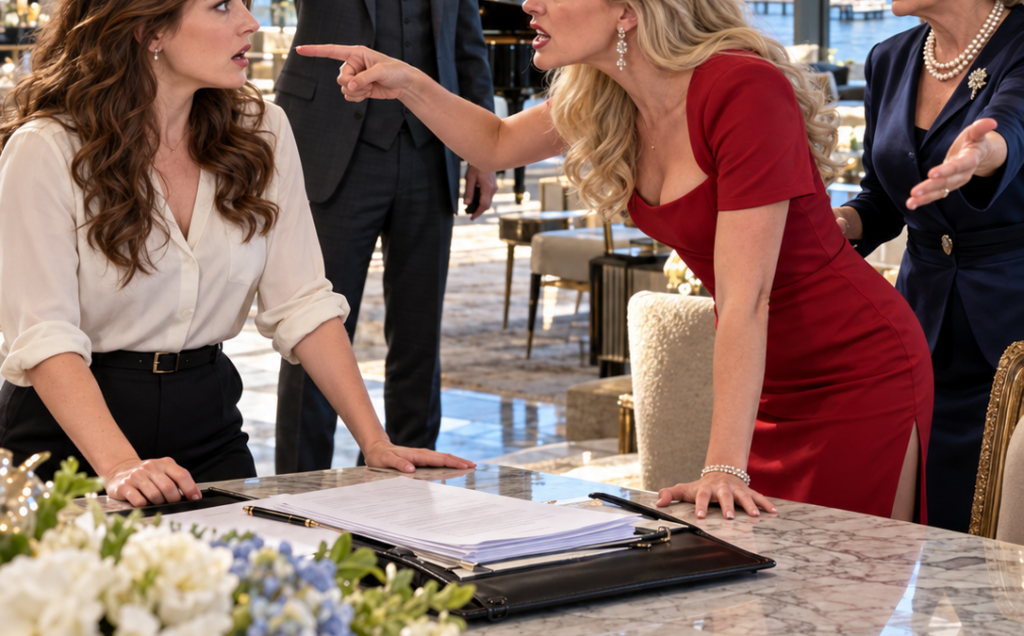
Chloe entered carrying a thick blue folder.
Marcus followed her.
Nobody asked about my deployment.
Nobody asked whether I’d slept.
Diane simply folded her hands and smiled.
“Elena, there’s a wonderful business opportunity we’d like to discuss.”
Marcus began explaining an ambitious real estate project in Charlotte.
Two luxury towers.
Retail space.
Private investors.
Significant projected returns.
According to him, the financing was almost complete.
The only remaining requirement was additional financial backing.
Chloe slid the folder toward me.
“We just need your signature.”
I opened it.
The first page described a four-million-dollar commercial loan guarantee.
I turned another page.
Then another.
Diane watched impatiently.
“There’s no need to study every detail, sweetheart. Gerald has already reviewed it.”
Gerald Whitcombe was Diane’s attorney.
That didn’t reassure me.
I had spent ten years reading construction contracts where a single overlooked clause could cost taxpayers millions.
I wasn’t about to sign anything without understanding it.
By page six, I noticed references to existing debt.
By page eleven, I found several missed payments.
By page nineteen, I understood exactly what they wanted.
Marcus’s business was already in serious financial trouble.
The proposed loan wasn’t simply financing new construction.
Much of it would be used to refinance obligations his company was struggling to repay.
And my signature would create a substantial personal financial obligation if the borrowing company defaulted.
I closed the folder.
“No.”
Chloe blinked.
“What?”
“I’m not signing this.”
Marcus laughed nervously.
“Elena, you’re misunderstanding the structure.”
“I understand it perfectly.”
Diane’s smile disappeared.
“This family has given you everything.”
I looked at her.
“Excuse me?”
She leaned forward.
“We took you in. We raised you. We gave you opportunities you never would have had otherwise. The least you can do is help us when we need you.”
