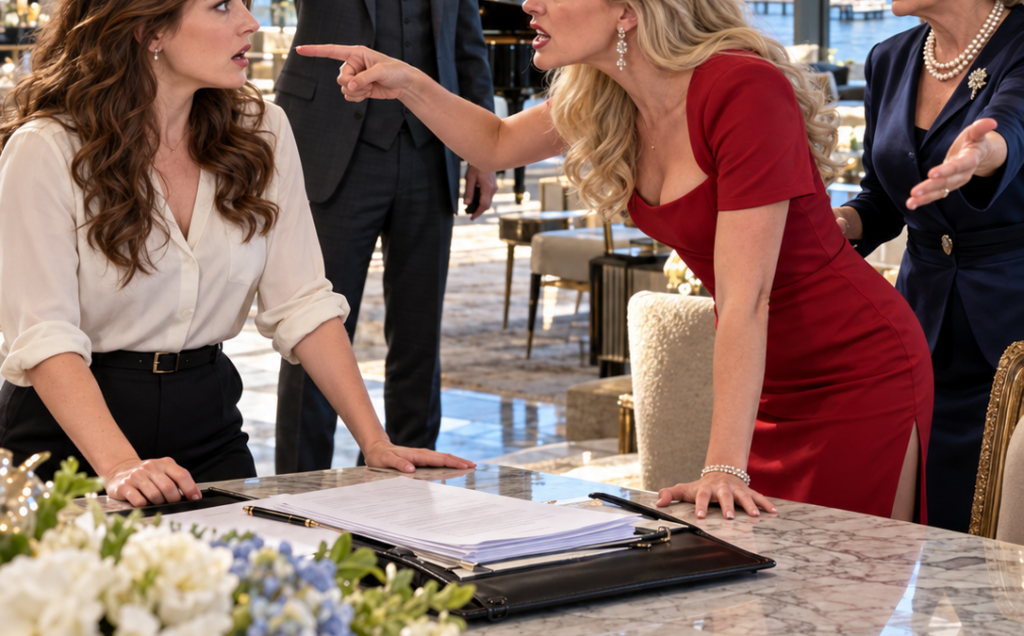
I felt my chest tighten.
Then Diane said something that erased the last of my doubts.
“Do you have any idea where you’d be today if Arthur hadn’t taken in a stray?”
Chloe looked away.
Even Marcus stopped talking.
I stared at the woman who had lived under the same roof as me for twenty-six years.
A stray.
After all that time, that was still how she saw me.
I picked up the pen.
Diane relaxed.
Chloe smiled.
Marcus leaned forward.
Then I placed the pen on top of the unsigned agreement.
“No,” I repeated.
Diane’s expression hardened.
“Then perhaps it’s time we formally reconsider your place in this family.”
I stood up.
“If that’s what you want, put it in writing.”
And I walked out.
Outside, rain poured across the driveway.
I climbed into my rental truck and sat behind the wheel, staring at the lake through the windshield.
I’d faced dangerous situations overseas. I’d managed emergencies, dealt with difficult contractors, and made decisions affecting hundreds of people.
But nothing had prepared me for hearing the woman who helped raise me describe me as a stray.
I reached into my duffel bag.
This time, I opened Dad’s envelope.
Inside was a short handwritten note.
Elena, if you’re reading this, things have gone the way I feared. Go see Victor Vance in Lynchburg. Don’t tell Diane first, and don’t sign anything until he’s explained everything.
I love you, sweetheart. I’m sorry I can’t be there to help you through this.
There was an address beneath his signature.
I stared at the note.
Victor Vance.
I vaguely remembered Dad mentioning an old Army friend who had become an attorney.
I started the engine.
Victor’s office occupied the second floor of an old brick building above a watch repair shop.
When I knocked, a white-haired man wearing a cardigan opened the door.
He studied my face.
Then his expression changed.
“Elena Langford?”
“Yes.”
He closed his eyes for a moment.
“Thank goodness.”
He stepped aside.
“Come in, sweetheart. Your father told me you’d find your way here eventually.”
His office was crowded with books and old photographs.
One picture showed two young soldiers standing beside a military truck.
I recognized Dad immediately.
The other man looked vaguely familiar, although I couldn’t explain why.
Victor offered me coffee.
I declined.
Then I handed him the envelope.
He read it slowly and nodded.
“Arthur was hoping you’d never need that.”
He unlocked a cabinet behind his desk and removed several folders.
For the next two hours, I learned more about my father’s final years than I’d discovered during the fifteen months since his death.
Dad had grown suspicious about certain financial transactions shortly after becoming ill.
Large payments were leaving accounts connected to the lake property.
Some transactions had been authorized by Diane.
Others had not.
With Victor’s help, Dad quietly reviewed rental records, bank statements, and company documents.
What he discovered devastated him.
For several summers, Diane had been renting the lake house to wealthy vacationers while telling Dad she was visiting relatives.
She used a private rental company registered in her name.
The income had never reached the accounts belonging to Langford Lake Holdings.
Instead, substantial payments went directly to Marcus’s development company.
The records showed nearly nine hundred thousand dollars in rental proceeds after management fees and expenses.
“Marcus has been losing money for years,” Victor explained. “Diane kept sending him more, hoping the next project would save the last one.”
He opened another folder.
Inside was a six-hundred-thousand-dollar home-equity loan agreement.
Arthur’s signature appeared near the bottom.
I studied it.
Something was wrong.
Dad always formed the first letter of his signature with a sharp, distinctive angle.
This signature was rounded.
“That’s not his handwriting.”
Victor nodded.
“Your father said the same thing.”
The document had supposedly been signed while Dad was receiving chemotherapy.
Victor had preserved the relevant medical records, and an independent handwriting examiner had identified substantial inconsistencies.
The loan’s validity was now being challenged.
My stomach turned.
“Did Diane forge his signature?”
“That’s what the evidence suggests. But a court or the proper authorities will have to determine responsibility. Your father wanted the records preserved.”
I looked at him.
“Why didn’t Dad confront her?”
Victor sighed.
“Partly because he was exhausted. He had very little time left, and he didn’t want to spend it fighting in court.”
He removed his glasses.
“But mostly, Elena, he was worried about you.”
I stared at him.
“He knew you were deploying. He didn’t want you caught in the middle of a financial disaster while you were overseas.”
Victor opened a blue binder.
“Instead, he took steps to protect what mattered most.”
He turned the binder toward me.
Langford Lake Holdings had always owned the property.
When I turned eighteen, Dad transferred ten percent of the company to me.
Diane held another ten percent.
The remaining eighty percent belonged to Dad through his revocable trust.
Eleven days before he died, he amended that trust.
Under its terms, his entire eighty-percent interest was to pass to me.
Victor, acting as trustee, had subsequently completed the required company records and transfer documentation.
The result was unmistakable.
I controlled ninety percent of the company that owned the lake house.
Diane owned ten percent.
And under the company’s operating agreement, the controlling member held authority over major property decisions.
I sat motionless.
“Are you saying the house is mine?”
Victor nodded.
“Through the company, yes. You hold ninety percent. Your father also named you the successor managing member.”
I looked down at the documents.
For fifteen months, Diane had continued acting as though she controlled the estate.
She’d apparently assumed that her position as Arthur’s widow gave her authority over everything.
But the records told a different story.
“Why didn’t you tell me?” I whispered.
Victor’s expression softened.
“Arthur wanted you focused on coming home safely. He left instructions for me to manage the trust and protect the assets while you were deployed. I should probably have contacted you sooner, but he was adamant about giving you some peace.”
