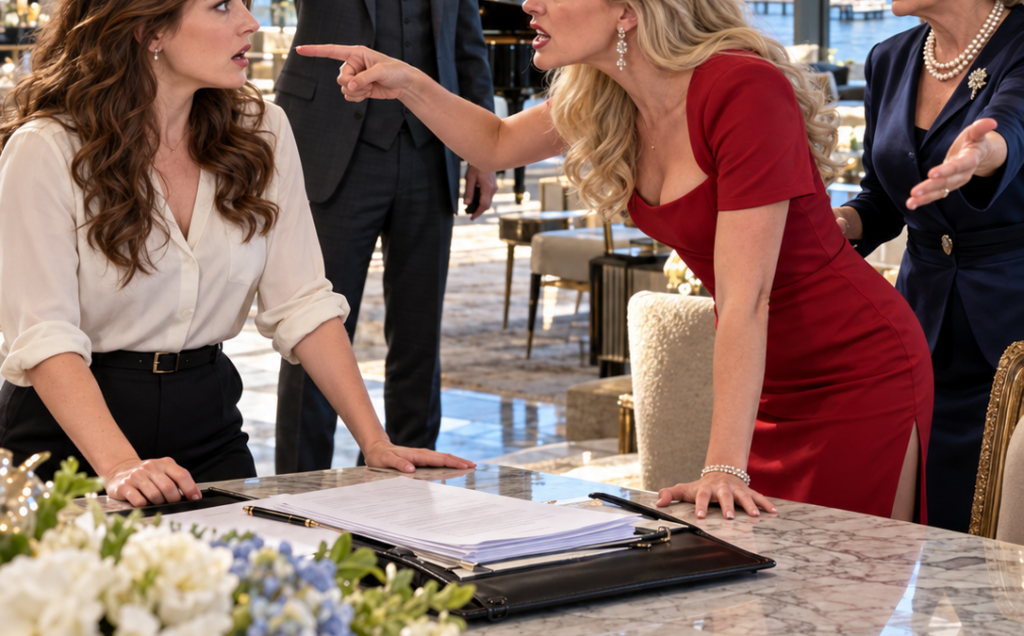
“I’m sorry for what I said about you.”
I nodded.
“Thank you.”
I wasn’t ready to forgive her.
Maybe I never would be.
But I no longer needed her approval.
After she left, I walked through the empty house.
I passed the dining room, the kitchen, and the staircase where Dad used to sit waiting for me to come home from school.
Then I stepped outside.
The lake was calm.
The dock stretched into the afternoon sunlight.
I sat where Dad always sat and listened to the water moving beneath the boards.
For the first time since his funeral, I felt completely at home.
But I didn’t want to keep the lake house as an empty monument to a man who had loved people more than possessions.
So I began making plans.
With Victor’s help and the guidance of a veterans’ organization in Roanoke, I established a small retreat program for military families.
From late spring through autumn, the house began welcoming families whose lives had been affected by service.
Parents whose spouses were deployed.
Children who missed their mothers or fathers.
Veterans recovering from difficult experiences.
Families who simply needed a week together somewhere peaceful.
They stayed without charge.
We called it the Reyes-Langford House.
I chose the name because I wanted both of my fathers remembered.
Daniel Reyes, the soldier who saved Arthur’s life.
And Arthur Langford, the man who kept his promise to care for Daniel’s little girl.
We placed a small brass plaque at the end of the dock.
It bore their names and two simple words.
A promise kept.
Chloe began visiting on weekends.
Our relationship was awkward at first.
We had decades of childhood resentment to work through.
But we started slowly.
We cooked together.
Painted the boathouse.
Talked about our marriages, our mistakes, and the things we’d misunderstood about Dad.
One afternoon, while we were painting a wall, Chloe put down her brush.
“Elena, can I ask you something?”
“Sure.”
“Do you think Dad really loved me?”
I stared at her.
“Of course he did.”
She looked doubtful.
“He always seemed so proud of you.”
I sat beside her.
“Chloe, do you remember when you were five and had pneumonia?”
She shook her head.
“Dad stayed at the hospital with you for a week. He slept in a chair beside your bed every night.”
Her eyes widened.
“He did?”
“Yes. And every morning, before you woke up, he’d sit there holding your hand.”
Tears rolled down her cheeks.
“I never knew that.”
I squeezed her shoulder.
“He loved you. We just spent too many years letting other people convince us love had to be a competition.”
She hugged me.
It was the first time she’d done that since we were children.
Today, Chloe works at a dental office in Lynchburg.
She’s rebuilding her finances and her confidence.
She refuses to accept money from me, although I’ve offered help.
“I need to learn how to stand on my own feet,” she says.
I’m proud of her.
As for Diane, our relationship remains distant.
She sends the occasional holiday card.
I respond politely.
Perhaps that’s all we’ll ever have.
But I no longer carry anger around with me.
It would take up space better used for other things.
Last summer, a seven-year-old boy named Mateo came to stay at the retreat with his father.
His mother was serving overseas.
Mateo was quiet during his first few days.
He watched the other children play but rarely joined them.
One evening, I found him sitting alone at the end of the dock.
I sat beside him.
For several minutes, neither of us spoke.
Then he pointed toward the brass plaque.
“What does that mean?”
I looked at the words.
A promise kept.
“It means two soldiers were best friends,” I explained. “One saved the other’s life. Later, the man who’d been saved promised to look after his friend’s little girl.”
Mateo thought about that.
“Did he?”
“Yes.”
“Who was the little girl?”
I smiled.
“Me.”
He looked at me with wide eyes.
“Really?”
“Really.”
“Was he a good dad?”
I looked across the lake.
The setting sun turned the water orange and gold.
I remembered Arthur teaching me to fish.
Helping me with math homework.
Cheering at my graduation.
Holding my hand in the hospital.
And telling me I had never been anyone’s charity.
“He was the best father a little girl could ask for.”
Mateo nodded seriously.
“My mom’s coming home in October.”
“That’s wonderful.”
“She promised.”
I smiled.
“Then I hope October comes quickly for both of you.”
He moved a little closer.
We watched the sunset together.
Eventually, his father called him inside for dinner.
Mateo jumped up and hurried toward the house.
I remained on the dock.
For most of my life, I’d believed I had to earn my place in the Langford family.
I’d worked harder.
Studied longer.
Tried to be quieter, kinder, stronger.
I thought that if I accomplished enough, perhaps Diane would finally consider me worthy.
But Arthur had never asked me to earn his love.
Not once.
He had given it freely.
And when he left me the lake house, he hadn’t simply given me a valuable piece of property.
He’d given me the opportunity to turn that love into something that could help other families.
I looked toward the house.
The windows glowed warmly.
Inside, children laughed around the dinner table.
Someone was setting out plates.
A little girl ran across the lawn calling for her father.
For years, people had talked about the lake house as though its seventeen-million-dollar value was the most important thing about it.
But sitting there that evening, I understood something Dad had known all along.
The house mattered because of the lives it sheltered.
Not because of the money it represented.
I reached into my pocket and touched Daniel Reyes’s old dog tags.
Then I looked down at the brass plaque.
Two fathers.
One promise.
And a little girl who had finally stopped wondering whether she belonged.
