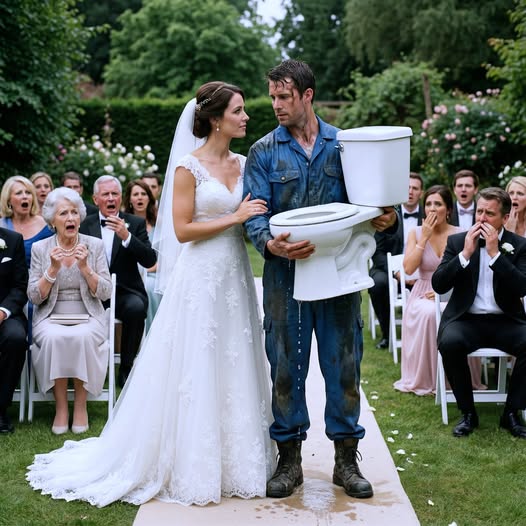
“Marrying a plumber? How embarrassing!” Those were the stinging, final words my mother hurled at me before turning her back. My sister, never one to miss a moment of cruelty, laughed and asked aloud who would ever be caught dead at such a wedding. They walked away, leaving me to face the aisle in solitude. I stood there in my white dress, my body trembling, while my phone buzzed against my hip with a notification that I knew would shatter whatever fragments of my heart remained. But as they walked away, they had no idea that within twenty-four hours, my humble husband would be the face broadcasting on every news channel in America. They had no idea that the man they had branded a disgrace was about to become the most powerful person they knew.
And when the truth finally broke, I would wake up to exactly 129 missed calls. My name is Nia, and I am twenty-eight years old. I work as a landscape architect in Atlanta, dedicating my days to designing spaces where people can find peace, even if I could never seem to find it within the walls of my own home.
For my entire existence, I was the invisible daughter. I was the one who was never quite ambitious enough, never quite elite enough for my parents, Desmond and Patrice. They were firmly entrenched in the upper echelon of Atlanta society, a world where your surname, your zip code, and your job title mattered infinitely more than the content of your character. Yesterday should have been the happiest day of my life. Instead, it became the day I realized that to my family, my happiness was far less important than their pristine reputation.
The air in the garden was thick and heavy with the intoxicating scent of jasmine and magnolia. I had designed this space myself, transforming a small, neglected plot of land into a sanctuary. It was modest, certainly, but it was ours.
The string quartet began to play the opening notes of Canon in D, a melody I had dreamed of walking down the aisle to since I was a little girl. My hands were shaking so violently I could barely maintain my grip on the bouquet of wild orchids. I stood at the top of the stone path, concealed by a trellis thick with ivy, taking a deep, shuddering breath to steady my frayed nerves.
This was it. The moment every bride waits for. I stepped out from the safety of the greenery and looked down the aisle.
The sight that greeted me nearly made my knees buckle beneath me. On the right side—the groom’s side—every single chair was filled. There were about twenty people there, mostly Marcus’s friends. They were a diverse group; some wore simple, off-the-rack suits, while others looked surprisingly distinguished for friends of a local plumber. But regardless of their attire, they all wore warm, encouraging smiles. Then, I looked to the left.
The bride’s side. It was a sea of empty white folding chairs. Row after row of vacant seats stared back at me like jagged teeth in a gaping mouth.
My parents were not there. My sister, Keisha, was not there. My aunts, my uncles, my cousins—none of them had come.
I had sent invitations to forty family members. Not a single one had shown up. The silence radiating from that side of the aisle was louder than the music.
It felt like a physical blow, a punch to the gut that sucked the air right out of my lungs. I froze, my foot hovering over the first paving stone, unable to take a step. My phone, which I had tucked into the hidden pocket of my dress for emergencies, buzzed against my hip.
I knew I should ignore it. I knew I should keep my head high and keep walking. But a sick, sinking feeling in the pit of my stomach told me I needed to see it.
I pulled it out, my fingers trembling so badly I almost dropped the device. It was a text message from my mother, Patrice. I opened it, hoping against hope for an emergency—a flat tire, a sudden illness, anything that would explain this total abandonment.
But the message was clear, cruel, and precise. It read simply: “Nia, I am sorry, but I cannot lower myself to be seen sitting in a backyard with a blue-collar crowd. It would be social suicide. Your father and I are at the yacht party with Brad and Keisha.”
The text continued: “We have an image to maintain. Good luck with your life of mediocrity.” I stared at the screen, the words blurring as hot tears welled up in my eyes.
Mediocrity. That was the word she used to describe the love of my life. Social suicide. That was how she viewed my wedding. They were on a yacht. Right now, at this very moment, while I stood alone in a garden fighting back sobs, they were drinking champagne and laughing on a boat belonging to my sister’s fiancé.
They had chosen a party over their daughter’s wedding. A sob escaped my throat, loud and ugly. The music faltered.
The guests on Marcus’s side shifted uncomfortably, exchanging worried glances. I felt naked, exposed. The shame burned across my skin like fire.
I wanted to turn around and run. I wanted the earth to open up and swallow me whole. How could they do this to me? How could they be so heartless?
Then, I saw him. Marcus. He was standing at the altar under the oak tree we had picked out together. He was not wearing his usual work boots or his coveralls. He was wearing a charcoal suit that fit him perfectly, though I assumed he had rented it. He looked handsome, strong, and steady. But it was his eyes that saved me.
He was not looking at the empty chairs. He was not looking at the confused guests. He was looking only at me.
