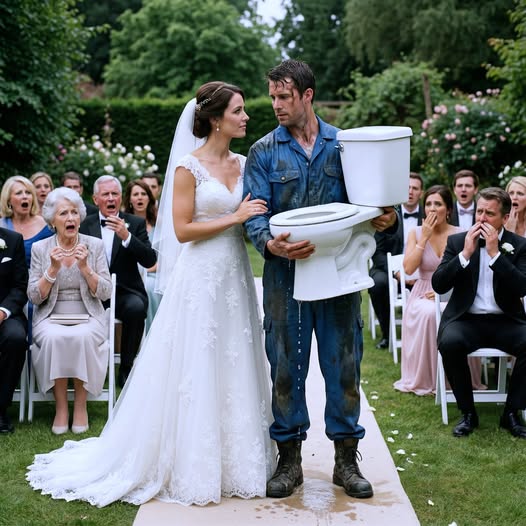
I nodded because I wanted to believe him, but inside I felt hollow. I knew he had friends, good people, but it wasn’t the same. A wedding without your family feels like a tree without roots.
I felt severed. And the worst part was knowing that right now, across town, my mother and sister were probably laughing, checking names off a list, satisfied that they had successfully quarantined the infection that was my marriage. It was a foolish errand born of that desperate childish hope that never quite dies.
I drove to my parents’ estate the night before the wedding, thinking that maybe if I looked them in the eye, they would remember they loved me. I parked my beat-up sedan next to Brad’s gleaming Porsche and walked to the front door. My hands were shaking as I rang the bell.
The housekeeper let me in. Her eyes filled with a pity that stung more than a slap. They were in the formal living room sipping scotch and discussing the floral arrangements for Keisha’s upcoming nuptials.
When I walked in, the conversation died instantly. The air in the room turned frigid. My mother, Patrice, did not even set down her glass.
She just looked at me with raised eyebrows, waiting for me to explain my intrusion. “I am getting married tomorrow,” I said, my voice trembling slightly. “I know you hate my choice.”
“I know you think I am making a mistake. But I am your daughter. Please, just come.”
“You do not have to approve. Just show up. Do not let me stand there alone.”
My mother sighed a long, weary sound, as if I were a persistent telemarketer. “Nia, we have been over this. We have standards.”
“We have a reputation. We cannot be seen endorsing this farce.” Then Brad stood up.
He was wearing a suit that probably cost more than my entire wedding budget. He swirled his drink and sauntered over to me, a smirk playing on his lips. He looked me up and down with a sneer that made my skin crawl.
“You really do not get it, do you, Nia?” he said, his voice dripping with condescension. “This is not just about you marrying a nobody. It is about the smell.”
“You are bringing the stench of the sewer into this family. Marcus is just a plumber. He spends his days elbow-deep in other people’s filth.”
“He does not deserve to step foot in this house. And frankly, neither do you if you think he is your equal.” I felt a flash of white-hot anger.
“Marcus is ten times the man you will ever be,” I shot back. “He builds things. He fixes things.”
“You just move money around and pretend it makes you important.” Brad laughed, a cruel, barking sound. “I create wealth, Nia.”
“Marcus unclogs toilets. There is a difference.” I turned to my father, ignoring Brad.
“Daddy, please, just walk me down the aisle. That is all I ask.” Desmond Vance stood up from his leather armchair. He walked over to the mantelpiece where I had placed a cream-colored envelope moments before entering the room.
It was my wedding invitation, hand-addressed with the calligraphy Marcus and I had painstakingly done ourselves. My father picked it up, holding it by the corner as if it were contaminated. He walked over to the trash can in the corner of the room.
He did not look at me. He looked at the invitation with a mixture of boredom and disgust. Then he dropped it.
I watched it flutter down into the wastebasket, landing on top of coffee grounds and discarded tissues. “You chose your path, Nia,” my father said, his voice void of any emotion.
“You chose a life of mediocrity and dirt. You chose him over us. As far as I am concerned, I have only one daughter and her name is Keisha.”
He looked up then, and his eyes were like stone. “To me, you are dead. Do not come back.”
“Do not call us when he leaves you. Do not ask for money when you are starving. You are dead to this family.”
The finality of his words hit me like a physical blow. The hope I had been clinging to finally shattered, scattering like glass across the floor. I looked at my mother, expecting her to intervene, to soften the blow.
She just took a sip of her scotch and looked away, staring at a painting on the wall as if I were already invisible. I nodded slowly, the tears drying on my face. “Okay,” I whispered.
“I understand.” I turned around and walked out of the room. I walked out of the house I grew up in, past the portraits of my ancestors, past the trophies and the awards, past the life I was supposed to want.
I walked out the front door and into the night air. I did not look back. As I got into my car, I realized that by throwing me away, they had accidentally set me free.
They had cut the last string tying me to their expectations. I was an orphan now, but I was free. And tomorrow I would start a new family with a man who would never make me beg for love.
The morning of my wedding was quiet. There was no bustle of bridesmaids fighting over mirrors, no mother fussing with my veil, no father practicing his toast in the hallway. It was just me and my reflection in the small bridal suite at Willow Creek Gardens.
My friend Linda zipped up the lace dress that I had fought so hard to keep, and her hands were gentle, but her eyes were sad. She knew. Everyone knew.
The silence where my family should have been was a physical weight pressing down on my chest, making it hard to take a full breath. When I stepped out into the garden, the late afternoon sun was filtering through the willow trees, turning the leaves into cascades of gold. It was breathtaking.
