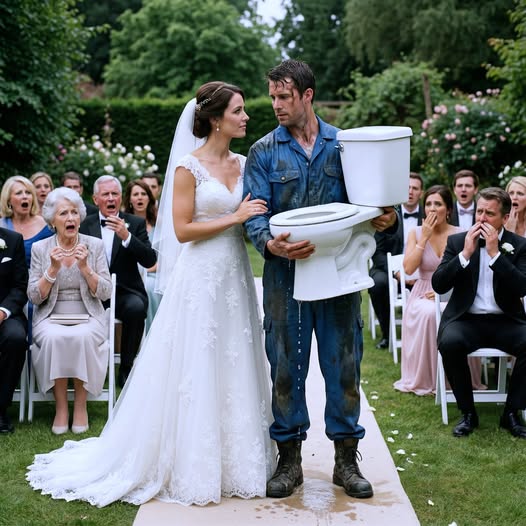
He stepped down from the altar, ignoring tradition, ignoring the audible gasps of the officiant. He walked down the aisle, his strides long and purposeful, until he reached me. He took my phone gently from my hand, looked at the screen for a fleeting second, and then slid it into his own pocket.
He took both my hands in his. His palms were warm and rough, the hands of a man who knew the value of hard work. “They do not deserve you, Nia,” he whispered, his voice fierce and low.
“Look at me. They are not here because they are small people chasing small things. But I am here.”
“And I am not going anywhere. Today is about us. Just us.”
“Do not let them steal this moment from you.” I looked into his dark, soulful eyes and saw a depth of love that my parents had never shown me in twenty-eight years. I realized then that family is not defined by whose blood runs in your veins, but by who stands by your side when the world falls apart.
I took a shuddering breath and nodded. “I am ready,” I whispered. Marcus tucked my hand into the crook of his arm.
He did not go back to the altar to wait for me. He walked me down the aisle himself, filling the empty space my father should have occupied. As we walked past the empty rows of chairs, I felt a strange sensation wash over me.
The grief was still there, heavy and sharp, but underneath it, a cold anger began to harden. They thought they could break me. They thought their absence would ruin me.
But they were wrong. We reached the front, and the ceremony continued. I spoke my vows through tears, but they were tears of defiance now.
I promised to love this man, this plumber who treated me like a queen. I promised to build a life with him, a life far away from the toxicity of the people who had birthed me. But as we stood there, I noticed something strange.
The guests on Marcus’s side, the ones I thought were just his drinking buddies or fellow contractors, were whispering. I caught snippets of conversation. “Is that him? It looks just like the magazine cover.”
“No, it cannot be, he is supposed to be in Silicon Valley.” I did not pay it much mind. I was too focused on the ring Marcus was sliding onto my finger.
It was a simple gold band, or so it seemed. I did not know then that it was vintage platinum and that the diamond he had proposed with was not a cubic zirconia, as my sister had sneered, but a flawless, rare stone he had won at a private auction. I did not know a lot of things.
I did not know that the man holding my hand, the man my parents had dismissed as a dirty laborer, was actually the founder and CEO of Hydroflow Tech, a company that had just patented a revolutionary water filtration system. I did not know that he had just signed an 800-million-dollar contract with the federal government. And I certainly did not know that tomorrow morning, while my parents nursed their hangovers on that yacht, they would turn on the television and see my husband’s face on every major news network.
But to understand how we got to this moment, to understand the sheer magnitude of the disrespect that led to this empty garden, you have to go back. You have to go back six months to the night I first introduced Marcus to my family. The night the dinner from hell changed everything.
It was a humid evening in Atlanta six months ago when I made the mistake of thinking my family might look past appearances. My parents, Desmond and Patrice, live in a gated community where the lawns are manicured with scissors and the neighbors judge you by the model year of your luxury car.
I had warned Marcus. I told him to wear his best suit, to pretend to be something he was not just for one night. But Marcus, being the man he is, refused to be fake.
He had spent the entire day at a site inspecting a massive water treatment facility that was failing, and he came straight to my parents’ house to make our dinner reservation. He arrived in his work clothes. He was wearing heavy-duty coveralls with a name tag on the chest and steel-toed boots that still had mud from the construction site on the soles.
There was a smudge of grease on his right hand and the faint smell of industrial solvent clinging to him. To me, he looked like a hard worker. To my parents, he looked like the help.
When we walked through the double mahogany doors, the silence was deafening. My father, Desmond, stood in the foyer wearing a silk smoking jacket, holding a crystal glass of cognac. He looked at Marcus like he was a stain on his expensive Persian rug.
Marcus extended his hand, a warm, friendly gesture and a smile that could light up a room. “Mr. Vance, it is a pleasure to finally meet you,” Marcus said, his voice deep and respectful. My father just looked at the hand.
He looked at the small spot of grease on Marcus’s thumb, then looked at me with pure, unadulterated disgust. He did not shake his hand. He did not even nod.
He turned his back and walked into the dining room, throwing a comment over his shoulder. “Patrice, remind me to have the maid wipe down the doorknobs and sanitize the entryway tomorrow. It smells like manual labor in here.”
I felt my face burn with shame. I squeezed Marcus’s hands silently, begging him to forgive them, but he just gave me a reassuring wink. We followed my father into the dining room where the rest of the tribunal was waiting.
