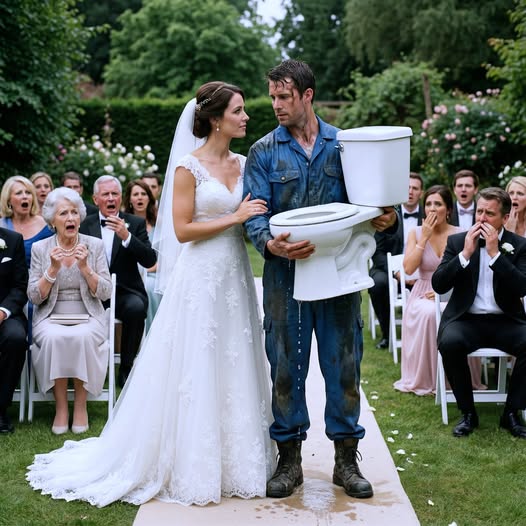
“We thought you would feel more at home here among your own kind. You know, manual laborers and service staff. It saves you the embarrassment of trying to keep up with the intellectual conversation at the main tables.”
The cruelty was so breathtaking, so precise, that for a moment I could not breathe. She was calling him stupid to his face in the middle of a ballroom, while sipping champagne she bought with money my father made from corporate law. She was reducing the man I loved to a stereotype because he knew how to fix a pipe.
I stood up, my chair scraping loudly against the floor. “We are leaving,” I said, my voice shaking. “We are not staying here to be insulted, Mom.”
“Come on, Marcus!” I grabbed Marcus’s hand, expecting him to be furious, expecting him to be ready to burn the place down. But when I looked at him, he was perfectly calm. He did not look humiliated.
He looked like a man watching a toddler throw a tantrum. He looked at my mother with a strange, unreadable expression, almost like pity. He squeezed my hand, anchoring me to the spot.
“No, Nia,” he said, his voice smooth and steady. “We are not leaving.” He looked at my mother and raised his glass of water in a mock toast.
“Thank you for your consideration, Mrs. Vance. It is very thoughtful of you to worry about my comfort. I am sure the conversation at this table will be far more honest than anything happening at the front of the room.”
My mother scoffed, rolling her eyes before turning on her heel and gliding away to greet a senator. I looked at Marcus, bewildered. “Why are we staying?” I whispered urgently.
“Why would you let them treat you like this?” Marcus pulled me back down into my chair and leaned close to my ear. His breath was warm, and his presence was solid, a rock in the middle of a storm. “Because if we leave, they win,” he whispered.
“If we leave, they get to tell everyone we were rude and ungrateful. We stay, we eat their food, we smile, and we let them play out their little tragedy. Let them show everyone exactly who they are, Nia.”
“Because when the curtain falls on this act, they are going to wish they had written a different ending. Trust me. Let them finish the show.” I did not know what he meant, but I trusted him.
So I sat in the back by the kitchen doors, holding the hand of a man worth more than everyone in the room combined, and watched my family celebrate their own ignorance. We found a hidden gem on the outskirts of the city called the Willow Creek Gardens. It was an old nursery that had been converted into an event space with winding paths covered in wisteria and a small gazebo that looked like something out of a fairy tale.
The best part was the price. The owner, an elderly woman named Mrs. Higgins, charmed by our story, offered us a cancellation rate that fit perfectly within our meager budget. For the first time in months, I felt a spark of genuine excitement.
I made the mistake of posting a single photo of the gazebo on my social media, simply captioned, “FOUND THE PLACE.” I should have known that my sister Keisha watched my feed like a hawk, looking for anything she could mock or destroy. Even though Keisha had secured the most expensive ballroom in Atlanta and was planning a destination wedding in Italy, she could not stand the idea of me having even a sliver of happiness.
She saw the post and immediately showed it to our mother. I can imagine the conversation perfectly. They probably laughed at how small it was, how rustic compared to their marble floors and crystal chandeliers.
But laughter wasn’t enough for them. They needed to ensure my failure was absolute. My mother realized she knew Mrs. Higgins from the garden club circuit, a group of wealthy women who spent more on orchids than most people spent on rent.
Patrice Vance picked up the phone not to congratulate me but to crush me. She called the venue owner and leveraged the family name. She told Mrs. Higgins that the Vance family did not sanction this union and that if she wanted to keep the contract for the upcoming charity gala hosted by my father’s firm, she would need to clear her calendar of any unauthorized events involving her wayward daughter.
I received the call from the venue three days later while I was sketching a landscape design at my desk. The manager sounded pained and awkward. “I am so sorry, Nia,” he stammered.
“But we have a scheduling conflict. We double-booked the date. We have to cancel your reservation.”
My heart stopped. “But we signed a contract,” I pleaded, my voice rising in panic. “I paid the deposit.”
“You cannot just cancel three weeks before the wedding. Every other venue in the city is booked or out of my price range.” The manager sighed and dropped his voice to a whisper.
“Look, it is not a scheduling conflict. Your mother called the owner. She made it very clear that hosting you would be bad for business.”
“I am sorry, kid, but Mrs. Higgins cannot afford to lose the Vance account. She told me to refund you immediately.” I hung up the phone and put my head in my hands.
They had taken the one thing I had managed to secure. It wasn’t enough that they weren’t coming; they had to make sure I had nowhere to go. I felt small and powerless against the crushing weight of their influence.
When Marcus came home that evening, I was sitting in the dark, the refund notification glowing on my phone screen. I told him everything through jagged sobs, expecting him to finally break, to finally scream or storm over to my parents’ house. Instead, he went very still.
