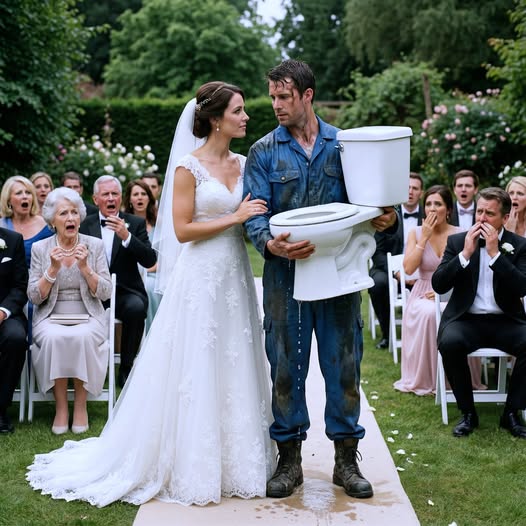
My father stood up abruptly, walking to the window that overlooked the manicured grounds of the estate. “Good men are a dime a dozen, Nia. Successful men, men of stature…”
“Men who understand the burden and the privilege of Black excellence, those are rare. Your mother and I worked our fingers to the bone to lift this family out of mediocrity. We built a legacy.”
“We navigate spaces that people who look like us were excluded from for generations. And now you want to bring a laborer into this house. You want to drag us back down.”
He turned to face me, his eyes cold. “I will not allow it.” I tried to interject to explain that honest work is not a disgrace, that character matters more than a job title.
He cut me off with a sharp wave of his hand. “Listen to me clearly because I will only say this once. If you marry this man, you are no longer a daughter of this house.”
“I will not have my name attached to such a spectacle. I will not have my colleagues and my fraternity brothers laughing behind my back because my daughter married the help.” He leaned over the desk, his face inches from mine.
“I will not spend a dime on that trash wedding. Not for the venue. Not for the dress.”
“Not for a single flower. If you want to throw your life away, you will do it on your own dime. Do not expect a check.”
“Do not expect a blessing. And do not expect us to be there to witness our own humiliation.” The words hung in the air, sucking the oxygen out of the room.
He was disowning me financially and emotionally because of my partner’s perceived tax bracket. He was choosing his reputation over his daughter. I realized in that moment that he did not see me as a person.
He saw me as an extension of his brand, and I was failing to meet the quarterly projections. I stood up, my legs shaking but my resolve hardening into steel. “I do not need your money,” I said, my voice quiet but firm.
“I wanted your presence. I wanted my father to walk me down the aisle. But if your love is conditional on my husband’s resume, then I guess I never really had it to begin with.”
I walked out of his study and out of that house. I sat in my car for a long time staring at the steering wheel. I checked my bank account on my phone.
I had my savings from my architecture job. It was modest, intended for a down payment on a house or an emergency fund. It was not enough for the grand wedding I had been raised to expect, but it was enough for something real.
I drove home to the small apartment I shared with Marcus. When I walked in, he was sitting at the kitchen table sketching something in a notebook. He looked up and saw my face, saw the red-rimmed eyes and the set jaw.
He did not ask what happened; he just stood up and held me. “We will do it ourselves,” I whispered into his chest. “Just us.”
And that is exactly what we did. We planned a wedding on a shoestring budget fueled by love and defiance, unaware that the storm was only just beginning. The reality of my father’s ultimatum hit hard when I sat down to look at my bank account.
I had just poured the majority of my savings into launching my own landscape architecture firm. It was my dream, a small studio dedicated to sustainable urban gardens, but in the startup phase, it was a financial black hole. I was living on ramen and hope, watching every cent that left my account.
Now with a wedding to plan and zero support from my family, the numbers on the spreadsheet looked less like a budget and more like a disaster. I sat at our small kitchen table, surrounded by receipts and brochures for budget venues. The cheapest floral package I could find was still more than my rent.
I rubbed my temples, feeling the familiar prickle of a stress headache. My parents’ voices echoed in my head, telling me I was settling, telling me I was destined for mediocrity. I refused to let them be right, but looking at the cost of catering for just 50 people, I felt a wave of despair.
Marcus walked in fresh from the shower, smelling of soap and the faint metallic scent of copper pipes. He saw my face, saw the red ink on the ledger, and immediately pulled up a chair next to me. He took my hand, his rough calloused fingers tracing the lines of my palm.
“Baby, put the calculator away,” he said softly. “We do not need to stress about this. I have some savings.”
“Let me pay for the wedding. I can cover the venue, the food, the dress, whatever you want.” I looked at him, my heart swelling with love but also a fierce protectiveness.
I knew how hard he worked. I pictured him crawling into crawl spaces, dealing with sewage backups, working late nights and weekends to build his plumbing business. I thought about the physical toll his job took on his body, the way he groaned sometimes when he stood up after a long day.
There was no way I was going to let him drain his hard-earned savings on a party just because my father was a tyrant. “No, Marcus,” I said, squeezing his hand back. “I cannot let you do that.”
“We are in this together. I know how hard you work for your money. I am not going to let you burn through your emergency fund for flowers and tablecloths.”
“We will figure this out. We will do something small. Something within our means.”
