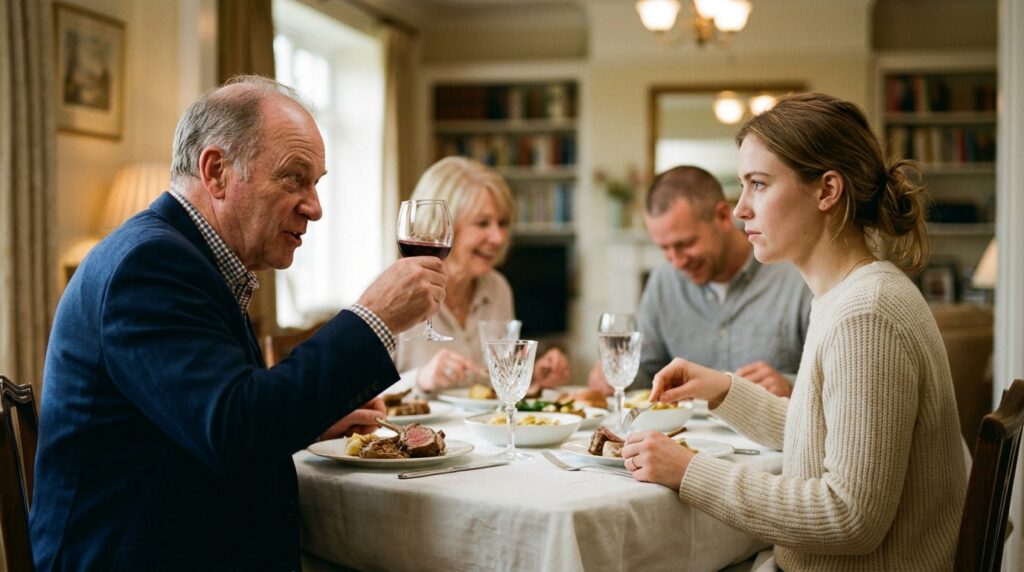
The Easter dinner
My father raised his glass at Easter dinner, looked right at me, and said, “Some children are a gift, others are just furniture.” The table erupted in laughter. My brother, his girlfriend, my aunt, even my mother’s nervous smile. I didn’t cry. I didn’t throw my napkin down and storm out.
I just set my fork on the rim of my plate very carefully and said, “Lucky for you, I just signed a lease on my own place, 2800 m away. You won’t have to look at the furniture anymore.”
The silence that swallowed that room was the most honest thing my family had ever given me.
Have you ever sat at a table where the laughter was aimed at you? Tell me where you’re watching from tonight. I want to know I’m not the only one.
I grew up in Columbus, Ohio, in a beige split level on a street where every yard had a basketball hoop and every dad coached something. Ours was no different. My father, Douglas, though everyone called him Doug, coached my brother Garrett’s little league team.
From the time Garrett was 7 years old, he wore the same Navy windbreaker to every game for 12 years and kept the schedule magnetized to the refrigerator like a second religion. My mother, Trudy, kept the house and kept the peace, which in our family meant the same thing.
And then there was me, the younger one, the girl, the quiet one who drew floor plans in her notebooks instead of hearts and kept a tape measure in her backpack like other kids kept lip gloss.
I am Willa. Not Willa, short for anything, just Willa.
And this is how I learned that some tables aren’t worth fighting for a seat at.
Growing up in the shadow
The favoritism wasn’t violent. That’s the thing that makes it so hard to explain to people who haven’t lived inside it. It wasn’t cruel in any dramatic way.
Nobody screamed. Nobody hit. It was subtler than that.
It was the way my father’s voice changed register when Garrett walked into a room, lifting half a note, warming like a house when the heat finally clicks on. It was the way my accomplishments were received with a nod, while Garrett’s were received with ceremony.
When I won the regional spelling bee in fifth grade, my parents took me to Applebee’s. When Garrett made the travel baseball team that same spring, they rented out the pavilion at Genoa Park and invited 40 people.
I remember sitting at the edge of that pavilion, eating potato chips from a paper bowl, watching my father sling his arm around Garrett’s shoulders in front of everyone, beaming like he’d personally manufactured the kid.
I spent most of my childhood trying to recalibrate, trying to figure out what frequency I needed it to broadcast on to get that same look. I tried soccer, too quiet for my father’s taste. I tried asking about baseball, about his stories, about the 1995 World Series, which he would discuss for hours if you gave him the opening.
For a little while, it worked. He’d lean back and talk, and I’d sit there absorbing every word like a plant turned toward the only window in the room.
But it was never quite the same.
When Garrett walked in, my father’s eyes moved. Not crually, not deliberately, just instinctively, the way a compass needle always swings north.
My mother saw it. I know she did because of the way she would sometimes reach over and squeeze my hand under the table during an inner a small private gesture as if she were saying I see you without ever saying it out loud.
But she never named what she saw. In our house, naming things was considered making problems worse. So she squeezed my hand and folded napkins and kept the piece.
And I learned to fold myself small in the same way.
I found architecture the way some people find religion, by accident in a moment of total desperation.
Phân cảnh 3: The architectural escape
I was 13. It was a Tuesday in February, and I was avoiding the living room where my father and Garrett were watching Sports Center loud enough to rattle the walls.
I had wandered into the garage where my grandfather’s old drafting table lived under a canvas tarp, and I lifted the tarp and just stood there.
The table was enormous, scarred with pencil grooves, still faintly smelling of graphite and something medicinal, like old rubber erasers. A set of drafting tools lived in a tin box beside it. Compasses, triangles, a worn-down T-square.
I didn’t know what any of them were called yet. I just knew they were precise, deliberate, that each mark they made was on purpose.
I sat down and drew a house, not a child’s house with smoke coming out of a chimney. A real house with rooms that made sense, with a hallway that flowed, with windows placed to catch morning light.
It took me 3 hours, and I had no idea where the time went.
When I came inside, the game was over, and my father had gone to bed without noticing I’d been gone.
That became the pattern of my adolescence.
While the rest of the house orbited Garrett, his games, his grades, his college recruitment visits, his mounting mythology, I retreated to the garage and drew buildings.
I checked out every architecture book the Columbus Metropolitan Library owned. I studied floor plans the way my brother studied batting averages. I taught myself about load-bearing walls, about passive solar design, about the difference between a party and a plan.
I built models out of cardboard and balsa, wood, tiny structures that filled the garage shelves my father never used.
He noticed them once.
He stood in the garage doorway on a Saturday morning, coffee in hand, and scanned the shelves with the expression he usually reserved for things he couldn’t make heads or tails of.
