“I don’t need you to fix it,” I said. “I just needed you to say it.”
My father got back on the line.
He didn’t apologize.
He wasn’t built for apologies the way some people aren’t built for certain kinds of music. The frequencies just don’t register.
But he said roughly, “The house. It sounds like you did good work on it.”
“I did,” I said. “I had a lot to work with.”
He made a sound that was almost a laugh.
“Right,” he said. “Okay.”
It was the most concession he knew how to make.
I accepted it as what it was.
After I hung up, I stood in my kitchen for a while.
The morning light was coming through the new windows at an angle I had specifically planned for, warm and low across the floor.
Outside, the neighbor’s dog was barking at something. The street was quiet the way streets are on holiday weekends.
I refilled my coffee and sat at the white oak table, the center chair same as always, and rested my hand on the surface.
In a few weeks, Garrett and Priya were getting married in Columbus, and I had a dress to pack and a flight to book and a person to be for a few days who was measured and present and genuinely happy for them because I was.
But right now, in this moment, in this room that I had built from studs and plans, and a drafting compass that had belonged to my grandfather, I was just myself.
No modifier, no comparison, no diminishment attached.
I thought about what my grandmother had said.
“The people who don’t see you, that’s their poverty, sweetheart, not yours.”
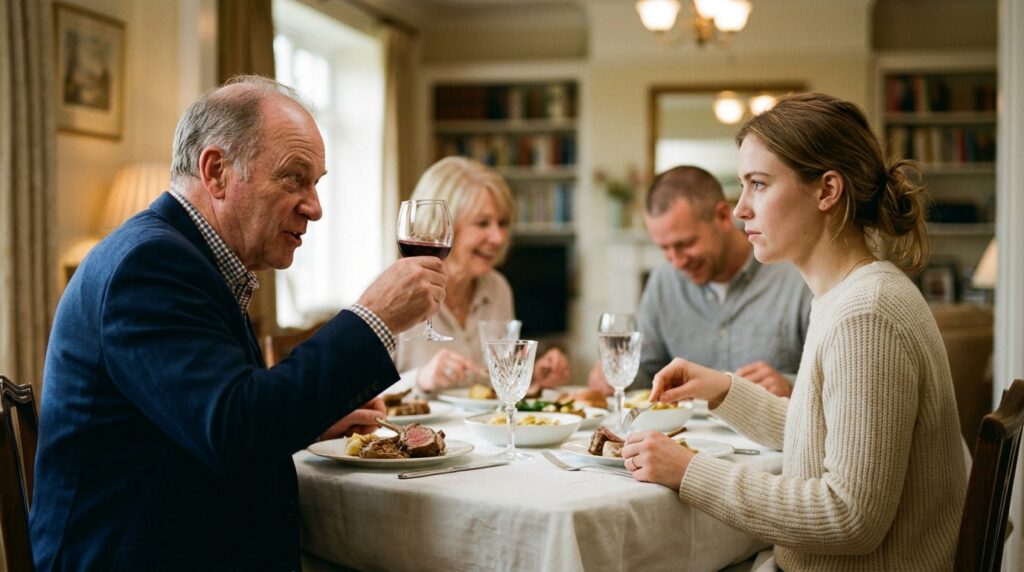
I thought about the Easter table, my father’s voice, the laughter, the 3 seconds that rearranged everything.
I thought about the tin box on the counter and the falling water postcard and the 12×4 apartment in Eugene with the leaking window and the single lamp I’d kept on late into every night because the work had to get done and there was no one to do it but me.
I thought about what it took to build something that holds not just a building but a life.
The long years of unglamorous labor, the maintenance of your own belief when everyone around you has looked away.
The choice made again and again to keep your hands on the work even when no one is watching, especially when no one is watching.
The old tin box caught the light from across the room.
A compass, two triangles, a worn T-square, tools for making things precise, for measuring exactly what is and marking exactly where you want to go.
I opened the box and took out the compass.
The hinge still worked perfectly.
I set the point against the oak table and drew slowly a small circle in the air above it.
Not touching, just the motion of it, the ark completing itself.
Outside, the city was waking up. Portland on a winter morning, gray and alive, the streets rain-wet and shining.
Somewhere a few blocks over, the bakery would be open by now.
Josephine would probably walk her dog past my gate around 9, and she would wave if she saw me in the window.
I set the compass down on the table.
I picked up my coffee.
I didn’t need a seat at anyone else’s table anymore.
I had eight chairs, all the same height, and every single one of them was mine to fill.
