At Strand Plus Co., I started on residential projects, then moved to adaptive reuse. Older buildings repurposed for new lives, warehouses becoming community centers, decommissioned schools becoming mixed-use housing.
It was exactly the kind of work I’d drawn in that garage without knowing the name for it.
My supervising architect, a meticulous woman named Dr. Petra Linskott, who had been in the industry for 30 years, told me six months in that I had unusually good spatial instincts.
She said it the way a doctor delivers good news. Matter-of-factly, without embellishment, which made it mean more, not less.
Three years in Strand Plus Co. made me a project lead.
I was 26.
I was the youngest person in the firm to hold the title, which someone mentioned at the team lunch they threw and which made me feel briefly like I existed in some undeniable way.
I called my mother that evening.
She said, “That’s wonderful, sweetheart.”
She told my father. I heard her saying it in the background.
He came on the line for a moment and said, “Good. Keep working hard.”
Then Garrett had apparently done something at his Wreck League game that weekend, and that’s where the conversation went.
I held the phone against my ear in my Portland kitchen for a few seconds after we said goodbye, listening to the silence of the call ending.
Then I set it on the counter and went back to my desk.
Phân cảnh 6: Defining success alone
Here is the thing nobody tells you about achievement when you’re chasing the wrong audience for it.
It doesn’t fill what you thought it would.
Every milestone I reached, I held up in my mind like a photograph. Look, look at this. Look what I made and turned it toward people who were facing a different direction.
After a while, the photographs just accumulated in a drawer somewhere inside me. Unclaimed, still beautiful maybe, but lonely in the way that beautiful things are when there’s no one to show them to.
I made friends slowly in the way introverted people do, one at a time, through sustained proximity, through late nights working on the same project, through the gradual accumulation of small trusts.
My closest friend was a structural engineer named Felix, who had an encyclopedic knowledge of Pacific Northwest geology and made extremely terrible coffee that he was extraordinarily terrible proud of.
He was one of those people who laughed with their whole body and remembered every detail you’d ever told them and never once made you feel like you were taking up too much of his time.
Felix was the first person I ever told about the garage drafting table.
We were sitting on the roof of our office building one evening after a long day watching the light go off the west hills, and it just came out: the drafting table.
My grandfather’s tin box of tools the three on my first real floor plan while my father watched baseball in the next room without y without knowing I existed.
Felix listened the way he always did, completely, and when I finished he said, “You built everything on a foundation nobody else could see.”
I thought about that for a long time afterward.
Phân cảnh 7: The final confrontation
The Easter invitation came via text, which was itself a kind of statement.
My mother: “Easter weekend, we’re doing dinner. Garrett and Priya will be here. Would be nice to have you.”
I stared at it for a while.
The flight from Portland to Columbus was manageable. I had vacation days I hadn’t used. Some part of me still carried the old belief that if I showed up enough something would eventually shift, that proximity might accomplish what distance had confirmed impossible.
So I booked the flight.
Garrett had gotten engaged the previous fall to a woman named Priya, who was warm and laughed easily and had the particular skill of making everyone in a room feel welcome, which I appreciated because it made the room easier to be in.
They were getting married in June.
I was invited to the wedding, which had been communicated through my mother in a slightly roundabout way that told me Garrett hadn’t thought to include me himself, but had agreed when my mother suggested it.
I’d said yes and meant it.
Priya deserved good people at her wedding, and I intended to be one of them.
Easter dinner was the same as every dinner I’d ever eaten in that house, organized around my father’s preferences, executed by my mother’s labor, narrated by Garrett’s highlights.
The table was set with the good china my mother only used for company, which technically meant she considered me company, which was something, I suppose.
The ham was beautiful. The rolls were from scratch. My mother had put tulips in a vase at the center of the table, yellow and white, and they were the most relaxed things in the room.
I had been there 24 hours, and nothing had been said about the project lead promotion. My mother knew I’d told her on the phone 3 weeks earlier, but she hadn’t mentioned it to my father, or if she had, he hadn’t found it interesting enough to bring up.
At dinner, Garrett talked about a potential promotion at his sales job, and my father lit up in the familiar way, leaning forward, asking follow-up questions, projecting confident opinions about how Garrett should handle the negotiation.
Priya caught my eye across the table once with a look that was not unkind.
I smiled back.
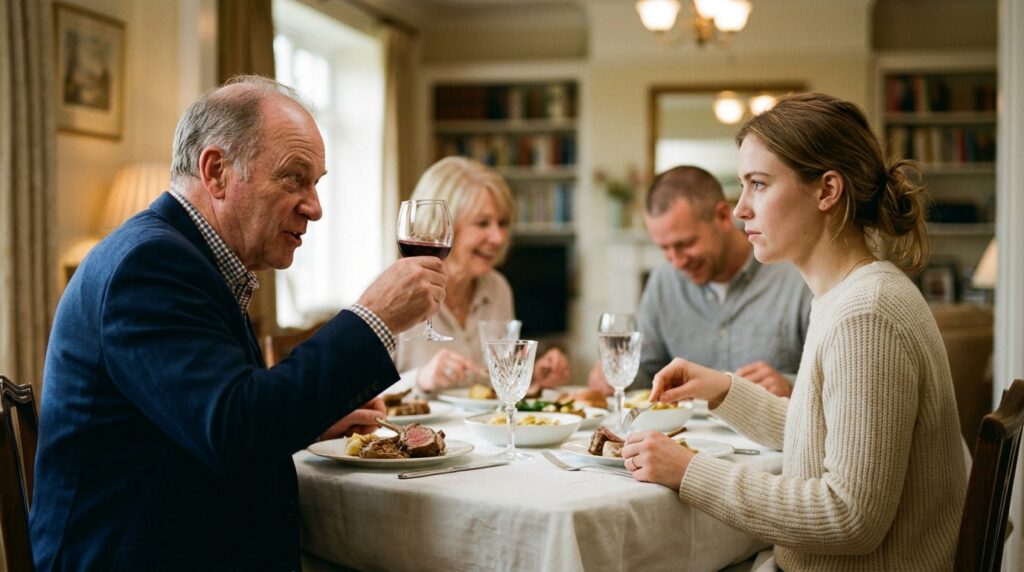
Then my father picked up his wine glass and cleared his throat.
He did this the way he always did when he was about to say something he considered important. The theatrical pause, the slight squaring of the shoulders.
He looked around the table. He let the moment build.
“I just want to say,” he began, “that I am a lucky man. Some children fill you up with pride.”
