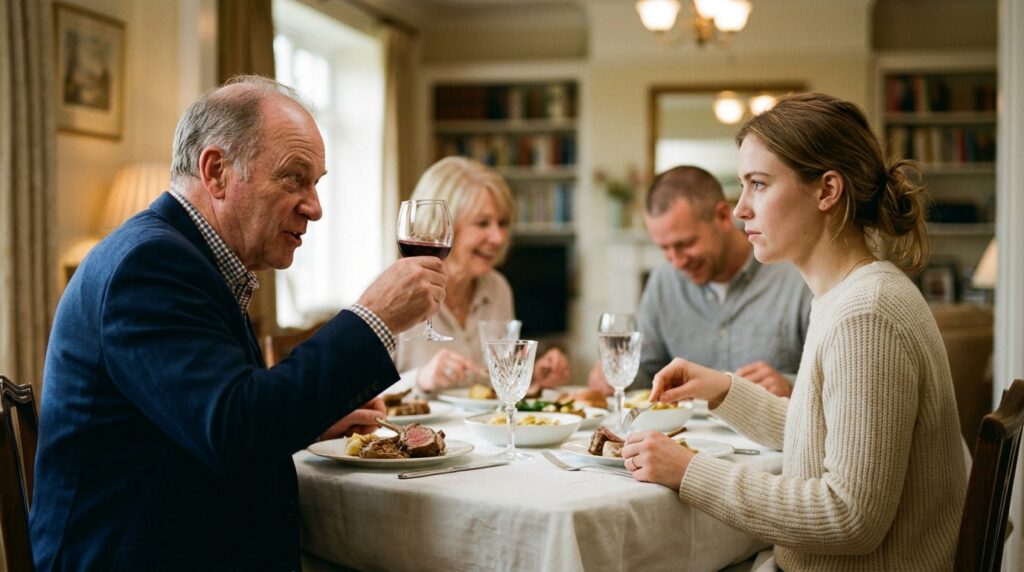
He raised his glass toward Garrett.
“And some…”
He glanced at me with the small indulgent smile he used when he thought he was being charming.
“Well, some are just furniture taking up space.”
He chuckled.
Garrett laughed.
My aunt, who was seated to my right, laughed behind her napkin.
My mother’s eyes dropped to her plate. Priya’s smile went careful and still.
I sat very quietly for about 3 seconds.
I want to be precise about those three seconds because they mattered.
In that span of time, something rearranged itself. Not shattered, rearranged. Like a room where someone has moved all the furniture to the walls and suddenly you can see the floor clearly for the first time.
I set my fork down on the edge of my plate.
I looked at my father and I said calmly, the way I’d say anything measured and true:
“Good thing I just signed a lease on my own place. 2800 m from here. You won’t have to look at the furniture anymore.”
The laughter stopped.
My aunt’s napkin came down from her mouth. Garrett’s smile stayed on his face, but his eyes went uncertain.
My father blinked.
He had not expected a response. He had not expected me to speak at all.
My mother’s head came up.
I held my father’s gaze for one full beat, not angry, not pleading, just steady, the way I’d learned to hold a line on a blueprint, even when my hands were tired.
Then I picked up my glass of water and took a sip.
The table did not recover its rhythm after that.
Conversations resumed in fragments, cautious and short. My father ate without speaking. My mother refilled the water pitcher twice out of pure nervous energy.
When dessert came, a lemon cake my mother had made from scratch, I had a slice and said it was delicious because it was.
After dinner, I helped my mother clear the table, and she worked beside me in silence for a while before she said quietly, “He doesn’t mean it the way it sounds.”
“Mom,” I said gently. “He means it exactly the way it sounds. He’s just never had to say so to someone who wasn’t going to absorb it.”
She was quiet again.
“Then you scared him. I think he didn’t expect that. That’s the thing about furniture,” I said. “It doesn’t usually talk back.”
She pressed her lips together, and I thought she might cry, but she didn’t.
She laughed, a small surprised sound, and covered her mouth.
And then we were both standing at the kitchen sink, slightly laughing, and it was the most honest moment we’d shared in years.
I flew back to Portland on Monday morning.
Phân cảnh 8: Recognition and redemption
6 months later, the project I’d been leading for the better part of a year was unveiled. A former textile mill in North Portland, four stories of brick and old timber converted into 60 units of affordable housing with a community garden on the roof and a maker space on the ground floor.
The project had won a regional design award before construction was even finished. And when it opened, the city paper ran a feature on it with a photograph that included me in it.
Hard hat, sight plans rolled under my arm, standing in the rooftop garden with the St. John’s Bridge visible behind me in the afternoon light.
The caption named me as lead architect.
My grandmother saw it.
Not my parents.
My grandmother on my mother’s side, a woman named Lorina, who was 81 years old and lived in a condo in Beexsley and read two newspapers a day out of what she called principal.
She called me the morning the article ran. She had somehow found it online, which was itself an achievement I deeply respected.
“Willa,” she said, and her voice had that particular texture it got when she was moved by something. A little rough, like fabric pulled tight.
“I’m looking at a photograph of you standing on a rooftop in Portland, Oregon, and I want to tell you something.”
“Okay, Gran,” I said.
I was sitting at my desk eating a breakfast sandwich, and I set it down.
“I want to tell you that I am not surprised. Not one bit.”
She paused.
“I used to watch you in that garage. You know that? Your grandfather’s drafting table. You used to go in there and you’d be so quiet, so absolutely still. And I used to think that child is building something in there. Nobody knows it yet. But she is.”
My throat closed.
I didn’t say anything.
“The people who don’t see you,” she continued. “That’s their poverty, sweetheart. Not yours. You understand me?”
“Yes,” I managed.
“Good.”
A beat.
“Now, tell me about the rooftop garden. Are they growing vegetables? I want to know if they’re growing vegetables.”
Creating a chosen home
The following spring, I bought a house.
It was not a large house. It was a 1940s Craftsman in the Woodstock neighborhood of southeast Portland. Narrow and deep, with a covered front porch and original hardwood floors and a kitchen that had been renovated somewhere in the 1990s in a way that was deeply unfortunate.
It needed work, real work, not cosmetic. The bones of it needed attention.
The plumbing was partial copper, partial something else, and the electrical had been touched by at least three different people over the decades.
I knew all of this going in.
That was precisely why I bought it.
I spent 8 months renovating it on evenings and weekends, doing what I could myself and hiring specialists for the rest.
I gutted the kitchen entirely and rebuilt it from the studs out, open to the dining room, white oak cabinetry, countertops the color of warm concrete.
I refinished the floors myself on my knees with a hand sander in the parts the machine couldn’t reach.
