I knocked out a wall between two small back rooms and created one larger one that became my home studio.
I installed three new windows in the living room to catch the afternoon light I’d mapped over the first winter before I bought the place.
In the center of the main room, I placed a dining table I’d had built by a woodworker in the Pearl District. Solid white oak, long enough for eight people, every chair the same height, no head and no foot.
I wanted no hierarchy in the geography of it.
I sanded the edge myself until it was smooth as water and sat at the center chair the night it was delivered and just stayed there for a while in the quiet of my own house, listening to the neighborhood settle around me.
I had my grandmother’s tin box of drafting tools on the kitchen counter. I’d asked for it when she moved to a smaller condo and she’d handed it over with both hands. The way you pass something you know matters.
I hadn’t opened it. I just kept it where I could see it.
I had no family photos on the walls. I had photographs of buildings.
Khan Sulkq Institute, Zaha Hadid’s Maxi in Rome, a small rural library in rural Japan that had won a prize for exactly the rightness of its proportions.
I had prints from local artists. I had a framed copy of my first design award certificate, not out of vanity, but because I had earned it alone, and it deserved a wall.
For the first Thanksgiving in that house, I invited everyone who had no particular place to go.
Felix and his partner, who was from Brazil and found American Thanksgiving baffling and therefore festive.
A junior architect in our office named Dileia, who had moved to Portland from Baton Rouge that September and still looked slightly stunned by the weather.
My neighbor from across the alley, a retired librarian named Josephine, who brought her homemade bread every time anyone in the neighborhood had reason to celebrate.
A professor from Portland State who had been a guest lecturer at a workshop I’d attended, and who said when I invited her that she hadn’t had Thanksgiving with real people in 4 years.
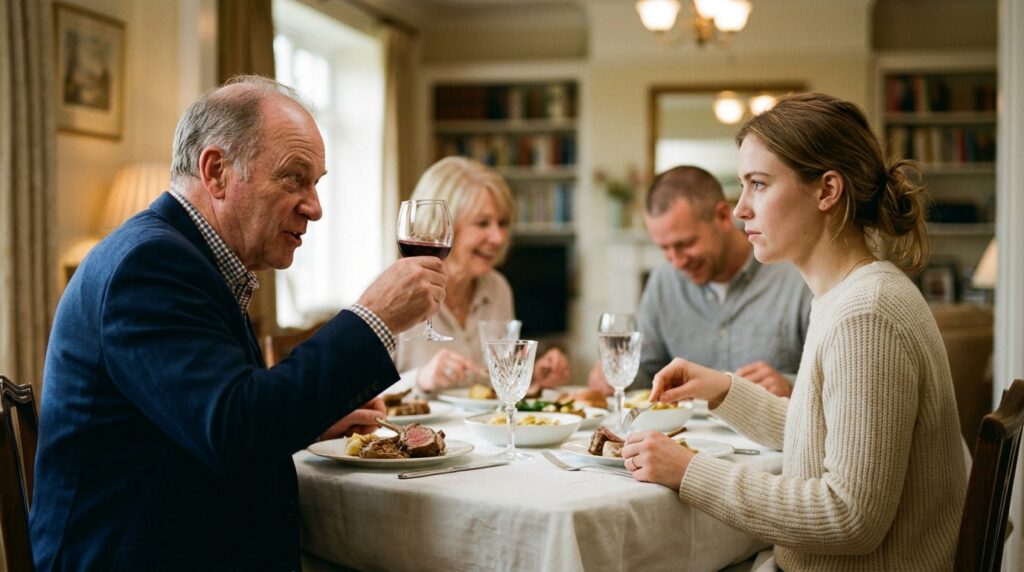
I cooked the turkey, and Felix made his objectively terrible coffee, and we played music, and there was no head of the table, and no one’s name went unspoken, and no one’s news went without a real response.
Josephine cried a little when she toasted the meal and said, “This is the kind of room I forgot existed.”
I knew exactly what she meant.
My cousin on my mother’s side, a woman named Cecile, who was one of the only people in my extended family who had ever said outright that she thought the way I was treated growing up was wrong, posted a photo from that dinner on her social media.
She captioned it something about chosen family and building your own table.
It got shared more than she expected.
Finding peace and agency
My father called the next morning.
I was standing in my kitchen in socks, holding a mug of coffee, watching the backyard through the window I’d installed myself.
The call surprised me.
He had not called me directly in, I calculated, nearly 2 years.
I answered.
“Willa,” he said.
His voice had the stiff quality it got when he was uncomfortable, when the emotional terrain he was standing on wasn’t terrain he’d chosen and didn’t know how to navigate.
“York posted pictures of your dinner.”
“I know,” I said.
I kept my voice even.
“People are sharing it. People are saying…”
He stopped.
“Saying things about our family.”
“I didn’t say anything about our family,” I said. “I just had people over for dinner.”
A silence.
“It looks like you implied,” he started, “that you had to build your own family because—”
“Because what, Dad?”
He didn’t answer.
In the background, I could hear a television. The low murmur of a morning show.
I heard my mother say something, and then the sound shifted and she was on the line.
“Willa.”
“Hi, mom.”
“I saw the pictures,” she said. “The house is beautiful. I didn’t know you’d… I didn’t realize the renovation was so far along.”
“It’s been done for a few months,” I said.
A pause, then quietly:
“It looks like you.”
I didn’t answer right away.
“What do you mean?” I asked.
“I mean it looks like something you made,” she said. “It looks like it came from you.”
I swallowed.
“It did,” I said. “All of it.”
She was quiet for a moment.
In the background, I heard my father say something to her, low and unintelligible. She said something back to him that I couldn’t make out.
Then, into the phone:
“I wish I had. I should have…”
She stopped.
“I know,” I said.
And I did.
I knew what the end of that sentence was. I’d been carrying the shape of it for years.
We didn’t say anything for a while. Just the static of a phone call between two people who were for the first time being honest with each other about the weather between them.
Then she said, “Your grandmother calls you every week, doesn’t she?”
It wasn’t quite a question.
“Every Sunday,” I said.
She told me she saw you standing in a rooftop garden in the newspaper. She said she cried.
I heard something change in my mother’s voice.
She cried.
She said she wasn’t surprised. I told her. She said she used to watch me in the garage and knew I was building something.
A long silence on the line.
“She always saw you more clearly than the rest of us,” my mother said.
And her voice was strange and small with honesty.
“I don’t know how to fix that, Willa. I don’t know if you want me to try.”
