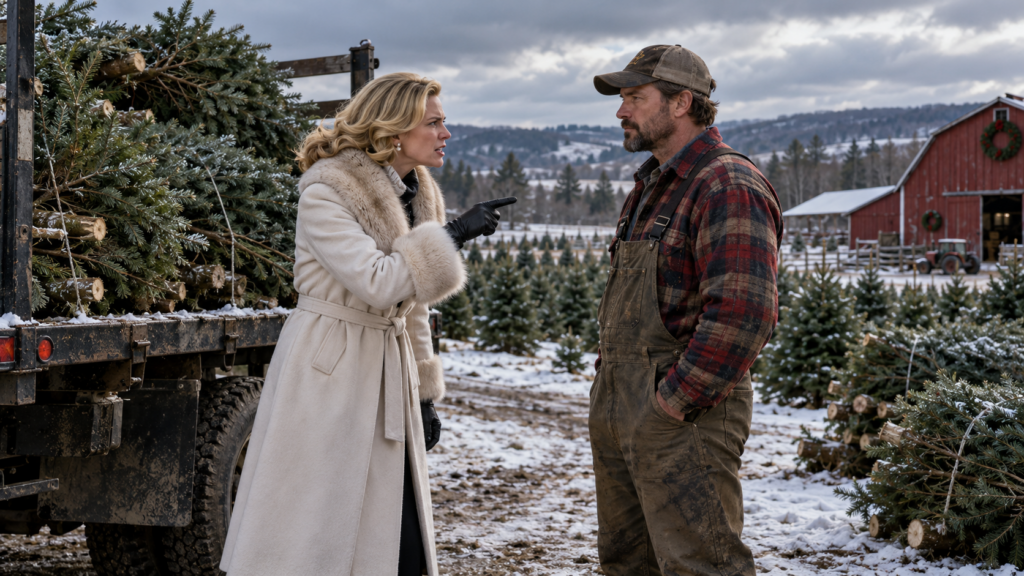
“You cannot park that truck here. This is a direct violation, and I will have you fined.”
I looked at the woman standing in front of my delivery truck, then at the survey marker six feet from her shoes.
“This line right here marks my property boundary.”
She barely glanced at it.
“The association rules still apply, Mr. Bennett.”
“No, they don’t.”
Her jaw tightened.
“You need to cooperate with the community.”
That was the first time I realized Patricia Holloway didn’t understand the difference between being HOA president and owning everything she could see.
My name is Cole Bennett.
My family had grown Christmas trees on forty-seven acres outside Cedar Grove, Pennsylvania, for three generations.
My grandfather planted the first rows in 1969.
My father expanded the operation.
By the time I took over, Bennett Christmas Farms supplied independent tree lots, garden centers, churches, and several regional retailers every November and December.
It wasn’t a hobby.
It was our livelihood.
Then Evergreen Hills appeared.
A developer bought the old soybean fields east of us and built nearly three hundred expensive homes behind decorative stone walls and wrought-iron gates.
The subdivision had walking trails, a clubhouse, a pool, and eventually an HOA president named Patricia Holloway.
Patricia’s first visit happened in October.
She drove onto my property without calling and parked beside the packing shed.
“I have a wonderful opportunity for you,” she announced.
That should have warned me.
Her idea was a “Christmas Tree Walk.”
Families from Evergreen Hills would stroll among my trees, take holiday photographs, drink cocoa, listen to carolers, and enjoy what she called “an authentic rural Christmas experience.”
Honestly, it wasn’t a terrible concept.
We occasionally hosted school groups.
But December was our busiest month.
Thousands of trees had already been tagged for wholesale buyers.
Crews were scheduled.
Trucks were booked.
I told Patricia I couldn’t commit without reviewing logistics, insurance, parking, and whether any usable section of the farm would be available.
She smiled.
“I’m sure we can make it work.”
“That isn’t a yes.”
“Of course.”
She left.
I thought the conversation was over.
Four days later, my neighbor Frank Delaney walked into the packing shed carrying a glossy flyer.
“You doing some big Christmas festival?”
“What festival?”
He handed it to me.
EVERGREEN HILLS PRESENTS
THE FIRST ANNUAL CHRISTMAS TREE WALK
A MAGICAL FAMILY EXPERIENCE AT BENNETT FARM
There was a photograph of evergreen rows beneath artificial snow.
My barn stood in the background.
Tickets were thirty-five dollars per family.
I stared at the flyer.
“I never approved this.”
Frank frowned.
“They’re selling tickets online.”
I opened the website.
The event had two time slots every Saturday and Sunday for three weekends.
Hot chocolate.
Professional photo stations.
Live music.
Children’s ornament workshop.
And “exclusive access to Bennett Farm’s private Christmas forest.”
Private was apparently decorative language.
Then I saw the number that made my stomach tighten.
SOLD OUT.
One thousand tickets.
Patricia had sold access to my farm before I had agreed to host anyone.
I called her immediately.
“You need to cancel this event.”
“Cole, don’t overreact.”
“You sold tickets to private property.”
“We discussed the event.”
“We discussed the possibility.”
“You never objected.”
“I specifically told you I hadn’t approved it.”
She sighed as though I were being difficult.
“We’ve already collected money. Vendors are booked. Families have made plans.”
“Then refund them.”
“That would damage the association’s reputation.”
“That isn’t my problem.”
Her voice hardened.
“Your farm benefits from this neighborhood. Property values around here have increased dramatically.”
“I sell Christmas trees, Patricia. I’m not listing the farm.”
“You could show some community spirit.”
“I could also fulfill the contracts I signed before you invented an event on my land.”
Silence.
“What contracts?”
“Wholesale orders.”
Another silence.
Then she said, “You’re not planning to cut the trees in the event area.”
It wasn’t a question.
“They’re already sold.”
“You can’t.”
I almost laughed.
“They’re my trees.”
“We photographed those rows for the promotion.”
“You photographed inventory.”
“Cole, one thousand families are expecting those trees to be standing.”
“And five commercial buyers are expecting them on trucks.”
She lowered her voice.
“You need to delay the harvest.”
“No.”
“If you destroy the event after we’ve sold tickets, the association will hold you responsible.”
That sentence told me exactly where this was heading.
So I stopped arguing.
I saved the event webpage.
Downloaded the advertisements.
Took screenshots showing the sold-out ticket count.
Printed every email Patricia had sent me.
Then I pulled our sales contracts.
Nearly four hundred trees in the photographed section had been sold months earlier.
Delivery dates were fixed.
Deposits had been paid.
My customers had done nothing wrong.
The following Monday, our harvest crew arrived before sunrise.
Chainsaws started at 6:30.
By ten, the first rows were opening up.
At noon, a tractor pulled a bundled load toward the packing area.
By two, the first forty-foot trailer was nearly full.
Then Patricia’s SUV came flying down the farm lane.
She stopped beside the loading crew.
Got out.
And stared.
Where her glossy brochure showed dense walls of perfect evergreens, there were now wide spaces between the remaining rows.
The trees weren’t destroyed.
They weren’t wasted.
They were being shipped to the people who had actually paid for them.
Patricia marched toward me with the flyer crushed in one hand.
“What have you done?”
“Worked.”
“You cut them down!”
“That’s generally how Christmas tree farming works.”
Her face turned red.
“You owe this association one thousand Christmas trees.”
Behind her, another loaded truck started its engine.
I looked at Patricia.
Then at the trees.
Then back at her.
“You sold one thousand tickets to land you never rented and trees you never bought.”
She pointed at me.
“We will sue you for every dollar.”
“Good.”
That stopped her.
I pulled a folder from the cab of my truck.
“Because if we’re going to talk about money, I think your homeowners deserve to know exactly how much you collected before you ever had permission to set foot here.”
