I saw payroll.
She saw a community amenity.
I saw my grandfather planting saplings in ground he had mortgaged everything to buy.
That difference explained the entire dispute.
After the authorized Christmas walk ended, Elaine stayed behind while we took down signs.
“You know,” she said, “I think people understand the farm better now.”
“That was worth doing.”
“We should make it annual.”
I gave her a look.
She raised both hands.
“With a contract.”
“Now you’re learning.”
We eventually did make it annual.
Small.
Controlled.
Always after the heaviest wholesale shipping week.
Some years weather canceled it.
Some years we skipped it because inventory was tight.
Nobody complained.
Permission remained permission.
A few Evergreen Hills families even became regular retail customers.
Instead of driving two hours to a giant tree attraction, they came to our small farm stand, bought wreaths, and learned which rows were actually open for choose-and-cut customers.
The neighborhood and the farm found a rhythm.
Patricia disappeared from HOA life.
Her event company closed the following year.
I heard she continued working in marketing.
I never spoke to her again until nearly four years later.
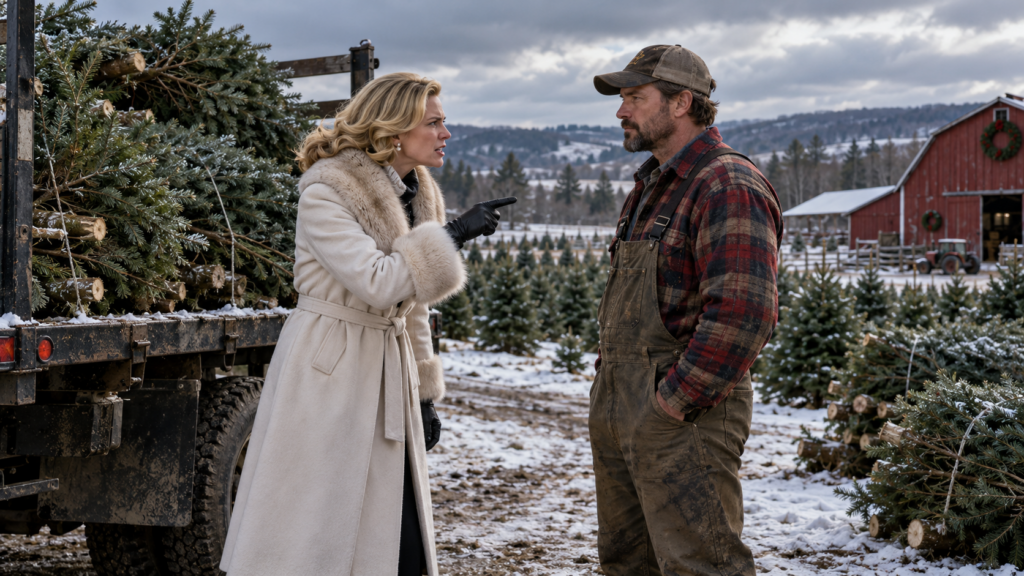
She came to the farm one December morning.
No blazer.
No binder.
She parked near the retail shed and waited until I finished tying a tree onto a customer’s SUV.
“I need a Christmas tree,” she said.
I looked at her.
“For your house?”
“Yes.”
I pointed toward the retail lot.
“Those are available.”
She walked through them for several minutes.
Finally she chose an eight-foot Douglas fir.
One of my employees brought it to the baler.
Patricia stood beside me while the machine compressed the branches into netting.
“I suppose you think this is funny.”
“Not really.”
“You won.”
I shook my head.
“There wasn’t anything to win.”
She looked toward the fields.
“I lost the board.”
“You lost their trust.”
“That’s what I mean.”
The worker finished wrapping her tree.
Patricia handed me her credit card.
Before I ran it, she said quietly, “I really thought you had agreed.”
I believed she believed that now.
Memory has a way of becoming friendlier to the person who made the mistake.
“I told you I would consider it.”
“I heard what I wanted.”
“Yes.”
She nodded.
Then she said something I never expected.
“I should’ve asked twice.”
“No.”
She looked at me.
“You should’ve waited for the answer once.”
For the first time in years, Patricia smiled.
Not the political smile she wore as HOA president.
A tired, embarrassed, ordinary smile.
“That too.”
I charged her for the tree.
Full price.
Some lessons should not be discounted.
After she drove away, my father’s old foreman, Ray Collins, came out of the shed.
“Was that her?”
“Yep.”
“You should’ve charged double.”
“That would be bad business.”
“Would’ve been good Christmas spirit.”
I laughed.
Ray had worked for my family since I was a teenager.
He remembered my grandfather.
Sometimes he still called me “kid” even though I was approaching fifty.
He looked across the fields.
“Your granddad would’ve enjoyed that whole mess.”
“He would’ve yelled more.”
“Definitely.”
Then Ray grew serious.
“He also would’ve kept shipping.”
That was true.
And maybe that was the part I was proudest of.
Through the entire dispute, Bennett Christmas Farms never missed a contracted delivery because of Evergreen Hills.
The first angry phone call came while we were loading trucks.
The HOA meeting happened while another crew was tagging rows.
Lawyers exchanged letters while we sharpened saws.
Patricia threatened fines while trees moved toward customers.
The business continued.
That mattered because confrontation can become intoxicating.
Once someone attacks what’s yours, it’s easy to make the fight your entire life.
But the farm didn’t exist to fight Patricia Holloway.
It existed to grow trees.
That lesson outlasted everything else.
Today, Evergreen Hills still sits east of us.
Their entrance is larger now.
The houses are more expensive.
They have newer bylaws and fewer arguments about trucks parked near my boundary.
Every December, I receive a formal email from the HOA asking whether we are available for the Christmas walk.
Sometimes I say yes.
Sometimes no.
Nobody prints a flyer until I answer.
On the wall inside my packing shed, I still keep one copy of Patricia’s original advertisement.
SOLD OUT — 1,000 TICKETS.
Right beside it hangs our wholesale shipping schedule from that same December.
Four hundred trees.
Five commercial buyers.
Every order delivered.
I keep both documents because together they tell the story better than I ever could.
One showed promises somebody made without permission.
The other showed promises my family had actually made—and kept.
Land ownership isn’t complicated in the way people sometimes pretend.
Rules can be complicated.
Insurance can be complicated.
Contracts can be complicated.
But the first question is usually simple.
Whose property is it?
If the answer is someone else’s, you ask.
You don’t advertise first.
You don’t sell tickets first.
You don’t invent consent because the event sounds wholesome.
And you certainly don’t threaten to fine the owner because his Christmas tree truck is parked on his own Christmas tree farm.
Patricia once told me the association rules still applied beyond the survey line.
They didn’t.
But one rule did apply to both sides.
Respect the boundary.
Once Evergreen Hills learned that, we became pretty good neighbors.
And every December, when families walk through the section of trees we deliberately open for them, I watch children race beneath the lights and parents take photographs.
It looks remarkably similar to the event Patricia imagined all those years ago.
There is just one important difference.
This time, they asked.
The end
Disclaimer: This content is entirely AI-generated for fictional and entertainment purposes only. Any resemblance to actual persons, living or dead, events, or locations is purely coincidental, and the creator assumes no liability for any interpretation of this content.
