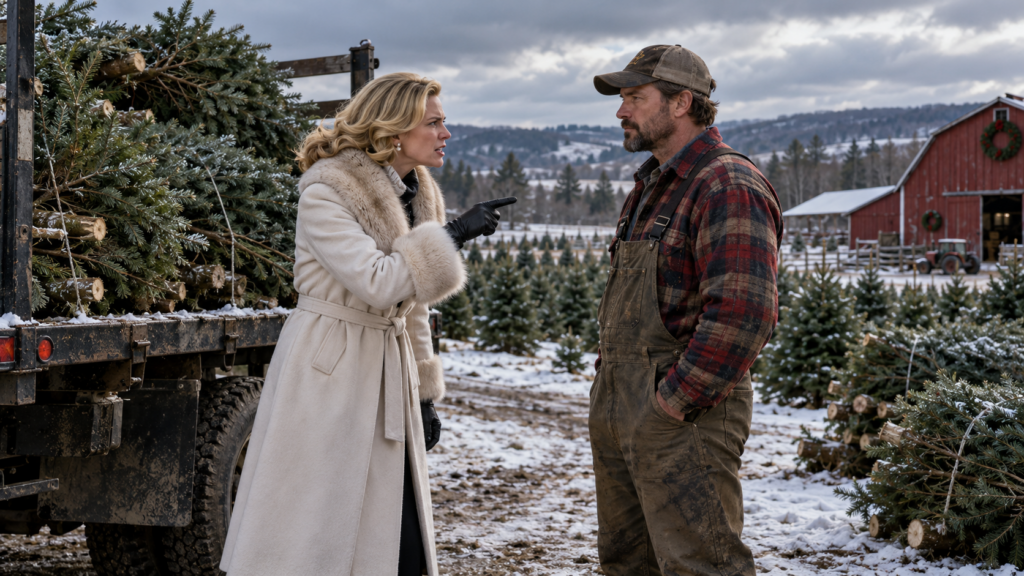
The board voted to cancel.
Patricia voted no.
The announcement went out on Thursday evening.
THE EVERGREEN HILLS CHRISTMAS TREE WALK HAS BEEN CANCELED DUE TO CIRCUMSTANCES BEYOND THE ASSOCIATION’S CONTROL.
Jason Keller replied to the entire community mailing list.
“Not beyond the association’s control. We sold tickets before securing the venue.”
That email became legendary.
Patricia demanded he apologize.
He declined.
Then the audit results came back.
The financial issue was not as dramatic as neighborhood gossip had predicted.
Patricia had not stolen thirty-five thousand dollars.
Most funds were still traceable.
But the board discovered she had awarded her own company a management contract without proper disclosure or documented approval.
That was enough.
Homeowners were furious.
They had been told the event was a community project.
They had not been told their HOA president intended to be paid personally for managing it.
Worse, Patricia’s company agreement included a cancellation clause allowing it to retain most of its fee even if the event failed.
Elaine stared at that document during the next meeting.
“You get paid because you organized an event on property you never secured?”
Patricia crossed her arms.
“I performed the planning work.”
“You planned something you had no authority to hold.”
“The farmer backed out.”
From the back of the room, Jason said, “He never backed in.”
People laughed.
Patricia slammed her gavel.
“Enough.”
It wasn’t enough.
The board voted to terminate the contract with Holloway Holiday Experiences and demand repayment of fees that had not been properly authorized.
Then they voted to issue full ticket refunds.
The HOA reserve fund covered the shortfall while disputes over vendor deposits were resolved.
Families got their money back before Christmas.
That mattered to me.
None of them should have lost thirty-five dollars because Patricia wanted a photograph.
A week before Christmas, Elaine and two other board members came to the farm.
Not Patricia.
Elaine carried a folder.
“We’ve formally removed all references to Bennett Christmas Farms from HOA marketing.”
“Thank you.”
“And the board would like to apologize.”
“You don’t owe me one personally.”
“We do as an organization.”
She handed me a letter.
It acknowledged that the farm never authorized the Christmas Tree Walk.
It also confirmed that Evergreen Hills claimed no regulatory authority over my property.
That sentence made me smile.
Elaine noticed.
“I insisted on that paragraph.”
“Best paragraph in the letter.”
“There’s one more thing.”
The board wanted to reimburse me for legal expenses directly caused by the dispute.
David had already advised me what documentation was reasonable.
I accepted.
Then Elaine looked past me at the remaining rows of Christmas trees.
“My granddaughter was really excited about walking through these.”
I understood what she was asking without her asking.
That gave me an idea.
But this time, we were going to do things in the correct order.
Part 4
The following October, Elaine called.
She was HOA president by then.
Patricia had lost a recall vote in January.
The vote wasn’t especially close.
Her undisclosed business arrangement mattered.
So did the unauthorized event.
But I think what finally ended her presidency was simpler.
Residents got tired of being told every mistake was someone else’s fault.
Elaine’s first question surprised me.
“Would you consider hosting something small at the farm this Christmas?”
I laughed.
“You’re brave.”
“I’m calling eleven months early.”
“Already an improvement.”
This time, we did it properly.
The HOA submitted a written proposal.
Forty families maximum.
One afternoon.
No commercial vendors.
No access to working harvest rows.
The association provided proof of insurance.
Parking remained on their side of the boundary.
Visitors would enter through a designated gate.
My farm would control the route.
And no ticket would be sold until both sides signed.
I charged them a modest site fee.
Not because I wanted the money.
Because permission should be unmistakable.
Elaine signed.
I signed.
David reviewed it.
Only then did they advertise.
The event sold out in two days.
On the Saturday before Christmas, children walked through a section of young Fraser firs that wouldn’t be harvested for several years.
We strung simple lights along the path.
My sister ran a cider table.
Wyatt Henderson from the local fire company brought a vintage engine decorated with wreaths.
Families took photographs.
No one wandered into active work areas.
No one interfered with deliveries.
No one pretended the land belonged to the HOA.
At one point, Jason Keller stood beside me watching his daughter hang a wooden ornament on a temporary display tree.
“Funny,” he said.
“What?”
“This was all Patricia wanted.”
“No.”
He looked at me.
“She wanted this without asking.”
That was exactly right.
The conflict had never really been about a Christmas walk.
If Patricia had come to me six months earlier with a real proposal, there was a decent chance we could have created one.
Maybe not during peak harvest.
Maybe not with a thousand families.
But something.
Her mistake was deciding my answer in advance.
She saw rows of trees.
She saw a festive backdrop.
She saw homeowners who would pay.
And somewhere between seeing an opportunity and printing the flyers, she stopped seeing an owner.
People do that with land more often than they realize.
A field looks empty, so they call it unused.
A forest looks beautiful, so they call it public.
A farm looks picturesque, so they treat it like scenery.
But working land is doing something even when outsiders can’t see it.
Those Christmas trees had been pruned for years.
Fertilized.
Protected from disease.
Tagged by buyers.
Counted as inventory.
Scheduled for harvest.
A twenty-minute holiday photograph represented seven or eight years of work.
That was why I couldn’t simply “leave the trees standing.”
The association’s event existed for one weekend.
My customers had built their own businesses around the deliveries I promised.
Some operated seasonal lots that earned most of their annual income in six weeks.
One delayed truck could affect dozens of families.
Patricia saw trees.
I saw contracts.
She saw atmosphere.
