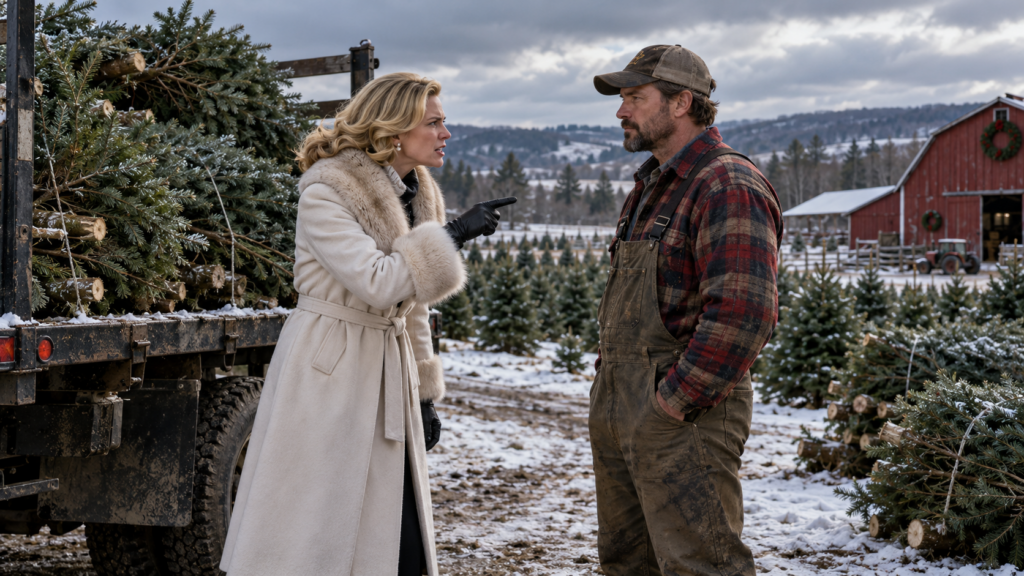
For the first time, Patricia Holloway looked genuinely afraid.
By sunset, half a dozen Evergreen Hills residents had driven to the farm after hearing the event might be canceled.
Most arrived angry.
I understood why.
They had paid for something advertised as guaranteed.
So I showed them the truth.
The original emails.
My response saying the event was only a proposal.
The wholesale contracts dated months before Patricia’s flyer.
And the county parcel map showing every advertised acre belonged to Bennett Christmas Farms.
A father named Jason Keller read the documents twice.
“So she sold us tickets before you agreed?”
“Yes.”
“Did the HOA pay you anything?”
“No.”
Another woman asked, “Did they even have insurance for an event here?”
“I never received a certificate.”
That changed the mood immediately.
People stopped asking why I had cut “their” trees.
They started asking where their money had gone.
The HOA called an emergency meeting that evening.
Patricia told residents I had unexpectedly withdrawn cooperation and sabotaged a charitable community event.
Then Jason stood up.
He had photographed my documents.
“You never had an agreement,” he said.
Patricia insisted our conversation created verbal authorization.
A board member asked whether counsel had reviewed that claim.
Another asked whether the HOA had permission to use my property in its advertising.
Then the treasurer, Elaine Porter, asked the question that made the room go silent.
“Patricia, where are the ticket proceeds?”
Nearly thirty-five thousand dollars had been collected. Only part of it appeared in the HOA event account. Patricia stared at Elaine.
“That money is committed.”
“To what?”
Patricia didn’t answer. Elaine closed her laptop.
“Then tomorrow morning, I’m reconciling every dollar.”
Suddenly, the missing Christmas trees were no longer Patricia’s biggest problem…
Elaine Porter called me at 8:11 the next morning.
“I owe you an apology.”
“You didn’t sell tickets to my farm.”
“I approved the event budget.”
“That’s different.”
“Not different enough.”
Elaine had been HOA treasurer for two years. She was a retired controller who believed receipts were a form of moral philosophy.
She had spent the night reviewing transactions.
The association had collected just over thirty-four thousand dollars in ticket revenue.
There were legitimate expenses.
A deposit for portable restrooms.
Hot chocolate supplies.
A photographer.
A local acoustic group.
Printing costs.
But almost nine thousand dollars had gone to a company called Holloway Holiday Experiences.
The address matched Patricia’s home.
“What was it for?” I asked.
“Event management and creative services.”
“Did the board approve that?”
“No.”
Elaine sounded furious with herself.
“It was buried inside the broader event package.”
That did not automatically make Patricia a criminal.
But it made the residents much less interested in blaming me.
The board froze further event spending and hired outside counsel.
Patricia, meanwhile, doubled down.
She sent me a formal demand letter accusing Bennett Christmas Farms of causing financial damage to Evergreen Hills by “withdrawing venue access after public reliance had been established.”
My attorney, David Kramer, read it over coffee.
“Did you sign anything?”
“No.”
“Accept payment?”
“No.”
“Provide event dates?”
“No.”
“Approve advertising?”
“No.”
He turned the page over.
“Then this is mostly theater.”
“What about her claim that I verbally agreed?”
“Your emails immediately afterward say you were considering the proposal. That helps.”
He smiled.
“And her decision to sell tickets before finalizing permission helps even more.”
David sent a response demanding that Evergreen Hills stop using my farm’s name and images in promotion.
We also required written confirmation that the event had been canceled and that no guests would be instructed to enter my property.
That last part became important.
Because Patricia refused to cancel immediately.
Instead, she posted an update saying the HOA was “working through an unexpected dispute with the venue owner.”
Venue owner.
As though I ran a banquet hall and suddenly got moody.
Then she told residents the first Saturday might proceed in a “modified format.”
I called David.
“What does that mean?”
“No idea.”
We found out two days later.
A landscaping crew arrived along the eastern boundary carrying temporary fencing and holiday decorations.
They began installing signs directing guests toward a walking trail.
Part of that trail crossed my property.
I drove over.
The crew supervisor showed me a map provided by the HOA.
A red dotted line labeled CHRISTMAS WALK ROUTE ran fifty yards inside my boundary.
“Stop work,” I said.
He looked exhausted.
“Sir, I’m getting different instructions from everybody.”
“I don’t blame you. But this is private property.”
I showed him the survey.
He called his office.
Ten minutes later, his crew packed up.
Patricia arrived as they were leaving.
She got out before her SUV fully stopped.
“You cannot keep obstructing a community event.”
“You cannot keep scheduling a community event on my farm.”
“We moved the route.”
“Onto a different section of my farm.”
She pointed toward my delivery truck parked near the boundary.
“You cannot park that truck here. This is a direct violation. I will have you fined.”
I looked down at the survey monument beside us.
“This line marks my property.”
“The association rules still apply here.”
“No.”
“Commercial vehicles visible from Evergreen Hills are prohibited.”
“Inside Evergreen Hills.”
“You’re deliberately creating an eyesore.”
“It’s a Christmas tree truck, Patricia. In December. On a Christmas tree farm.”
A crew member behind us coughed to hide a laugh.
Patricia heard him.
Her face hardened.
“I will make sure this business suffers.”
That was when I stopped seeing her as merely stubborn.
She was willing to hurt my farm because I wouldn’t rescue her from a mistake she created.
I documented the conversation.
Then I continued harvesting.
Truck after truck left that week.
Philadelphia.
Harrisburg.
Baltimore.
Independent lots in smaller towns.
Church fundraisers.
A garden center that had bought from my father for twenty-two years.
Every legitimate buyer got what they ordered.
Meanwhile, Evergreen Hills residents wanted refunds.
Some received them immediately.
Others didn’t.
The outside attorney warned the HOA that holding ticket money after the event became impossible could create additional problems.
