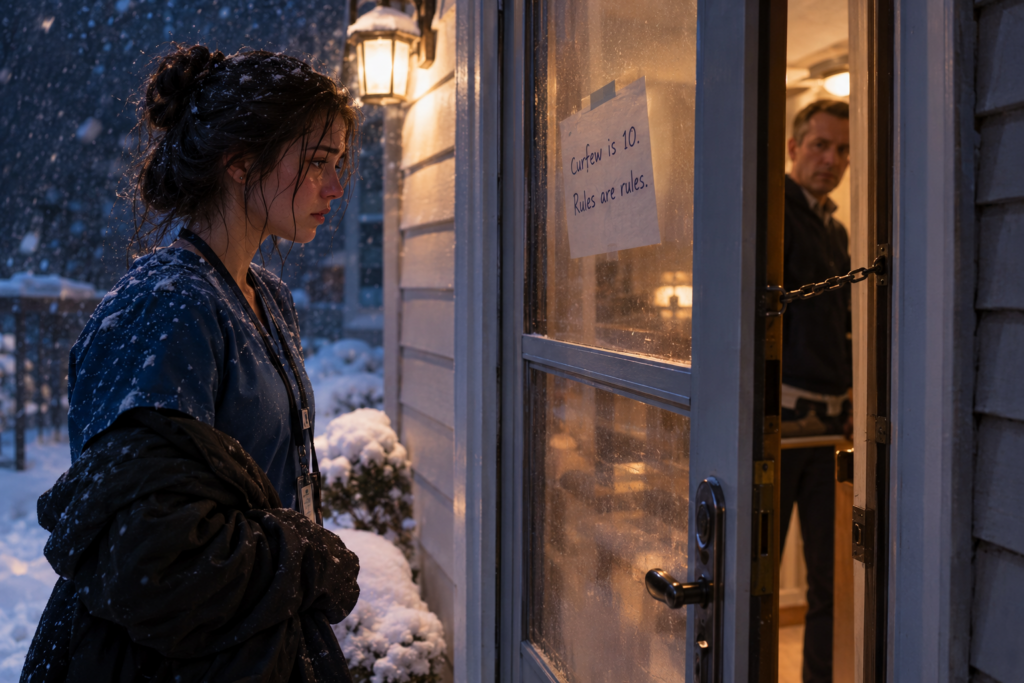
My dad had taped the note to the inside of the storm door. So, the first thing I saw at 10 after midnight, with snow up to my shins, was his handwriting.
“Curfew is 10. Rules are rules.”
My key turned. The door opened 3 in. and stopped against the chain. I had no coat because my coat was wrapped around a stranger in the back of an ambulance. My scrubs were damp from kneeling in a ditch, and the radio said it would be 12 below by 3.
I didn’t knock. I walked back to my car, checked the gas gauge, and dug the snow out of the tailpipe with my bare hands, the way I had done for that stranger an hour earlier. I was a nurse. I knew what a blocked pipe could do to someone asleep.
My phone buzzed, a number I didn’t know.
“Is this the nurse who stopped on County 75?”
By 9 the next morning, my mother would open that same door in her bathrobe to a woman holding a microphone.
Welcome back to Calm Drama Stories. Here we tell family stories about quiet women who finally stop shrinking, protect what matters to them, and build calmer lives on their own terms. So, pour something warm, get comfortable, and stay with me until the very end. Drop a comment and be sure to subscribe.
At 5 minutes after 7 that evening, my charge nurse put her hand on my shoulder and told me I wasn’t going home. Marisol Reyes had run the emergency department at the regional hospital in St. Cloud for 11 years. And she said it the way she said everything: kindly and without room for argument.
“You’re held, Kayla. Two of my night nurses are stuck on Highway 10, and a county plow just went over on its side near Foley. I need you till somebody gets here.”
The waiting room was full of people who had slipped on ice. There was a man with chest pain in bed six and a teenager with a dislocated shoulder in bed 9. I said okay because there was nothing else a nurse could say.
At 8:15, between a set of vital signs and a bag of fluids, I texted the family group chat: “Held over at work. Night nurses are stuck in the storm. Roads are bad. I’ll be late. I’m sorry.”
My mother liked it with a little heart. Under my father’s name, one word appeared a minute later.
“Red.”
That was all.
Marisol caught me looking at the screen.
“Your dad again?”
I nodded. She leaned on the counter.
“You know the night position is still open. 7 at night to 7:30 in the morning, $4.50 more an hour and nobody’s waiting up for you.”
I gave her the answer I always gave her.
“I can’t. House rules.”
At 1 minute after 10, I checked my phone again between two patients. Nothing. At 10:15, a night nurse named Brooke came through the ambulance doors with snow in her hair, apologizing to everybody. I gave her my report, grabbed my bag, and was scraping my windshield by 10:25.
While I scraped, I rehearsed my apology.
“I’m sorry, Dad. I couldn’t leave. They needed me.”
I said it out loud twice, the way I used to practice lines for school plays.
Highway 10 was closed, so I took County Road 75 towards Sock Rapids, driving 30 m an hour behind a wall of blowing snow. About 15 minutes out, my headlights caught something orange blinking under a drift in the ditch.
It was a pair of hazard lights, nearly buried. A sedan had gone nose first into the ditch, and the snow had piled over the back window. I pulled onto the shoulder, put on my own hazards, and called 911 before I did anything else.
You learned that in your first week of nursing school. You do not make two patients.
Then I climbed down. A man was sitting at the bottom of the ditch beside the driver’s door with his back against the tire. He was in his 70s with a white mustache and blood frozen on his forehead. His left wrist was bent at an angle wrists don’t bend.
“Dear,” he said through chattering teeth. “Went for the deer, then I went for the ditch.”
His name was Walt. He had tried to dig his car out, slipped, and couldn’t climb back up the slope with one good hand. His car had died. I braced my boots in the snow and let him use me like a fence post, and we crawled up together, one inch at a time.
I got him into the passenger seat of my car, where the heater was still blowing. His coat was soaked through at the shoulders, so I pulled it off him and wrapped him in mine, then tucked the silver emergency blanket from my trunk around his legs.
I didn’t rub his hands. You never rub them. I just kept him talking. He told me his wife’s name was Joanie. He told me he had driven a county plow for 31 years.
“I used to clear this road,” he said and laughed until he coughed.
Then I went back out into the wind and dug the snow out of my own tailpipe because I had parked tight against the drift. When I got back in, he asked what I’d been doing.
“Making sure we don’t breathe the exhaust,” I said.
He nodded slowly.
“Good girl. Joanie would like you.”
A state trooper named Hansen arrived at 11:20, and the ambulance came at 11:38, slow on the unplowed road. I gave the paramedic my report the way I would at work: time found, how long he’d been out, the wrist, the cut, how cold his hands had felt.
Trooper Hansen took my name and number for his report.
“If his family wants to reach me,” I said, “that’s fine.”
