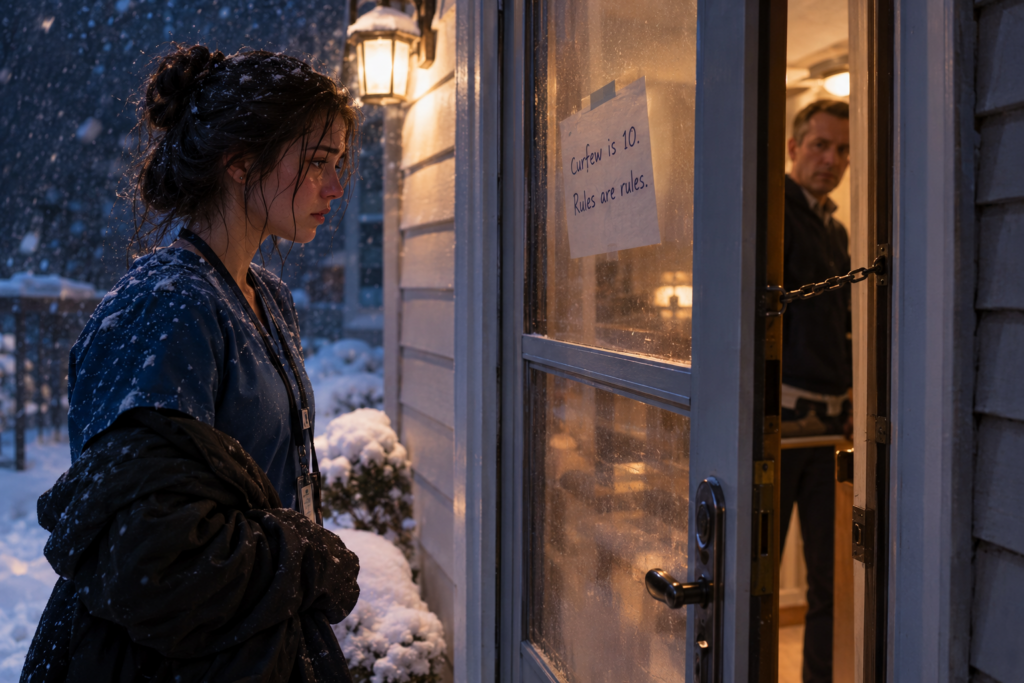
“You gave away your coat in a blizzard,” he said. “That’s not nothing.”
Then he told me about the plows. 31 years on county roads, most of them at night while everybody else slept.
“You know what I learned out there? The road doesn’t care whose rule it is. A drift is a drift. You either clear it or somebody freezes.”
He looked at me over his reading glasses.
“In this state, they’ll find you if you drive past somebody in trouble and don’t at least call it in. Did you know that? Minnesota says you have to stop. Your father’s house says you have to be home by 10:00. Seems to me you only broke one of those and it was the smaller one.”
Dana leaned forward in her chair.
“Okay, I’m just going to say it. Dad owns a duplex in Sock Rapids, 10 minutes from your folks. The upstairs has been empty since my mom died. The doctor wants somebody close by when he goes home in that cast, at least 6 weeks. And he won’t let me move in because he says I hover.”
Walt grunted.
“She hovers.”
Dana ignored him.
“The last tenant paid 750. No deposit. Please.”
I looked down at my hands. They still achd from the cold.
“I’d pay the deposit,” I said. “And I need to think about it.”
Walt nodded like that was the right answer.
“Thinking’s good. Just don’t do it in a driveway.”
I got home at 2 minutes to 6. The television in the living room was already on, tuned to channel 7, and my whole family was sitting in front of it like it was a funeral. Nobody looked up.
The segment was 90 seconds long. A photo of Walt in his hospital bed giving a thumbs up with his good hand. Dana standing outside her bakery saying the nurse had saved her father’s life. Me in my driveway talking about tail pipes.
Then my own voice filled the room.
“Yes. I got home at 10 after 12 and the chain was on.”
My father picked up the remote and turned the television off in the middle of my next sentence. His phone buzzed on the coffee table. He read it and his jaw went tight.
“Kitchen,” he said. “All of you.”
He sat at the head of the table. He put his phone face down beside his placemat, the way he did in staff meetings when he wanted everyone to know he had information they didn’t. My mother sat to his right. Tyler sat at the far end. I stayed standing until he pointed at a chair.
“That was Dr. Kesler,” he said.
Dr. Kesler was his principal.
“She asked whether I’d prefer to sit out the character counts assembly on Monday. Sit out. Three parents have called the school today. Three.”
He let that hang. Then he turned his phone over and read from the screen in a flat voice.
“Is this the same Mr. Mercer who gives kids lunch detention for being 2 minutes late to home room?”
He scrolled.
“Somebody should check on that girl.”
He set the phone down, screen up, so we could all see the bakery’s logo at the top of the post.
“26 years I’ve spent in that building teaching other people’s children that actions have consequences. And in one morning, my own daughter has made me a joke in the comments of a cupcake shop.”
He looked at me as if I’d written every comment myself.
“So, this is what’s going to happen tonight. You’re going to post on that bakery’s page. You’re going to say the story got exaggerated. The lock froze. You chose to stay in the car and you’re going to apologize to this family. Or,” he said, “you can move out by next Friday, and the car stays here because it’s mine.”
My mother’s hands were folded so tight on the table that her knuckles had gone white. Tyler was picking at his thumbnail. Then my father’s voice did something I had heard maybe twice in my life.
It cracked.
“I sat at Dy’s funeral when I was 17 years old. I watched my mother try to climb into the ground after him. Do you understand that? Everything I have ever done in this house, every rule on that refrigerator is so I never have to stand at one of those again.”
He believed it. That was the hardest part. He believed every word. And it still didn’t explain the garage.
I didn’t argue about the rules. I had spent my whole life arguing about the rules, and the rules had never been the point. I turned in my chair away from my father and looked down the table at my brother.
“Tyler,” I said, “what time did the garage open for you last night?”
My father’s hand came down flat on the table.
“That’s irrelevant.”
I didn’t look at him.
“I’m asking him.”
Tyler’s face went red from the collar up. He looked at our father and then at our mother and then at the salt shaker like it might have an answer. The refrigerator hummed. The clock over the stove ticked, the same clock I’d checked at 10:00 every night for 18 months.
“120,” Tyler said finally, very quietly. “Dad was in the kitchen. He opened it before I even hit the button.”
My mother turned her head slowly toward my father. I watched her face change, the way a patient’s face changes when the doctor finally says the word everyone in the room has been avoiding.
“You were up,” she said.
It wasn’t a question.
“You told me you’d turned your phone off and gone to sleep. You told me there was nothing anybody could do until 6.”
My father straightened his place. Matt.
“He asked permission, Linda. She didn’t. That is the entire point. That has always been the entire point.”
His voice was steady again. He had found his footing in the rule.
“She was holding a stranger’s head out of a ditch, Rick.”
My mother said it so quietly that Tyler leaned forward to hear.
