She was wearing her pale blue bathrobe, her hair still in its clip, holding the collar closed at her throat. On the front step stood a woman in a red parker with a microphone and behind her a man with a camera on his shoulder. A white van with a big seven on the side was parked at the curb. The woman smiled politely.
“Good morning, ma’am. I’m Nina Alrech with Channel 7. Is this where the nurse who slept in her car lives?”
My mother didn’t answer. Her hand tightened on her collar. Then she turned around and looked straight up the stairs at me, the way you’d look at a child who had just broken something expensive.
Nina kept going, still polite.
“There’s a post on the Facebook page for Brandt’s Bakery in Sartell. It’s been shared more than 3,000 times since early this morning. Walt Brandt’s family wants to thank the nurse who saved him on County 75 last night. They’d love for her to say a few words.”
Across the driveway, our neighbor Gloria Hogan stood in her driveway holding a shovel, not shoveling. My father appeared behind my mother, fully dressed now in his pressed slacks and his school fleece.
“Good morning,” he said in his principal’s voice, warm and firm. “There’s been some kind of misunderstanding. My daughter isn’t available right now.”
Nah looked past him up the stairs and saw me on the landing. She didn’t say anything about it. She just nodded once.
“We’ll be right out here,” she said.
My father closed the door halfway and spoke through the gap.
“Give us a few minutes.”
Then he shut it the rest of the way, slid the deadbolt, and turned toward the stairs. He didn’t look at me. He just said, “Kitchen.”
We stood around the island. My mother pulled her robe tighter. Tyler leaned in the hallway doorway with his hands in his pockets, trying to be furniture. My father spoke slowly, like he was dictating a memo.
“Here’s what happened. The lock froze in the storm. You didn’t want to wake the whole house, so you chose to wait in the car until morning. You’re going to go out there, thank them for the attention, and talk about the man. That’s it. Nothing else.”
My mother reached across the island and touched my wrist.
“Please, honey. Your father has parents at that school. You know how people are. They’ll twist it into something it wasn’t.”
Then my father reached into the pocket of his fleece and took out an index card. He slid it across the granite toward me. He had written my lines down. Three of them, numbered, in the same neat blue handwriting that had been taped to the storm door 12 hours earlier.
“One, thank you to the Brandt family and to Channel 7. Two, the front door lock froze during the storm and I chose not to wake my family. Three, I’m just glad Mr. Brandt is going to be okay.”
I stared at the card. I recognized the pen. It was the blue felt-tip he used to sign detention slips. He had sat down this morning, after my shower, after I fell asleep, and he had written me a script while the camera crew was still on the highway.
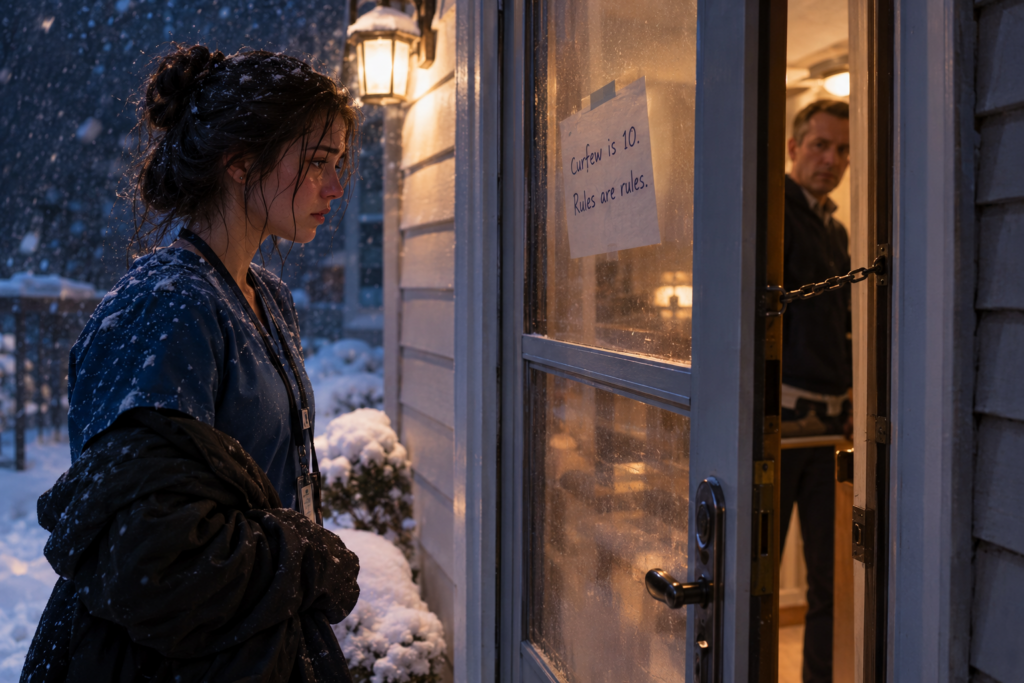
“The lock didn’t freeze,” I said. “The chain was on.”
My father’s voice dropped, the way it used to when I was little and had spilled something.
“Let me be very clear. The car you slept in last night is in my name. The roof you’re standing under is mine. Think hard about what you want to keep.”
Then, because he always did, he brought up Danny.
“I have stood at the grave of a 19-year-old who had no rules. You don’t get to make me the villain for keeping you safe.”
I looked at my mother. My mother was looking at the countertop. Outside, through the window over the sink, I could see the camera tripod in the snow.
“I need 5 minutes,” I said, and went upstairs with my phone.
I called Dana. She answered on the first ring, and she was already apologizing. She had written the post at 10 to 7 that morning, still furious, sitting in the ICU waiting room. She had thanked me, and then she had written the rest of it: the curfew, the chain, the 12 below.
When the station messaged her, she had given them my street.
“I should have asked you first,” she said. “I know that. I’m sorry.”
I closed my eyes.
“You didn’t say anything that wasn’t true,” I told her, “but from here on, I decide what I say about my own life.”
She was quiet a second.
“Yes, ma’am. That’s fair.”
Then her voice softened.
“Dad’s awake for real. They’re moving him downstairs this afternoon. He wants to see you.”
After we hung up, I sat on my bed and looked at the coat Dana had brought me in the middle of the night. A stranger had carried it out of an ICU and driven it across town at 2:00 in the morning so I wouldn’t freeze. My own mother had texted me from 30 ft away to keep the engine running.
I thought about the lines my father had written for me. The lock froze. I chose to wait. They were short and easy, and saying them would have made my whole family comfortable by lunchtime. I had said easier lies for him my whole life without anyone even asking.
But I had already told one lie for him last night, and it had sat in my stomach like a stone.
I put on the coat and went downstairs.
My father was waiting at the bottom of the stairs.
“Well?”
I zipped the coat up to my chin.
