They lifted Walt onto the stretcher and my coat went with him. I didn’t ask for it back. He needed it more than I did.
For the first time all night, I hadn’t thought about the clock. Then I got into my car and the dashboard said 11:55. I drove the last 10 minutes home telling myself that my father would understand.
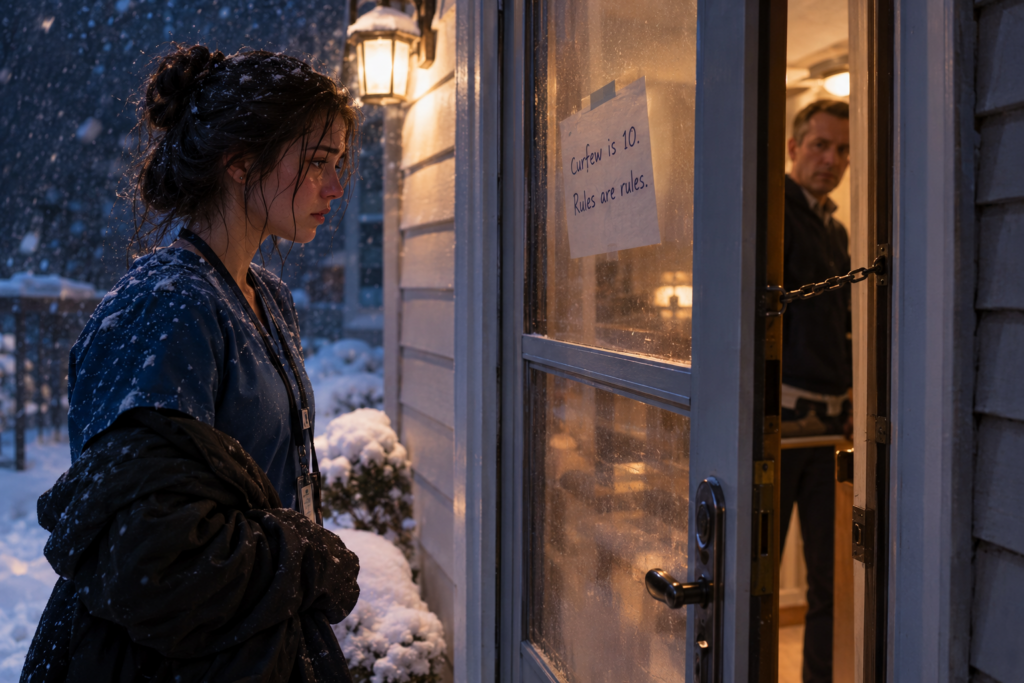
I had stopped for a man in a ditch. A man’s life was not a curfew violation. I believed that all the way up Larksburg Court, all the way up the front steps, all the way until the chain caught.
You already know how that part went.
At 12:20, sitting in the driveway with the engine running, I called my father. It rang five times and went to voicemail. I called again. Voicemail. I called my mother and she didn’t pick up either.
But at 12:31, a text came through.
“I’m so sorry, honey. Please keep the engine running. Your father is firm on this. Doors open at 6.”
I read it three times. The third time, I understood what it meant. My mother was awake. My mother knew. And my mother had decided to go back to sleep.
I sat with that for a while, watching my breath fog the windshield. And I did the math the way I always did, as if the right numbers could make it make sense.
18 months earlier, I had graduated with a nursing degree and $38,000 in student loans. My father had sat me down at the kitchen table and offered what he called the deal.
“Live here, save your money, follow the rules.”
I paid $600 a month in board on the first, no exceptions. I paid him another $150 a month toward the blue Corolla, which was still in his name and on his insurance.
The rules were printed, laminated, and stuck to the refrigerator with a magnet from his school. Curfew at 10, 11 on Saturdays. No locked bedroom doors. Phone location shared at all times. Guests approved 48 hours ahead. And at the bottom, underlined: “Doors open at six.”
My brother Tyler was 20 and lived under the same roof, and none of those rules had his name on them. He worked at a tire shop and took classes at the community college, and he came and went like weather. When I asked about it once, my father didn’t even look up from his grading.
“Your brother isn’t the one who will be walking to a car alone at night.”
I had stopped asking after that.
Sitting in the driveway now, I thought about calling a third time, but calling a third time would have been begging, and begging had never worked in our house. So, I turned off the engine to save gas, pulled my knees up inside my scrubs, and listened to the wind, and I thought about the porch swing.
I was 17 that October, the stage manager for the fall play at the high school. Our last dress rehearsal ran long, and then the director’s car wouldn’t start in the parking lot. A freshman named Ava was still waiting for her ride, 14 years old, standing alone under the one working light. Her parents were 40 minutes away.
I couldn’t leave her there. Nobody should have had to tell me that and nobody did. I waited with her until her mother’s minivan pulled in and then I drove home as fast as I dared.
I walked up the front steps at 10:40. The door opened 3 in. and stopped against the chain. I knocked softly, just once. The light in my parents’ bedroom window went out. That was the answer.
It was 38°. I found the plastic tarp my father used to cover the patio furniture, wrapped myself in it, and lay down on the porch swing. Every time I moved, the chains creaked, and I tried not to move. I watched my breath and counted the cars that passed. There were four.
At 6:00 in the morning, I heard the chain slide. My mother opened the door with red eyes and handed me a mug of hot cocoa without looking at my face. My father was already at the breakfast table with his coffee and the newspaper as if it were any other Saturday.
“Consistency is love, Kayla,” he said. “The world doesn’t make exceptions, so neither do I.”
Then he told me again about his brother, Dany. Dany was 19 when he drove into a tree at 1:00 in the morning coming home from a party. My father was 17. Their parents had never set a single rule.
“Rules are how I keep you alive,” he said and turned the page.
I got bronchitis that week and went to rehearsal anyway, coughing into my sleeve. Nobody in my family mentioned that night again. Ava gave me a thank-you card on opening night. I hid it in my desk drawer because it felt like proof of a crime, and I made myself a promise I kept for seven years.
I would never be late again.
Now I was 24. I had a license that said I could keep people alive. And I was still on the wrong side of that chain.
I started going over the night the way I’d go over a chart, looking for my mistake. That was my habit. I had built a whole life out of not making mistakes. Straight A’s, home early, apologizing before anyone could be disappointed in me.
I had become a nurse partly because it was work my father couldn’t find fault with. At my pinning ceremony, he hugged me and said, “I’m proud of you.” Then he stepped back and added, “Now don’t get a big head.”
