“Forgiveness does not require amnesia.”
“That sounds like something you’d put in an opinion.”
“Then I’m retiring before I become unbearable.”
He froze.
“What?”
I smiled.
“I said I’m retiring.”
“When?”
“At the end of the year.”
His face fell.
“Because of what happened?”
“No.”
That was true.
Mostly.
I had already been considering it.
Thirty-four years was a long time to carry other people’s conflicts home in your mind.
My husband and I had once planned to travel after retirement.
His death changed that plan.
For years, I remained on the bench partly because work gave shape to grief.
But the corridor incident clarified something.
I did not want my final years defined only by authority.
I wanted to learn who I was when no one called me Your Honor.
Six months later, Vanessa came to see me again.
This time, Daniel came with her.
She looked healthier.
Not happier exactly.
More settled.
She was working for a small legal aid organization on a temporary basis, mostly doing housing consultations and intake.
“It pays almost nothing,” she said.
“That can be educational.”
She smiled.
There was no defensiveness in it.
“I deserved that.”
“No, you didn’t. It was merely an observation.”
Daniel groaned.
Vanessa laughed.
A real laugh.
It startled me.
We ate dinner.
For the first hour, conversation stayed safely on weather, Daniel’s latest case, and the neighbor’s dog.
Then Vanessa set down her fork.
“I need to tell you something.”
Daniel looked at her but said nothing.
“I was in court last week.”
My body went still.
“As counsel?”
“Not yet. Observing.”
She folded her hands.
“There was an older woman there representing herself in an eviction matter. She was wearing a coat that was too big, and she kept dropping her paperwork.”
I waited.
“The attorney on the other side got irritated with her. Kept sighing. Talking over her.”
Vanessa stared at the table.
“I knew exactly what everyone in the room was thinking.”
“What?”
“That she was slowing everything down.”
She lifted her eyes.
“And suddenly I saw you.”
My throat tightened.
“I went outside with her afterward. Helped organize the papers. Called someone at the office to see whether we could take the case.”
“That was kind.”
“No.”
She shook her head.
“It was decent. There’s a difference.”
I smiled slightly.
“Yes.”
“I used to think kindness was something people did when they had extra time.”
“And now?”
“Now I think decency is what you owe someone before you know whether they’re important.”
For a moment, none of us spoke.
Then Daniel reached for her hand.
She let him.
They were still rebuilding.
I could see it.
Love after betrayal does not resemble untouched love.
It moves carefully.
Checks the floor before placing weight on it.
Sometimes that caution is weakness.
Sometimes it is wisdom.
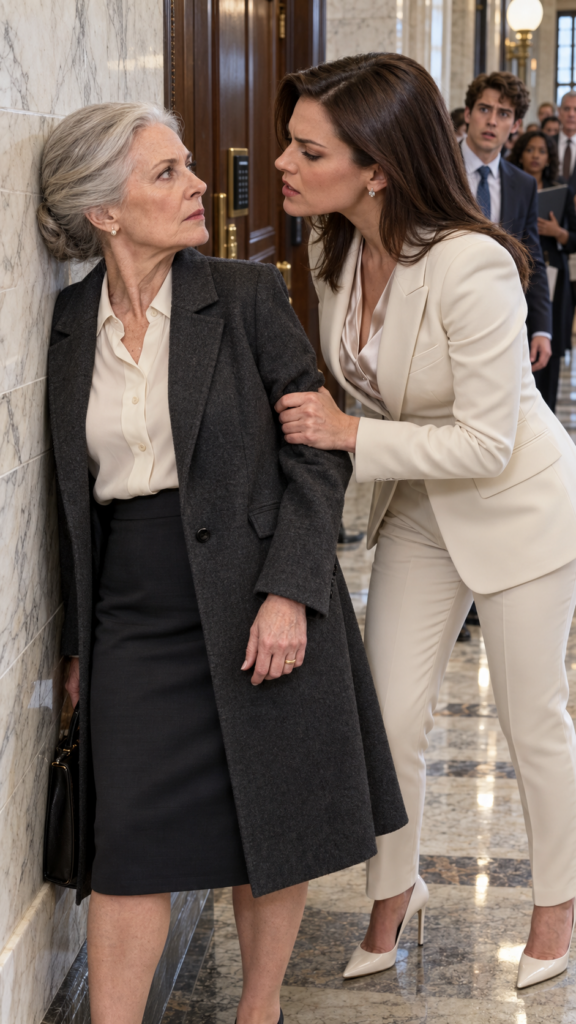
Later that year, on my final morning as a judge, I walked through the same courthouse corridor where Vanessa had shoved me.
The marble wall looked ordinary.
That surprised me.
Places rarely carry the meaning we assign them.
People do.
Noah Pierce, no longer quite so nervous, met me near chambers.
“Last day, Your Honor.”
“So they tell me.”
“You sure you don’t want another ten years?”
“Absolutely.”
He grinned.
Then he glanced toward the wall.
“I still think about that morning.”
“So do I.”
“I almost stepped in.”
“You should have.”
His smile vanished.
“I know.”
I touched his arm gently.
“Remember that.”
He frowned.
“Remember what?”
“That uncertainty is not always a reason to remain silent.”
I looked down the corridor.
Clerks rushed past us.
Lawyers argued softly into phones.
A woman balanced a paper cup of coffee on top of three binders.
Everyone was late for something important.
“I’ve spent most of my career watching decent people hesitate,” I said. “They see someone being humiliated and think, I don’t know enough. It isn’t my place. Someone else will handle it.”
Noah nodded.
“I did that.”
“Yes.”
“I’m sorry.”
“Then do differently next time.”
He smiled.
“I will.”
Inside my chambers, my robe hung beside the desk.
For decades, that robe had altered the way people looked at me.
It made strangers stand when I entered rooms.
It made lawyers choose their words carefully.
It made angry men lower their voices.
But the most important lesson I carried from that courthouse had come on a morning when I was not wearing it.
Vanessa had looked at my plain coat.
My low shoes.
My silver hair.
My unremarkable wedding band.
She had decided those things told her what I was worth.
And because she believed I had no power, she allowed herself to become cruel.
That was her failure.
But I would be lying if I said the lesson belonged only to her.

