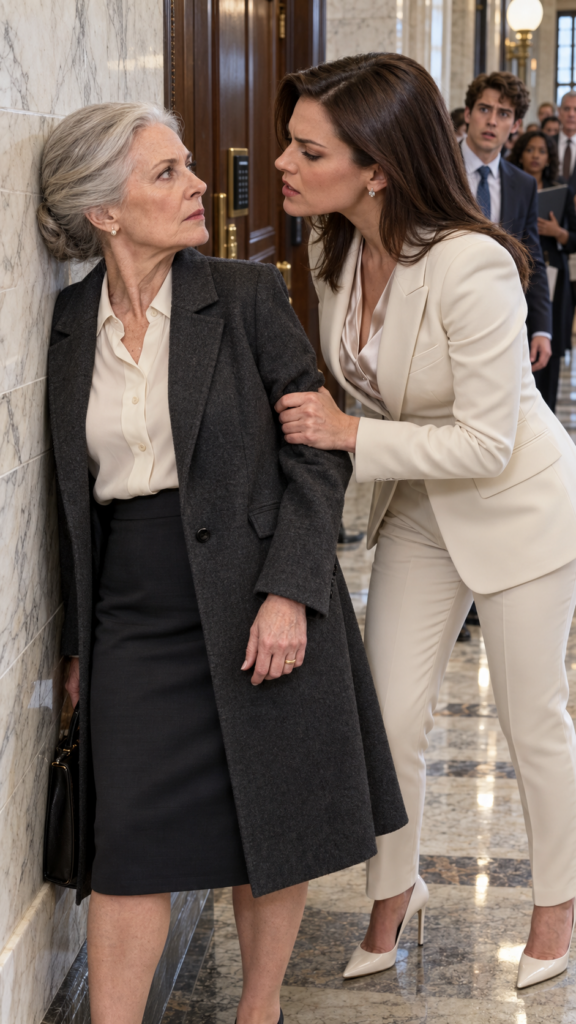
“Apparently someone told them there may have been physical contact.”
“Was the corridor camera active?”
“It covers the chambers entrance, not the whole hallway.”
“Does it show what happened?”
“I don’t know.”
I set the paper down.
“Preserve it.”
Elaine nodded but did not leave.
“What?”
“There’s more.”
I waited.
“Ms. Holloway is downstairs telling people there was a misunderstanding. She says you became disoriented, entered a restricted area, and she reached for you because you almost fell.”
For the first time since Vanessa pushed me, anger rose hot enough that I felt it in my throat.
“She said I almost fell?”
“Yes.”
I looked toward the closed chambers door.
The issue had changed.
She was no longer trying to survive a moment of shame.
She was constructing a story.
And she was using my age to do it.
“Who heard her?”
“At least two members of her firm. Possibly a reporter.”
That last word mattered.
“Has anyone spoken to media?”
“Not officially.”
I stood.
Pain stabbed my shoulder.
I ignored it.
“Get the security footage preserved. Also ask Marcus Bell and Noah to write factual incident statements before anyone discusses the event with them.”
Elaine’s eyebrows lifted.
“You are reporting it.”
“I’m preserving what happened.”
There is a difference.
At least, I told myself there was.
That afternoon, I received a text from Daniel.
Mom. What happened?
I stared at those four words longer than I should have.
Then another message appeared.
Vanessa called me crying. She said there was some kind of misunderstanding at court.
I typed a reply.
We need to speak in person.
Three dots appeared.
Vanished.
Returned.
Is she in trouble?
I almost wrote: Ask her.
Instead, I placed the phone facedown.
For years, I had believed silence was a form of restraint.
That day I began to understand that silence could also become a place where someone else wrote the story for you.
And Vanessa was already writing hers.
PART 3: WHAT MY SON HAD NOT TOLD ME
Daniel arrived at my house shortly after seven.
He still had his suit on.
His tie was loosened, and his hair had the disorder it always acquired when he had been running his hands through it.
At forty, my son had begun to resemble his father around the eyes.
That made difficult conversations harder.
I opened the door.
He hugged me automatically.
Then he stepped back.
“Are you okay?”
“My shoulder is sore.”
His face changed.
“She actually hurt you?”
I let him inside.
We went to the kitchen.
The house was the same one Daniel had grown up in, though nearly everything inside it had been replaced at least once.
He sat at the old oak table.
I remained standing.
“What did Vanessa tell you?”
“That you showed up at the courthouse unexpectedly. She said you went into a restricted corridor and she tried to stop you. She said you lost your balance.”
I said nothing.
Daniel’s face tightened.
“She said you were upset.”
“Was I?”
“I wasn’t there.”
“No. You weren’t.”
He looked down.
“Mom, just tell me what happened.”
So I did.
I gave him the facts.
Not my conclusions.
Vanessa confronted me.
She accused me of being confused.
She grabbed my arm.
She pushed me against the wall.
She told me not to tell anyone I was related to her.
She claimed Daniel had been worried I should no longer travel alone.
When I reached that final point, he looked up sharply.
“She said what?”
“That you had been trying to convince me I shouldn’t travel alone anymore.”
“I never said that.”
“I know.”
His chair scraped backward.
He stood.
“Jesus.”
“Sit down.”
He did.
For several seconds, he stared at his hands.
Then he whispered, “This is my fault.”
“No.”
“I should’ve told you.”
That sentence settled heavily between us.
“Told me what?”
He looked at me.
“Vanessa has been telling people things about you.”
I did not move.
“What things?”
“That you’re forgetful.”
My mouth went dry.
“She’s said you sometimes repeat yourself. That you get overwhelmed in the city. That after Dad died, you became more dependent.”
I almost laughed.
Not because it was funny.
Because grief sometimes leaves a person with no other sound.
“I have lived alone for six years.”
“I know.”
“I still sit on the bench.”
“I know.”
“I drove myself into Chicago this morning.”
“I know.”
He rubbed his face.
“She mostly said it around her friends. Sometimes coworkers. I thought it was exaggeration.”
“Why?”
He did not answer.
“Daniel.”
“Because she’s insecure about you.”
That surprised me more than the lies.
“About me?”
“She thinks you judge her.”
“I rarely discuss her career.”
“That’s part of it.”
I frowned.
He struggled for words.
“You don’t seem impressed by titles. Or money. Or the firm.”

