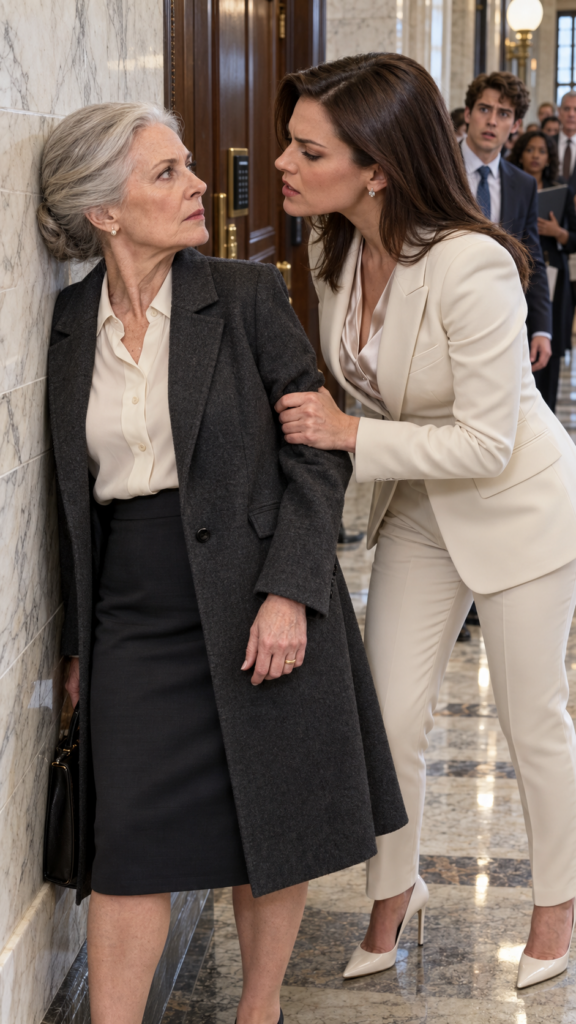
“Judge Holloway,” he said, “I want you to know that our review of the courthouse incident is concluded.”
“I do not need details of your personnel decision.”
“I understand. But there is something relevant to you.”
I waited.
“We interviewed Ms. Holloway regarding representations she made after the incident.”
My stomach tightened.
“She repeated the claim that you were confused and unstable?”
“Yes.”
“And?”
“We found that she had made similar statements about you previously to multiple employees.”
I closed my eyes.
The lie had roots.
Mercer continued.
“We also discovered that when she joined the Hollister team, she did not disclose the familial relationship.”
That was more serious.
“Was she required to?”
“Our internal conflicts questionnaire required disclosure of immediate family members serving in judicial positions.”
I said nothing.
“She listed you as retired.”
There it was again.
“She intentionally concealed my status?”
“We cannot speak to intent beyond what she admitted during the interview.”
“What did she admit?”
“That she did not want the relationship to affect her assignments.”
“Mr. Mercer, I do not want privileged details.”
“I understand.”
His voice softened.
“She has been terminated.”
I looked at the framed photograph of my late husband on the bookshelf.
In it, he was fifty-two and laughing at something outside the frame.
I wished desperately that he were there.
Not because I needed advice.
Because some griefs should be shared with the person who helped create the family you are grieving.
“I see.”
“Judge, I want to apologize.”
“For your associate?”
“For the fact that a culture of prestige can sometimes encourage young lawyers to confuse professional worth with proximity to power.”
That was not the apology I expected.
“We hired Vanessa because she was talented,” he continued. “She is talented. But talent without judgment is dangerous in this profession.”
I thanked him for informing me.
Then I ended the call.
I did not celebrate.
A career can take years to build and minutes to damage.
But it would be dishonest to say Vanessa’s firing felt like injustice.
She had not been dismissed for failing to recognize a judge.
She had been dismissed because she assaulted someone in a courthouse, lied about it, misrepresented a family conflict, and concealed information her firm required.
The fact that the victim was me made the story dramatic.
It did not create the misconduct.
That evening, Vanessa came to my house.
Alone.
I knew she was outside before she knocked because I saw her car through the living-room window.
For a moment, I considered not opening the door.
Then I did.
She looked different.
No ivory suit.
No heels.
She wore dark trousers, a plain sweater, and no makeup.
Her eyes were swollen.
“Can I come in?”
I stepped aside.
She entered the house and stood near the fireplace where Daniel’s graduation photographs still sat beside pictures of my husband.
She stared at one photo.
Daniel and Vanessa on their wedding day.
I was standing beside them.
Smiling.
“I lost my job,” she said.
“I heard.”
“My name is everywhere.”
“I am sorry for that.”
Her head snapped toward me.
“No, you’re not.”
I studied her.
“You believe I wanted this?”
“You could have stopped it.”
“How?”
“You could have said it was a misunderstanding.”
“It was not.”
“You could’ve told them I didn’t hurt you.”
“You did.”
“Not badly.”
There it was.
The instinct that had destroyed her again.
Not apology.
Minimization.
I felt something close inside me.
“Vanessa, if you came here hoping I will help you rewrite what happened, you should leave.”
Her face crumpled.
“I was scared.”
“I know.”
“You don’t understand what it was like for me at that firm.”
“Then tell me.”
She blinked.
Perhaps she had expected judgment.
Not invitation.
She sat slowly.
“I was always the person who didn’t know things.”
“What things?”
“Which restaurants mattered. Which schools people meant when they said ‘the Academy.’ What wine to order. Where partners vacationed. Everyone else seemed born knowing how to belong.”
I sat opposite her.
“So you learned.”
“I copied.”
She laughed bitterly.
“I copied everything. Clothes. Shoes. The way people spoke. I stopped telling anyone my mother cleans hotel rooms.”
“Why?”
“Because the first time I did, someone said, ‘That’s incredible. Look how far you came.’”
“That offended you?”
“It made me feel like they could see where I came from stamped across my forehead.”
I understood that feeling more than she probably imagined.
My father repaired farm machinery.
My mother worked nights in a nursing home laundry.
The first judicial dinner I attended as a young attorney, I spent half the evening watching other women to learn which fork to use.
But I had reached a different conclusion from Vanessa.
Belonging purchased by contempt was too expensive.
“You were ashamed,” I said.
“Yes.”

