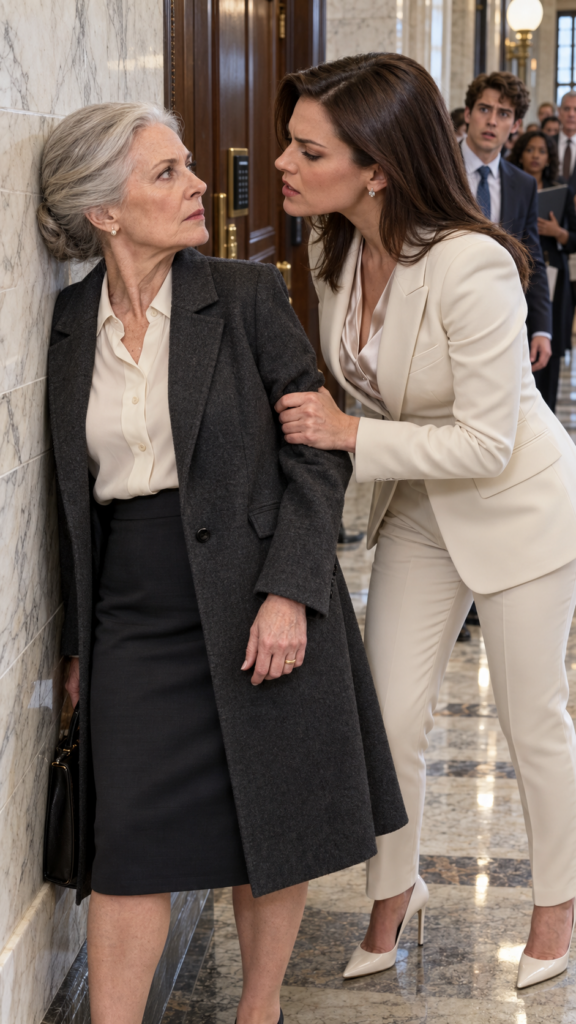
“And you decided I embarrassed you too.”
Her eyes filled.
“You never tried to impress anyone.”
“That bothered you?”
“It made me feel like everything I cared about was stupid.”
“I never said that.”
“I know.”
Her voice broke.
“I know now.”
I leaned back.
“Why did you tell people I was confused?”
She covered her face.
“I don’t know.”
“Yes, you do.”
A long silence.
Then she whispered, “Because if you were just an older widow who needed Daniel, then you weren’t someone they could compare me to.”
The truth finally entered the room.
Ugly.
Small.
Human.
“You thought I was competition.”
“I thought you saw through me.”
“I did not spend nearly as much time evaluating you as you imagined.”
That made her cry harder.
Sometimes humiliation comes not from being judged.
But from discovering that the tribunal existed only in your own mind.
“I’m sorry,” she said.
I waited.
“I’m sorry I grabbed you.”
I said nothing.
“I’m sorry I pushed you.”
Still I waited.
“I’m sorry I lied.”
Her hands trembled.
“And I’m sorry I used your age to make people think you couldn’t trust your own memory.”
That was the apology I needed to hear.
Not because it repaired anything.
Because it named what had been broken.
“I believe you are sorry,” I said.
She looked up.
“But?”
“But sorrow does not erase consequences.”
Her face tightened.
“I know.”
“Do you?”
She nodded slowly.
“I think I’m starting to.”
Then she asked the question I had expected from the moment she arrived.
“Will you help me?”
I looked at her.
“With what?”
“My license.”
The state disciplinary authority had opened a preliminary inquiry.
I had known it might.
“Help you how?”
“Tell them I’m not dangerous.”
I took a slow breath.
“Vanessa, I will tell the truth if I am asked.”
“That could end my career.”
“So could asking me to lie.”
She flinched.
I softened my voice.
“If they ask whether you apologized, I will say yes.”
Her shoulders dropped.
“If they ask whether I believe you are incapable of change, I will say I cannot know that.”
She nodded.
“If they ask what happened in that corridor, I will tell them exactly what happened.”
Tears slid down her face.
“I understand.”
I believed she finally did.
Then I asked, “Does Daniel know you are here?”
“No.”
“Why not?”
“Because he asked me to leave the apartment.”
That hurt more than I expected.
“When?”
“Yesterday.”
I looked toward the wedding photograph again.
“Is he ending the marriage?”
“I don’t know.”
“What did he say?”
“That he doesn’t know who I am when I’m afraid.”
That sounded like Daniel.
Not dramatic.
Precise.
Vanessa stood.
At the door, she stopped.
“Margaret?”
“Yes?”
“When you told me to take my hand off you…”
She swallowed.
“Why didn’t you tell me you were the judge?”
I thought about it.
Then I answered.
“Because I wanted you to take your hand off me when you believed I was nobody.”
She closed her eyes.
Nothing else needed saying.
PART 5: WHAT JUSTICE LOOKED LIKE AFTERWARD
The Hollister Development case was reassigned.
I never read the later filings.
I avoided news coverage whenever possible.
A judge has no business hovering over a case after recusal merely because curiosity survives ethics.
Months passed.
The bruise on my shoulder faded from purple to yellow and then disappeared.
The consequences did not.
Vanessa’s disciplinary matter ended without disbarment.
She received a formal sanction and was required to complete professional responsibility measures before returning to active litigation practice.
I learned those details from Daniel, not from court channels.
She did not return to Bradford, Lane & Mercer.
For a while, she did not practice law at all.
She moved into a small apartment.
Daniel moved into the guest room of a friend’s house and spent several months deciding whether his marriage had been damaged beyond repair.
I stayed out of it.
That may have been the hardest part.
A mother wants to repair.
A judge knows some decisions belong only to the people who must live with them.
One Sunday in early spring, Daniel came for dinner.
He stood at the kitchen counter cutting bread the way his father used to—uneven slices, crumbs everywhere.
“We’re in counseling,” he said.
I kept stirring soup.
“You and Vanessa?”
“Yes.”
I nodded.
“That is information, not a request for approval?”
He smiled faintly.
“I knew you’d say that.”
“What do you want me to say?”
“I don’t know.”
I turned off the burner.
“Do you love her?”
“Yes.”
“Do you trust her?”
He was quiet.
“Not yet.”
“Then that is where the work is.”
He looked at me.
“Aren’t you angry?”
“Yes.”
“Still?”
“Of course.”
He looked almost relieved.
I laughed.
“What?”
“I thought you had forgiven her.”

